
Why Do You Want to Work Here? How to Answer It Well
"Why do you want to work here?" is a test of whether you did your homework and whether your reasons are about the job or about yourself. A good answer to why do you want to work here has three parts: one specific fact about the company, one thing about the role that fits you, and one piece of evidence that you can do it. Most weak answers skip the first part or make the whole thing about pay, location or "great culture". This guide gives the structure, the research sources that produce a real fact, the answers that fail, and three worked examples.
TL;DR: Answer in three sentences: a specific company fact you found, what about this role fits what you want next, and evidence from your own record that you can do it. Research the careers page, recent news, the posting itself and people who work there. Never lead with pay, commute or culture. Keep it under 60 seconds.
What the question is testing
Interviewers know most candidates want a job more than this job. The question checks three things: did you prepare, do you understand what this role is, and can you connect your own goals to theirs in a way that suggests you will stay.
An answer that could be given to any company fails the first check; an answer about what you will get fails the third. One that names something real, links it to the role and ends on your evidence passes all three in under a minute.
The three-part answer
- A company fact (one sentence). Something specific and recent that you could only know by looking: a new location, a product, a service change, a stated priority in the posting or annual report. Not "you are a leader in your industry".
- Role fit (one sentence). What this role would let you do that you want to do next, stated in the posting's language.
- Your evidence (one sentence). The result or experience that shows you can do it. This turns a wish into a claim the interviewer can check against your resume.
Starting with the company fact proves the homework before anything else is said; ending on evidence gives the interviewer a reason to believe you.
Where to find a real fact
Ten to fifteen minutes of research per interview is enough. Look in this order.
- The posting. The first paragraph and the first three requirements often state what the team is trying to do this year. That is a fact you can quote back.
- The careers and about pages. Stated priorities, new offices, programmes.
- Recent news. Search the company name with the past year filter. A new contract, an expansion, a leadership change or a new service line.
- People who work there. Profiles of people on the team show how long they stay and what they moved into. An informational interview with one of them is the strongest source of all.
- Reviews, carefully. Employee review sites tell you what to ask about, not what to say. Never quote them in the answer.
Write down two facts, not one. If the interviewer mentions the first before you can, you still have the second.
Answers that fail
- Pay or benefits. True, but it is what you get, not what they get.
- Location or commute. "It is close to my home" says nothing about the work.
- "Great culture." Every company believes this about itself. Unless you can name one specific practice you observed, it is filler.
- Flattery without a fact. "You are the best in the industry" invites the question "at what?"
- Your career plan alone. "This role is a step towards management" is honest but centred on you. Pair it with what they gain from that ambition.
- Anything you could say to a competitor. If the answer works for the company across the street, it is not an answer to this question.
Three worked examples
Each is fictional and runs under 60 seconds. Note the company fact first, then the fit, then the evidence.
Retail supervisor to store manager
"Your posting says the Burnaby store is moving to extended hours in November and needs a manager who can build a second shift team from scratch. That is the part of this job I want: I like building a team more than inheriting one. At my current store I hired and trained a nine-person evening crew last year, and that shift's mystery-shop score has been the highest in the district for six months."
Accounts payable analyst, newcomer
"Harbourview announced in the spring that it is bringing accounts payable in-house from an outsourced provider, and the posting asks for someone who can set up the process, not just run it. Setting up is what I have done: in Manila I built the invoice matching process for a distributor handling 1,500 supplier invoices a month across three currencies, and I finished my Canadian bookkeeping certificate in June so I know the local requirements."
Mid-career software developer
"I noticed your engineering blog has been writing about moving the scheduling product to real-time updates, and the posting names event-driven systems as the first requirement. That is the work I want to spend the next few years on. At my current company I led the migration of our notification service to an event-driven design, which took it from a nightly batch to updates within seconds for about 200,000 users."
Say it aloud before they ask
This answer sounds different aloud than on paper. Written, the three sentences look tidy; spoken, the company fact often comes out as a nervous compliment. Record yourself once and listen for two things: did the fact sound like a fact, and did you stop after the evidence.
Pair the practice with your answer to tell me about yourself. The two usually arrive within the first five minutes and should not repeat each other; if your evidence here uses the same result as your introduction, pick a different one.
Turn the research into questions
The same research produces your questions for the interviewer. If you found that the company is opening a second shift, ask how the first months of that transition are being planned. A candidate whose answer and questions show the same homework is remembered as someone who wanted this job.
How TrinityTalent helps
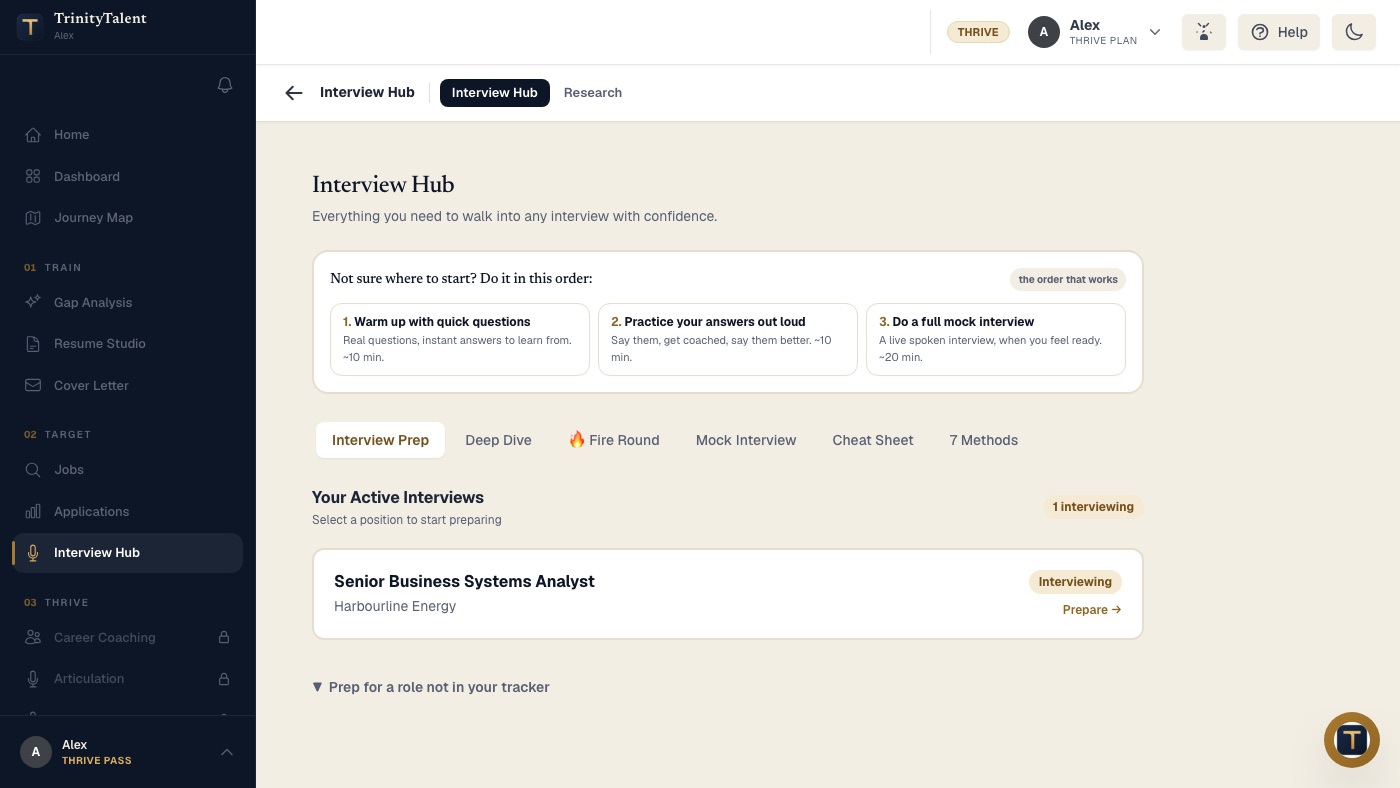
TrinityTalent's Interview Hub includes a research-backed company brief: name the employer and the role, and it gathers what is publicly known about the company and the position so your company fact is real rather than guessed. The Hub also coaches answers from your own resume, so the evidence sentence comes from your record.
Then you practise aloud. The live mock interview asks "why do you want to work here?" and the feedback tells you whether the fact landed and where you kept talking. Building, editing and exporting your resume on TrinityTalent is free.
Frequently asked questions
How long should the answer to why do you want to work here be?
Under 60 seconds, in three sentences: a specific company fact, what about the role fits what you want next, and one piece of evidence from your record. Stop after the evidence. Candidates who keep talking usually drift into pay or location, which undoes the answer they just gave.
What if I only want the job for the money?
You still need a real answer, because the interviewer is asking about fit, not motive. Find one concrete thing about the role or the company that you genuinely prefer over the alternatives, even if it is small, such as the size of the team or the type of work. Pair it with evidence you can do it. Leave pay for the offer stage.
Is it acceptable to mention company culture in the answer?
Only if you can name one specific practice you observed or heard about from someone who works there, such as how the team runs its weekly review. "Great culture" on its own is filler that every company believes about itself. A concrete fact about the work is always stronger than a general claim about the atmosphere.
How do I research a company for an interview quickly?
Spend ten to fifteen minutes in this order: the posting's first paragraph and top requirements, the careers and about pages, news from the past year, and profiles of people on the team. Write down two specific facts, so you still have one if the interviewer mentions the other first.
Put this into practice
Open the Interview Hub, research the employer, then say your answer aloud to the live mock interviewer before the real one asks.
Practise a mock interview