
Informational Interview Questions That Lead Somewhere
Good informational interview questions do two things at once: they teach you what a role is really like, and they make the person you are speaking with want to help you again. Most informational interview questions fail on the second part. They are either questions you could have answered with a search, or they are a disguised request for a job. This guide covers how to ask for 20 minutes, 15 questions grouped by what you want to learn, the questions never to ask, how to close with a next step, and how to record what you learned so it changes what you do next.
TL;DR: Ask for 20 minutes, name why this person, and offer to work around their calendar. Prepare five questions from three groups: the daily reality of the role, how people get hired into it, and what they would do in your position. Never ask for a job. Close by asking who else you should speak with. Write the answers down the same day.
What an informational interview is for
An informational interview is a short conversation with someone doing the work you want to do, or hiring for it. You are not being assessed, and they are not offering anything. The purpose is information you cannot get from a posting: what the job is like at 3 p.m. on a Tuesday, what separates people who get hired from people who do not, and which of your assumptions are wrong.
The second purpose is quieter. A person who spent 20 minutes helping you now has a small stake in how you do. If you handle the conversation well, they think of you when a role opens. That is why the questions matter: good ones make you memorable for the right reason.
How to ask for 20 minutes
The request is short and specific. Name the reason you chose this person, state the time you are asking for, and make saying no easy.
"Hello Ms. Duarte, I am a registered nurse moving into clinical informatics, and your path from ward nursing to systems analyst is the one I am trying to understand. Would you have 20 minutes in the next three weeks for a call? I will send three questions in advance so it is a quick conversation, and I understand completely if the timing does not work."
Three things make this work: the reason is about them, the time is small, and the questions in advance signal you will not waste the call. If they say yes, send the questions, confirm the time, and end on time.
Fifteen questions, grouped by goal
Choose five for a 20-minute call. Lead with the group that matters most to you now.
The daily reality of the role
- What does a normal week look like, and which part takes more time than people expect?
- What is the part of the job that is hardest to learn from the outside?
- Which skill do you use every day that the posting never mentions?
- What do new people in this role usually get wrong in the first six months?
- What would make you leave this role, and what keeps you in it?
How people get hired into it
- When you hire or see hiring for this role, what separates the shortlist from the rest?
- Which of my current experiences would you weight most, and which would you leave out?
- Is there a credential or tool that is a real requirement here, rather than a nice to have?
- How do most people on your team find their roles: postings, referrals or internal moves?
- If you were reading my resume for this role, where would you stop?
What they would do in your position
- If you were starting from where I am, what would you do in the next 90 days?
- Which free resources or communities actually helped you, and which were a waste?
- Who else should I be speaking with, and may I mention that you suggested it?
- Is there a project I could do on my own that would be taken seriously as evidence?
- What question should I have asked that I did not?
Questions 7 and 10 need the person to have seen your resume, so send it only if they agree in advance. Question 15 often produces the most useful answer of the call.
What never to ask
- For a job. "Are you hiring?" ends the conversation you asked for. If they want to refer you, they will say so, and question 13 gives them the opening.
- Anything a search answers. What the company does, how big the team is, what the posting says. Arriving without that knowledge tells them the 20 minutes was not worth preparing for.
- Salary, directly. Ask instead whether the posted range is realistic for someone with your background. Some people will answer; do not push.
- For feedback on your whole career. That is a mentoring relationship, not a 20-minute call.
Close with a next step
At minute 17, stop asking and close. Thank them for a specific answer, not in general. Then ask the two closing questions: "Is there anyone else you would suggest I speak with?" and "Would it be all right if I let you know how things go?" The first turns one conversation into two. The second gives you a reason to write again with news, which is how a contact becomes a referrer.
Send a thank-you message the same day. Two or three sentences, naming one thing you learned and one thing you will do because of it. If they gave you a name, tell them when you have made contact.
Log what you learned the same day
A conversation you do not write down is gone in a week. The same evening, record four things: who you spoke with and when, the three answers that changed your view, the action you committed to, and the names they gave you. Keep this in the same place you track applications, because the two lists feed each other; a contact from an informational interview is often the person you later ask for a referral.
Then compare what you heard with what you assumed. If three people say the credential you were about to pay for does not matter, that is your 90-day plan changing. For people who find this kind of outreach draining, networking without small talk shows how to make it a system with a fixed weekly quota.
How TrinityTalent helps
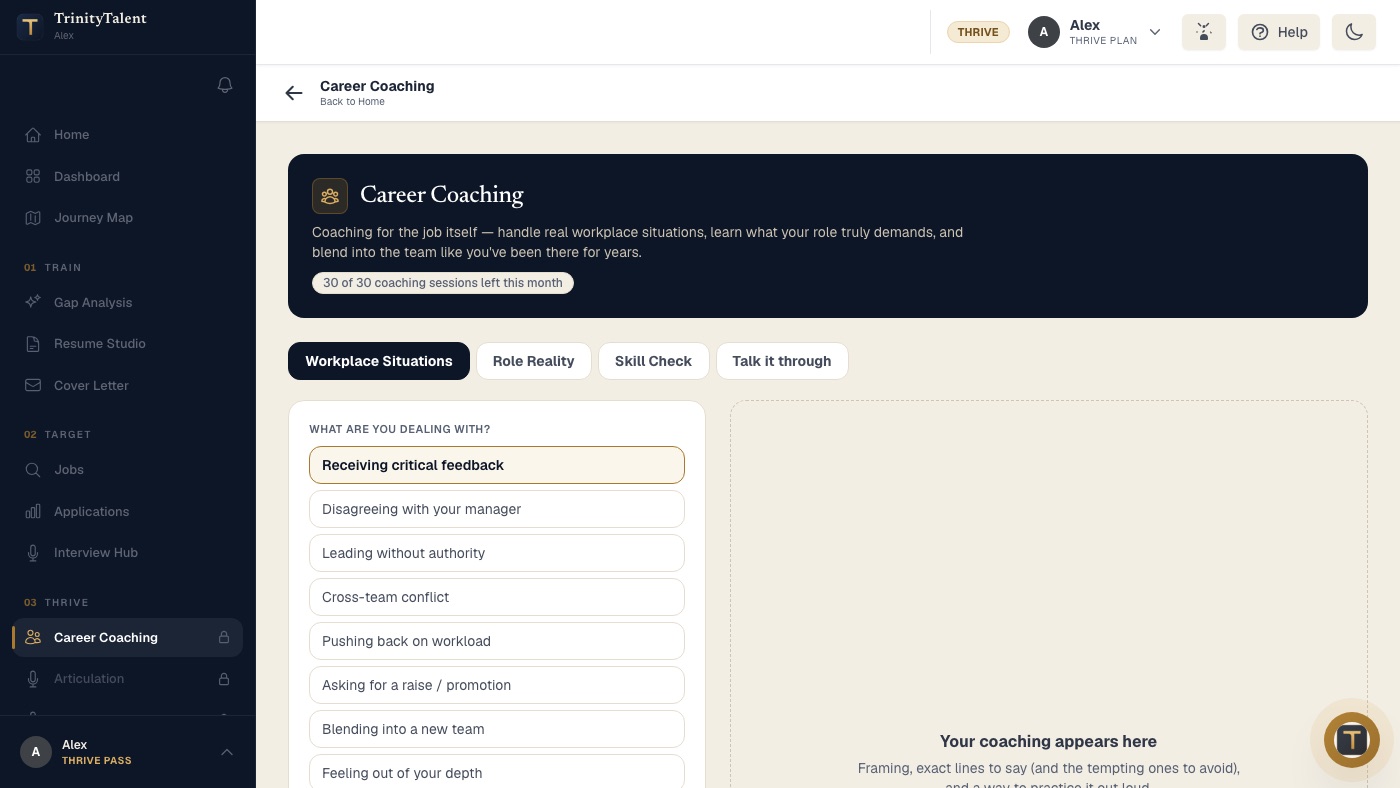
Walking into an informational interview already informed is what makes your questions good. TrinityTalent's Career Coaching includes a role reality briefing: name a target role and it gives a grounded account of what that role demands day to day, plus a first-90-days plan, so you spend the call testing what you know instead of asking the basics. The same area offers workplace-situation coaching with say-this and avoid-this scripts, useful when you are unsure how to ask a stranger for 20 minutes.
The Gap Analysis turns what you hear into action: it ranks your gaps for the target role and builds a dated 90-day plan with free resources first, and the Journey Map records your progress over time. Building, editing and exporting your resume on TrinityTalent is free.
Frequently asked questions
How do you ask for an informational interview?
Send a short message that names why you chose this person, asks for a specific small amount of time such as 20 minutes, offers to send questions in advance, and makes it easy to say no. Mention how you found them. Follow up once after a week if there is no reply, then move on.
How long should an informational interview be?
Ask for 20 minutes and end on time. Prepare five questions from a list of fifteen and lead with the group that matters most to you. If the person offers more time, accept, but never run over what you asked for. Respecting the limit is what earns a second conversation.
Should you bring your resume to an informational interview?
Only if the person agrees in advance. Offer it when you set up the call: "Would it help to see my resume beforehand?" If yes, the questions about where they would stop reading become possible. If no, do not push. The call is for information, not an assessment.
What should you not ask in an informational interview?
Do not ask for a job, do not ask anything you could have found with a search, and do not ask about salary directly. Asking "are you hiring?" ends the conversation you requested. If the person wants to refer you, asking who else you should speak with gives them the opening to do so.
Put this into practice
Career Coaching gives you a role reality briefing on any target role, so you walk into the conversation with informed questions.
Practise a mock interview