
Questions to Ask the Interviewer: 20 That Show Judgment
The questions to ask the interviewer are the last thing they hear from you, and they are scored. When a recruiter says "Do you have any questions for us?", the interview has not ended; it has changed direction. Good questions to ask the interviewer show that you have thought about the job as work, not as a prize. This guide gives 20 questions grouped by interview stage, explains what each one reveals, lists the questions to hold back, and shows how to record the answers so they help you decide.
TL;DR: Prepare three questions per stage and ask two. In the phone screen, ask about the process and the team's shape. With the hiring manager, ask what success looks like at 90 days and what the hardest part of the job is. With a panel, ask how the roles work together. In the final round, ask about growth and the next step. Never ask what the posting already answers.
Why your questions are part of the interview
Interviewers judge questions for the same reasons they judge answers. A question shows what you noticed and how you think about work. "What does a typical day look like?" tells them nothing about you. "The posting mentions replacing the billing system. Who owns that decision, and how would this role support it?" tells them you read the posting and are already picturing yourself in the work.
Questions also serve you. An interview is the only time you can ask a manager, on the record, how they run their team. The answers are data for a decision you may have to make in two weeks. Ask about the work, the team and the decision; leave perks until an offer is close.
Stage one: the phone screen (five questions)
A phone screen is usually run by a recruiter, who can answer questions about the process and the team's shape but not about the daily detail of the job.
- "What are the next steps in the process, and roughly how long does it take from here to a decision?"
- "Who would this role report to, and how large is the team today?"
- "Is this a new position or a replacement? If it is a replacement, what changed?"
- "What has made candidates a strong fit so far, and what has ruled people out?"
- "Is there anything on my resume you would like me to clarify before we finish?"
Question four is the most useful: recruiters see every candidate, so they know who advances. Question five lets them raise a doubt while you can still answer it.
Stage two: the hiring manager (six questions)
This is the person you would work for. Their answers reveal how the job really operates.
- "What would a strong first 90 days look like in this role? What would you want finished?"
- "What is the hardest part of this job, the part the current team finds most difficult?"
- "How does the team decide priorities when there is more work than time?"
- "How do you prefer to receive updates, and how often?"
- "What would make you say, a year from now, that hiring for this role was a clear success?"
- "Which other teams does this role work with most, and where does that relationship get complicated?"
When Priya Raman asked question seven for a project coordinator role, the manager said the hardest part was chasing engineers for status updates. Priya followed up: "Is that a tooling problem or a culture problem?" The answer, "Honestly, culture," told her the real job was persuasion, not scheduling.
Stage three: the panel (four questions)
A panel usually mixes a manager, a peer and someone from a neighbouring team. Direct each question to the person best placed to answer it, then let the others add to it.
- To the peer: "What does a good week look like on this team, and what does a bad one look like?"
- To the neighbouring team: "How does this role show up in your work? What do you need from it?"
- To the manager: "How do you handle disagreement between team members about the right approach?"
- To the room: "Is there a question you were hoping I would ask that I have not?"
Question 15 sounds risky. It is not. It invites the panel to raise their real concern and shows you can hold a room without controlling it. For more on facing several interviewers, see /blog/panel-interview-tips/.
Stage four: the final round (five questions)
By the final round, the employer is deciding between two or three people. Your questions should show judgment about the decision you are about to make too.
- "How is performance reviewed, and how are raises and promotions decided?"
- "Where have people in this role gone next, inside or outside the company?"
- "What is the biggest change the team expects in the next year?"
- "What concerns, if any, do you have about my fit for the role?"
- "What is the timeline for a decision, and is there anything else you need from me?"
Question 19 is the one most candidates avoid. Ask it anyway. A concern raised in the room can be answered; one that stays unspoken becomes a rejection you never understood.
What not to ask yet
Some questions are reasonable but badly timed. Asked too early, they suggest you are interviewing the perks, not the job.
- Salary and benefits. Wait until the recruiter raises the range or you have an offer. If a screen asks your expectations, give a range and move on.
- Vacation and remote days. Ask after an offer, when it is a negotiation, not a signal.
- "What does your company do?" You should already know. Ask about a specific product or decision instead.
- Anything answered in the posting. It shows you did not read it.
- How quickly you can be promoted. Ask about growth paths instead.
How to note the answers
Answers are only useful if you keep them. On a call, keep a document open with your questions listed and type a few words under each. In person, write short notes; most interviewers read note-taking as engagement.
Within an hour, expand the notes. Record what was said, what was not said, and how the interviewer reacted. A manager who brightens at "how do you handle disagreement?" runs a different team from one who changes the subject. Compare notes across stages: if the recruiter said eight people and the manager says five, ask about it next round. These gaps feed the follow-up email and the final decision, which /blog/second-interview-tips/ covers.
How TrinityTalent helps
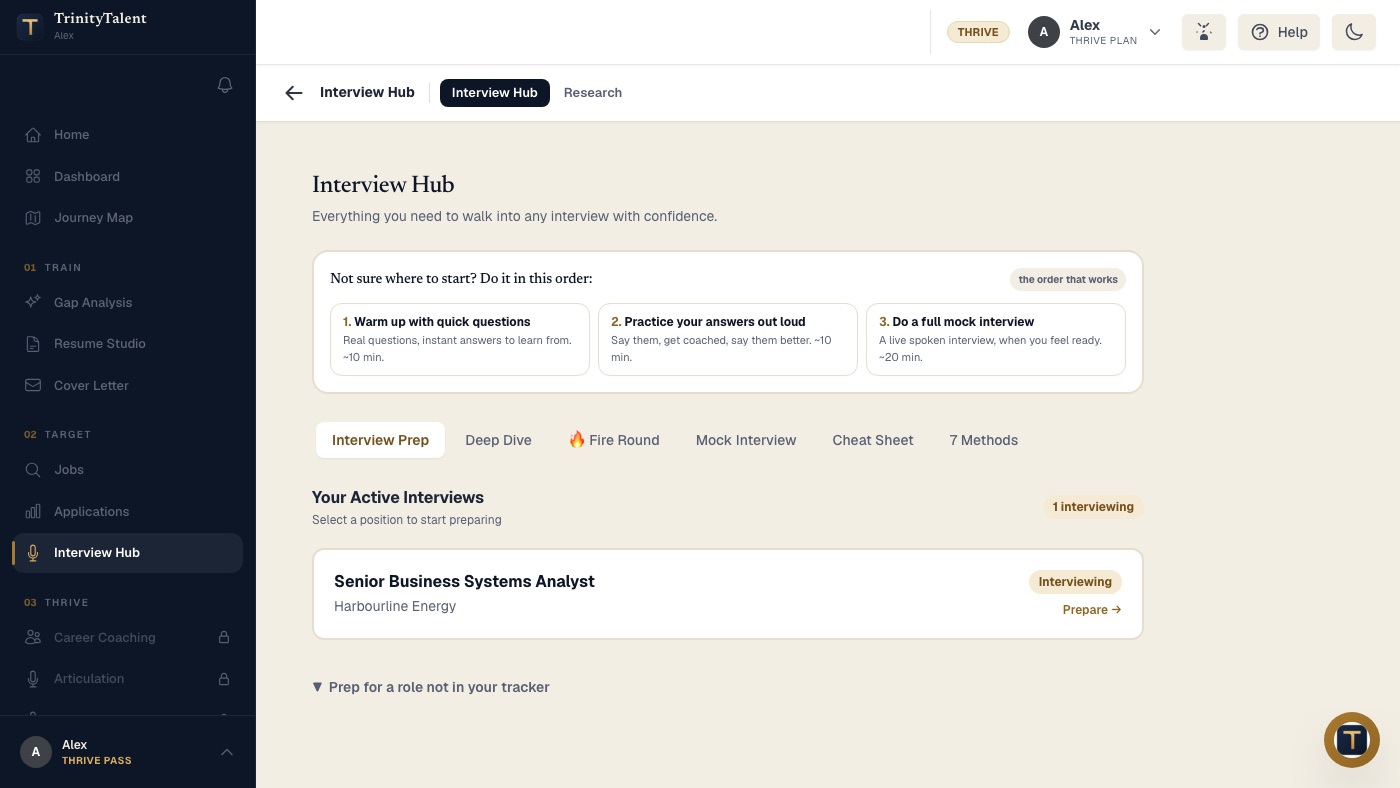
The Interview Hub in TrinityTalent pulls each active interview from your Application tracker, so the posting text, the resume version you sent and your preparation sit in one place. You can prepare for a role that is not in your tracker too. The Hub suggests an order: warm up with quick questions from the Fire Round bank of more than 700, practise your answers out loud, then do a full mock interview with a live spoken interviewer when you feel ready. Questions for the interviewer belong in that rehearsal: practising them aloud helps you ask them naturally instead of reading from a list. Building, editing and exporting your resume on TrinityTalent is free.
Frequently asked questions
How many questions should I ask the interviewer?
Prepare five or six and expect to ask two or three, because some will be answered during the interview. If time is short, ask one strong question rather than rushing through several. One question that shows you understood the job beats four generic ones.
Is it bad to have no questions for the interviewer?
Yes. Saying "No, you covered everything" reads as low interest, even when it is honest. Keep one question in reserve that cannot be answered in advance, such as "What would make you call this hire a clear success a year from now?".
Can I ask about salary in the first interview?
Only if the interviewer raises it first. Many recruiters ask for your expected range in the phone screen; answer with a range and ask what the budget is. Leave benefits, vacation and remote days until an offer is on the table, when they become a negotiation rather than a signal.
Should I ask the same questions to every interviewer?
Ask one or two of the same questions to different people on purpose; differences in their answers tell you how aligned the team is about the role. Tailor the rest to each person: process questions to recruiters, day-to-day questions to peers, decision questions to managers.
Put this into practice
Open the Interview Hub, pick the role you are interviewing for, and rehearse your closing questions out loud before the real conversation.
Practise a mock interview