
Tell Me About Yourself: How to Answer, With Examples
"Tell me about yourself" is the first question in most interviews, and it is the one candidates prepare least. That is a mistake, because the answer to tell me about yourself sets the frame for everything that follows. The interviewer is not asking for your life story. They are asking: who are you professionally, why are you here, and can you speak clearly for a minute? This guide gives a structure that answers all three in 60 to 90 seconds, three worked examples, and a way to practise it.
TL;DR: Answer in three parts: present (who you are now and your scope), past (the two or three experiences that led here), future (why this role, tied to the posting). Keep it to 60 to 90 seconds and about 150 words. Anchor every part to what the posting asks for. Practise it aloud until it is fluent, not scripted.
What the interviewer is actually asking
The question sounds open, but it has a purpose. In the first two minutes an interviewer forms a view of whether you are organised, whether you understand the role, and whether talking to you is easy. A rambling biography answers all three badly; a tight 90-second answer that ends at this job answers them well.
It is also your one chance to choose the headline: if you open by describing yourself as an operations person who fixes processes, the interviewer listens for that all afternoon.
The present, past, future structure
Three parts, in this order. The order matters: starting with the present tells the interviewer who is in the room before you explain how you got there.
- Present (about 25 seconds). Your current role or situation, in the words the posting uses, and the scope of what you handle. One sentence about what you are known for.
- Past (about 35 seconds). Two or three earlier steps that explain the present. Not every job; the ones that built the skills this posting names. One result with a number if you have it.
- Future (about 20 seconds). Why this role, this employer, now. This is the sentence that connects you to them, and it should use something specific from the posting.
Total: 60 to 90 seconds, roughly 120 to 170 words. Ending on the future hands the conversation back with a natural next question.
Anchor it to the posting
The same person gives a different answer to different postings. Before the interview, read the posting and mark the three requirements it repeats or lists first. Your present section should use the job title's language. Your past section should include the experience that proves the top requirement. Your future section should name the thing about this role that matches what you want next.
This is selection, not exaggeration. You have more history than fits in 90 seconds, so you choose the parts this listener needs. Leaving out your first job is not hiding it.
Three worked examples
Each example is fictional and runs about 80 seconds aloud. Notice how each ends at the role.
New graduate
"I finished a business degree in April with a focus on marketing analytics, and for the last eight months I have been the part-time coordinator for a campus career fair with 60 employers, which meant email campaigns, the registration site and the budget. Before that I did two co-op terms at a regional credit union, where I ran the newsletter and tested subject lines each week; open rates went from 18 to 27 percent over eight months. Your Marketing Coordinator posting lists email campaigns and reporting first, which is exactly the work I want to keep doing, and at a scale where the results are visible."
Mid-career professional
"I am an operations manager in food distribution, currently running receiving, picking and outbound scheduling for a site that ships about 1,200 orders a day with a team of 45. Over nine years I have moved from the floor to supervisor to manager, and the thread through all of it is process: last year we cut mis-picks by 40 percent by adding barcode scanning and a five-minute daily stand-up. I have done that at one site and I am ready to do it across several. Your posting is for a multi-site role in a company that is opening two new distribution centres, and that is the step I am looking for."
Career changer
"I am a registered nurse with eight years in acute care, and for the last two of those I have been the clinical lead for our ward's new charting system, which meant writing the training guide, running 14 sessions for 120 staff and being the person people came to when the software did not fit the workflow. That project showed me I want to build the tools rather than only use them, so I completed a health informatics certificate this spring. Your Clinical Implementation Analyst role sits exactly between those two worlds, and I would bring the clinician's view of what the software has to do at 3 a.m. on a ward."
Mistakes that lose the room
- Starting at birth. "I grew up in..." spends your best 20 seconds on something irrelevant.
- Reading the resume aloud. The interviewer has it. Choose; do not list.
- No ending. An answer that trails off with "so, yes" leaves the interviewer to rescue it. End on why this role.
- Going past two minutes. Attention drops after 90 seconds.
- Memorised word for word. It sounds recited and one lost word derails it. Memorise the three headlines, not the sentences.
Practise it aloud, not in your head
An answer that reads well on paper often runs long or stumbles aloud. Practise three times with a timer. First, from notes, to find the shape. Second, without notes, recorded, to hear the fillers and the trailing endings. Third, to another person or a mock interviewer, to feel the pressure of being heard.
Listen once for time and once for the ending; if the ending is weak, rewrite only the last sentence. The rest of your interview will draw on this same discipline; the STAR method and the common behavioural questions all reward the same answer-first habit.
How TrinityTalent helps
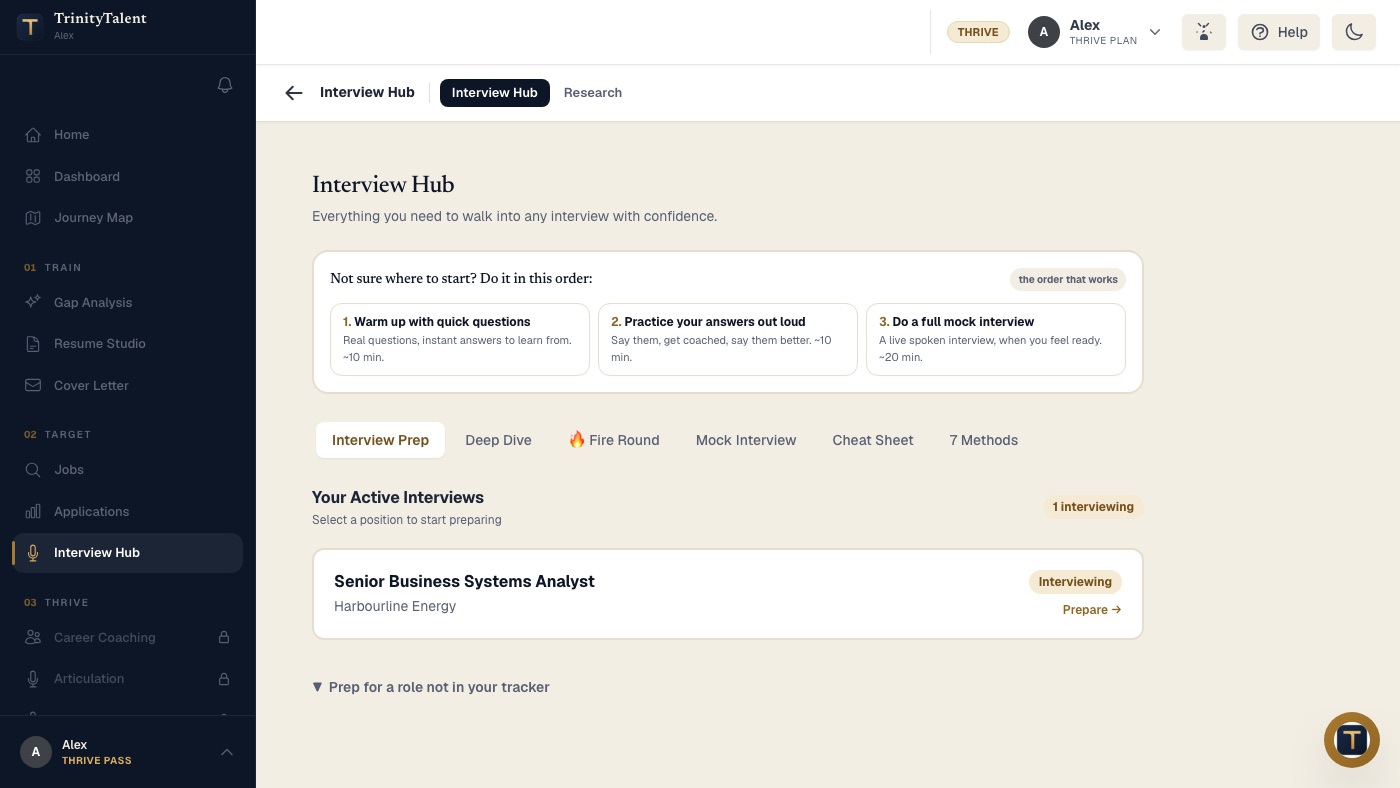
TrinityTalent's Interview Hub is built for exactly this kind of practice. It suggests an order: warm up with quick questions, then practise your answers out loud. The live mock interview puts you in front of a spoken interviewer who asks "tell me about yourself", and the feedback covers structure and clarity, so you learn whether your answer lands in 90 seconds or wanders. Answer coaching draws on your real resume, so the examples it suggests are your own.
The Voice Studio hears the actual recording and reports pace, pauses and filler words with a transcript that shows where each one happened; the recording stays on your device. Building, editing and exporting your resume on TrinityTalent is free.
Frequently asked questions
How long should the answer to tell me about yourself be?
Sixty to ninety seconds, which is about 120 to 170 words spoken at a normal pace. Interviewer attention drops after about 90 seconds. Cover your present role and scope, the two or three past steps that led here, and why this role now, then stop. Time yourself with a recording.
Should I talk about personal life when asked to tell me about yourself?
No, not in the first answer. The question is professional: who you are at work, how you got here and why this role. Family, hobbies and hometown can come up later if the interviewer opens that door. Spend your 90 seconds on the scope, results and fit the posting cares about.
Is tell me about yourself the same as walk me through your resume?
Almost. "Walk me through your resume" invites a slightly longer, chronological answer, but the same rule applies: select the steps that explain why you fit this role rather than reciting every job. Use the same structure and still end on why this role now.
How do I answer tell me about yourself with no work experience?
Use the same structure with different evidence. Present: what you are studying or just finished and one thing you are known for. Past: co-op terms, projects, part-time work or volunteering, with one measurable result. Future: why this role, tied to a line in the posting. Ninety seconds is still the limit.
Put this into practice
Say your answer out loud to the live mock interviewer in the Interview Hub and hear whether it lands in 90 seconds.
Practise a mock interview