
Do You Need a Cover Letter in 2026? When It Helps
Do you need a cover letter? In most cases the honest answer is: it is optional, but when you send one it is often read, and when it is read it changes the decision. So the better question is not "do you need a cover letter" but "where does one help enough to be worth ten minutes?" This guide answers that by employer type and situation, tells you the one case where you should skip it, gives a length, and shows how to write one quickly from the resume you already have.
TL;DR: Write a cover letter when the form has a field for it, when the employer is small, public sector or a nonprofit, and whenever your resume alone cannot explain your fit, such as a career change or a move to a new country. Skip it only when there is no way to attach one. Keep it to 200 to 300 words and build it from your resume and the posting.
The short answer by situation
Whether a letter is worth writing depends on who reads applications and how many they get.
- Large employers with high volume. The first screen is a recruiter with a stack of resumes, often ranked by an applicant tracking system. Letters are opened less at this stage. Still attach one if the field exists; the hiring manager often reads it later, when the shortlist is small.
- Small companies. The person reading is usually the manager who will work with you. Letters are read, and a specific one stands out from the majority that skip it.
- Public sector and nonprofits. Many hiring panels score applications against stated criteria, and a letter is where you address each criterion directly. Here a letter is close to required even when the posting says optional.
- Career changers and newcomers. Your resume shows a path that does not obviously lead to this job. The letter is the only place to explain why it does.
- Referrals. A letter lets you name the person who referred you in the first line, which a resume cannot do.
When you can skip it
Skip the letter when the application form has no field for it and no way to attach a second file. Forcing a letter into a "comments" box or pasting it above your resume in a single upload makes the resume harder to parse and rarely gets read.
You can also skip a letter for a quick-apply where the posting explicitly says "resume only". Follow the instruction. Ignoring it signals that you did not read the posting.
Everything else is a case for writing one. "Optional" in a posting means the employer will not reject you for leaving it out. It does not mean nobody reads it.
Why a letter still matters when it is read
A resume lists facts. A letter connects them to this job. Three things only a letter can do:
- Explain a choice. Why a nurse is applying for a software implementation role. Why you moved provinces. Why a two-year gap sits in the middle of the page.
- Show that you read the posting. A letter that answers the posting's first two requirements proves attention in a way a generic resume cannot.
- Sound like a person. Managers hire people they expect to work with. A short, plain letter in your own voice is a sample of how you communicate.
Consider Daniel, a fictional warehouse supervisor applying to a 30-person food distributor. His resume is strong but generic. His letter opens: "I am applying for the Warehouse Lead role. At my current site I cut mis-picks by 40 percent in a year with a daily five-minute stand-up, and your posting says accuracy is your first priority." The letter did not add a fact. It pointed the reader at the fact that mattered.
How long a cover letter should be
Between 200 and 300 words, three or four short paragraphs, on less than one page. A manager reads a letter of that length in under a minute. A full-page letter is skimmed, and the important line is missed.
The structure most career centres teach still works:
- Opening (2 to 3 sentences). The exact job title and one proof that you can do it. The opening line carries the most weight.
- Middle (1 to 2 paragraphs). Two or three pieces of evidence, each tied to a requirement in the posting. Numbers where you have them.
- Closing (2 sentences). What you want to happen next and a one-line thank you.
Cut anything that repeats the resume word for word. The letter should make the reader want to look at the resume again, not replace it.
Write one in ten minutes from your resume
You do not need to start from a blank page. Everything the letter needs is already in two documents.
- Open the posting and underline the first three requirements. Read how to read a job description if you are unsure what counts as a requirement.
- For each requirement, find the resume bullet that proves it best. If a requirement has no matching bullet, note it; that gap is what the letter has to address honestly or leave alone.
- Write the opening: job title, then the strongest proof.
- Write one sentence per remaining requirement, each starting with the evidence, not with "I believe".
- Write the closing. State that you would welcome a conversation and name the role once more.
- Read it aloud once. Cut every adjective that is not attached to a fact.
The result is short, specific and defensible. It took ten minutes because you were assembling, not inventing.
Mistakes that waste the letter
- The universal letter. If the only word that changes between applications is the company name, the reader can tell.
- Repeating the resume. Three paragraphs that restate your job history add nothing. Point at the facts; do not copy them.
- Apologising. "Although I do not have all the qualifications..." invites the reader to agree. Address a gap with what you have done about it, or leave it for the interview.
- Wrong name or wrong company. A letter addressed to last week's employer ends the application. Check the header, the greeting and the closing every time.
- Attaching it as an image or a scanned PDF. Some systems cannot read it. Send a text PDF or a Word file.
How TrinityTalent helps
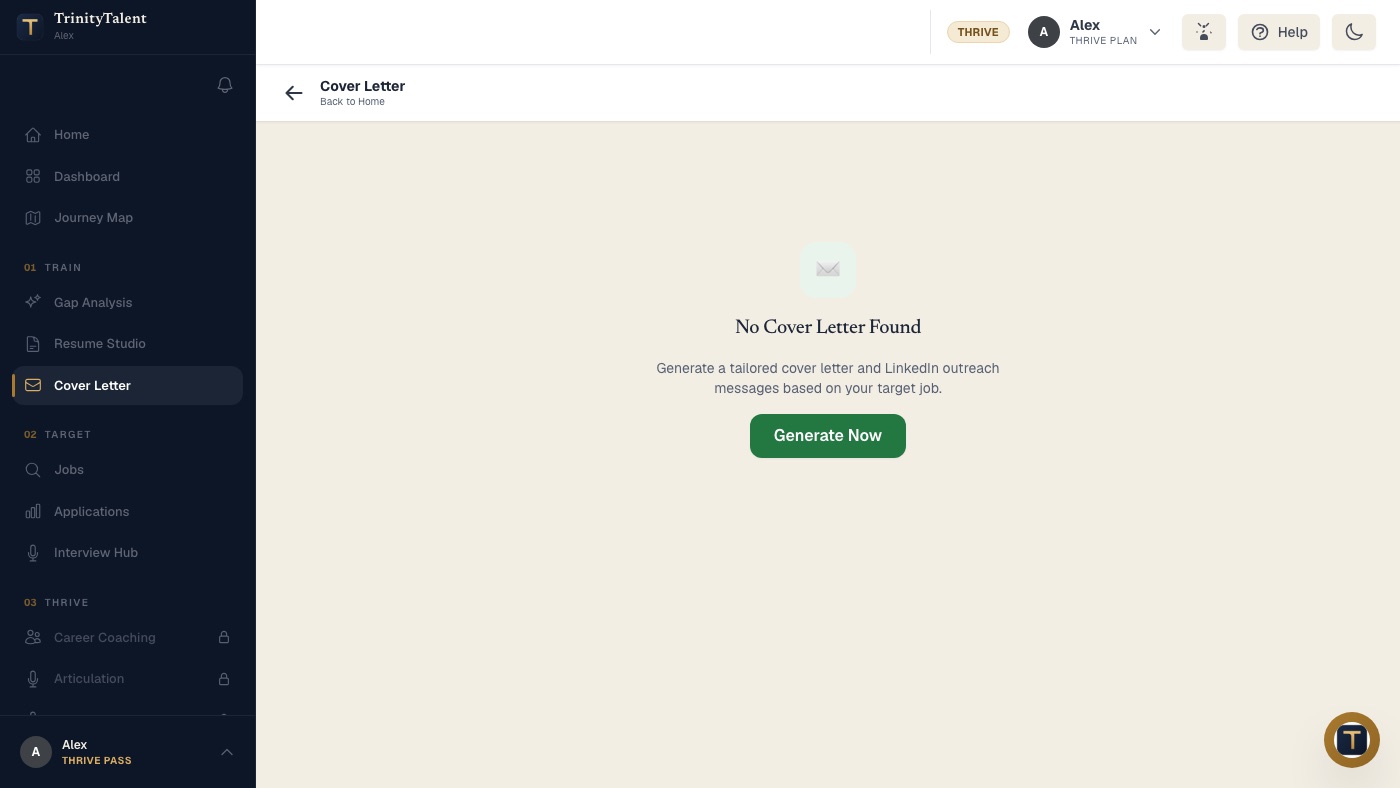
TrinityTalent's cover letter tool starts from the two documents the method above uses: your resume, which is already in the platform, and the real posting, which you paste in or link. It drafts a letter in the career-centre structure, opening with the job title and one proof, then a middle paragraph tied to the posting's requirements, then a short closing. You choose a length (short, medium or long) and a tone (professional, warm or direct). Every fact in the draft comes from your resume, so nothing appears that you cannot defend.
You edit the draft before you use it, and nothing is sent or submitted for you. The Application tracker keeps the posting text and the resume version you sent, so when the interview comes you can see exactly what the employer read. The tool is free while the product is in beta, with no credit card required.
Frequently asked questions
Do recruiters actually read cover letters?
Some do and some do not, and it depends on the stage. Recruiters screening high volumes often go straight to the resume. Hiring managers reading a shortlist of five open the letter more often, especially at small employers, in the public sector and at nonprofits. Since you cannot know which reader you have, attach one when there is a field for it.
Is a cover letter required if the posting says optional?
No, you will not be rejected for leaving it out. But optional means the employer allows a letter, not that nobody reads it. A specific letter separates you from the many applicants who skip it. The exception is a posting that says "resume only"; follow that instruction.
How long should a cover letter be in 2026?
Between 200 and 300 words, in three or four short paragraphs, on less than one page. That takes under a minute to read. Longer letters are skimmed and the important line is missed. Open with the job title and one proof, give two or three pieces of evidence, and close in two sentences.
Can I use the same cover letter for every job?
You can reuse the structure but not the content. The opening names the exact job title, and the middle paragraph answers that posting's requirements. If the only word that changes is the company name, the reader will notice. Changing the opening and the evidence sentences takes about ten minutes when you work from your resume.
Put this into practice
Paste a posting into the free cover letter tool and get a 200-word draft from your resume facts. Edit it, then attach it yourself.
Write your cover letter