
Cover Letter Opening Lines That Get Read (With Examples)
The best cover letter opening lines do two things in one sentence: they name the role and they give one piece of proof that you can do it. Most cover letter opening lines fail because they do neither. "I am writing to apply for the position of Operations Coordinator" tells the reader nothing the subject line did not already say. A hiring manager reads the first line and decides whether the second is worth the time. This guide gives you a structure for that first line, six openings for six situations, and the sentences to retire for good.
TL;DR: Open with the role and one proof, in the first sentence. Retire "I am writing to apply" and every line about how excited you are. Pick the opening that fits your situation: referral, career change, newcomer, internal move, cold approach, or a normal response to a posting. Keep the first paragraph under 60 words and let the middle paragraphs carry the evidence.
Why the first line decides whether the letter is read
A cover letter is read the way a resume is read: top first, and only as far as it earns. Hiring managers often open the letter after they have seen the resume, so the opening cannot repeat the resume. It has to add a reason to believe you fit this job, stated in a way the reader can check.
A manager who reads twenty letters in a sitting sees "I am writing to express my interest" twenty times. A letter that starts with a fact is different by the third word, and different buys you the second sentence.
The two-part opening: role plus proof
Part one names the job title exactly as the posting writes it. Part two gives one proof that connects to the posting's biggest requirement. Proof means a number, a named result, or a specific piece of experience. Adjectives are not proof.
Compare two openings for a payroll role:
- "I am excited to apply for the Payroll Specialist role and believe my skills make me a strong candidate."
- "I am applying for the Payroll Specialist role at Northgate Logistics. For the past four years I have run bi-weekly payroll for 380 hourly staff across two provinces with zero late remittances."
The second is longer, but every word works. A test for your own first sentence: cover the company name. Could it have been sent to any employer for any job? If yes, it is a template, not an opening.
Sentences to retire
- "I am writing to apply for..." The reader knows. Start with the role and the proof.
- "I am excited / passionate / thrilled about this opportunity." Enthusiasm is shown by specificity, not by stating it.
- "Please find my resume attached." Put it at the end, if at all.
- "My name is..." Your name is in the header and the signature.
- "I believe I would be a great fit." Show the fit; do not announce it.
- "Ever since I was a child..." Origin stories belong in an interview, if anywhere.
Six openings by situation
Each example is fictional. Keep the shape and replace the facts. The proof changes with the situation.
Referral
"Priya Nair on your customer success team suggested I apply for the Client Onboarding Specialist role. At Harbourview Credit Union I onboarded 60 to 80 new business accounts a month and cut the time to first login from nine days to four."
Name the referrer first. A referral is the strongest proof a letter can carry.
Career change
"I am applying for the Clinical Implementation Analyst role after eight years as a registered nurse, most recently leading the ward rollout of a new charting system for 120 staff. I am changing careers on purpose: I want to build the tools I spent years using."
State the change directly, then the one experience that already looks like the new job.
Newcomer to Canada
"I am applying for the Accounts Payable Analyst position. In my previous role in Manila I processed 1,500 supplier invoices a month and reconciled three currencies, and I completed a Canadian bookkeeping certificate at a local college in June."
Lead with the work, not the move, and put the local credential in the same sentence.
Internal move
"I am applying for the Team Lead position on the evening warehouse shift. In two years as a picker on the day shift I trained eleven new hires, and my lane has held the lowest mis-pick rate on the floor for six months."
Cite results the reader can verify by asking one colleague.
Cold approach, no posting
"I am writing to ask whether Cedar Health Network will need a bilingual medical office assistant this autumn. I run the front desk for a three-physician clinic, book 90 to 110 appointments a day, and handle French-speaking patients without an interpreter."
With no posting to match, name the function and the timeframe, then prove the function.
Responding to a posting
"I am applying for the Junior Data Analyst role posted on your careers page. In my final co-op term I built the weekly sales dashboard a 40-person regional team still uses, replacing a manual report that took two days to compile."
Match the title word for word, then prove the posting's first requirement.
What comes after the opening
Career centres teach a three-part structure because it matches how a manager reads. The opening states the role and one proof. The middle, one or two paragraphs, gives two or three more pieces of evidence, each tied to a line in the posting. The closing says what you want to happen next and thanks the reader in one sentence. Keep the whole letter between 200 and 300 words. If you are unsure whether a letter is needed at all, read when a cover letter is worth writing first.
The opening also sets the tone. A letter that opens with a number and then drifts into "I am a hard-working team player" loses the trust it just earned.
A ten-minute method for the opening
- Copy the exact job title from the posting into your first sentence.
- Read the posting's first three requirements. Circle the one you can prove best.
- Find the resume bullet that proves it. Pull out the number or the named result.
- Write one sentence: role, then proof. Read it aloud. Cut every adjective.
- Use a name in the greeting if the posting gives one; "Dear Hiring Manager" is acceptable when it does not.
Ten minutes is enough because you are not inventing anything. The opening already exists on your resume and in the posting. You are joining them.
How TrinityTalent helps
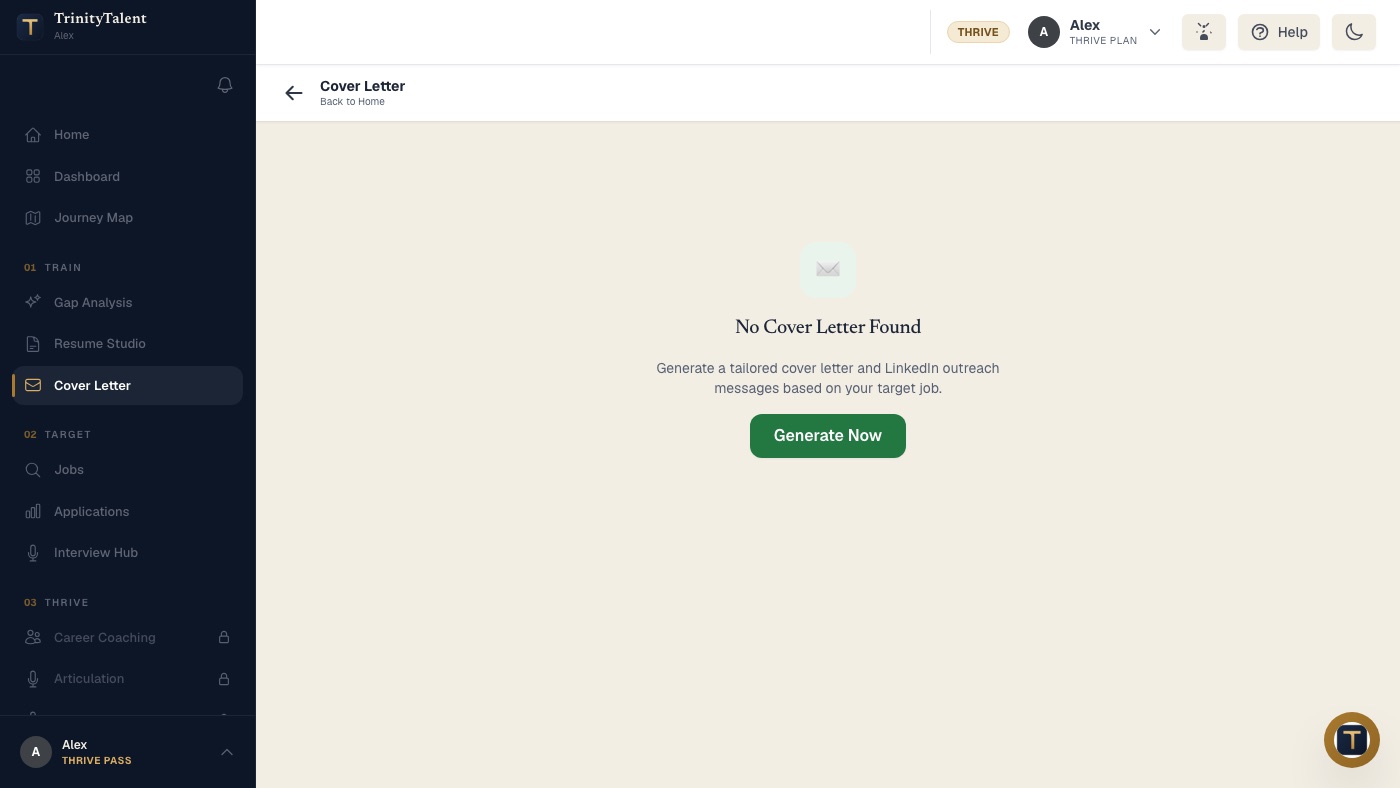
TrinityTalent's cover letter tool builds the letter from two sources you already have: your resume and the real posting. Paste the posting or its link, choose a length (short, medium or long) and a tone (professional, warm or direct), and the tool drafts a letter in the career-centre structure: an opening that names the role and one proof, a middle paragraph tied to the posting's requirements, and a short closing. Every fact in the draft comes from your resume.
The draft is a draft. You edit any line, including the opening, before you copy it into an application. Nothing is ever sent or submitted on your behalf. The tool is free while the product is in beta, with no credit card required.
Frequently asked questions
How should I start a cover letter if I do not know the hiring manager's name?
Use "Dear Hiring Manager" or "Dear [Team name] Hiring Team". Both are accepted in Canada and read as professional. Do not use "To Whom It May Concern", which sounds dated, and do not guess a name. Spend the effort on the first sentence instead.
Should I mention the company in the opening line?
Name the company and the exact job title in the first sentence, but keep flattery out. "I have long admired your culture" is not proof. If you know something specific about the company that connects to your evidence, such as a new location or a product launch, use it in the middle paragraph.
How long should the first paragraph of a cover letter be?
Two to three sentences, under 60 words. The opening names the role and gives one proof. Anything more belongs in the middle paragraphs. A long first paragraph delays the point and is the most common reason a letter is skimmed.
Is it acceptable to start a cover letter with a question or a story?
It is possible but risky. A question can sound like a sales email, and a story delays the role and the proof by several lines. If you use one, keep it to a single sentence and make sure the second sentence still names the role. For most applicants the direct opening reads as more confident.
Put this into practice
Paste a posting and the free cover letter tool drafts an opening from your resume facts. You edit every line before you send it.
Write your cover letter