
How to Read a Job Description Like a Recruiter
Knowing how to read a job description is the skill that separates a tailored application from a guess. Most people skim the title and the salary and start writing; learning how to read a job description properly takes fifteen minutes and tells you what the employer will actually screen for. A posting is a ranked list of problems the hiring manager needs solved, written in a hurry and padded with boilerplate. This guide gives you a method to strip the padding, rank the requirements and find the priorities the posting does not state directly.
TL;DR: Read the real posting, not a paraphrase. Split requirements into must-haves and nice-to-haves using the verbs the posting uses. Circle any phrase that appears twice; repetition signals priority. Read the seniority clues in the scope and reporting line. Note red flags. Then write down the three problems the role exists to solve and tailor to those.
Start with the real posting
Read the posting on the employer's own careers page or the portal it links to. Job boards often shorten, reformat or paraphrase the text, and some drop the requirements list entirely. If a posting has been copied between boards, find the original. The exact words matter because you will be matching your resume against them, and because an applicant tracking system will search for those words, not synonyms.
Save the full text as soon as you read it. Postings are taken down once the role fills, and you will want the text for the interview and for your application record.
Split must-haves from nice-to-haves
Postings mix hard requirements with wishes. The verbs tell you which is which.
- Must-have signals: "required", "must", "minimum", "essential", "you have", "you will need". Also anything in the "Qualifications" section that has a number attached: years, a degree level, a licence.
- Nice-to-have signals: "preferred", "an asset", "bonus", "ideally", "familiarity with", "exposure to".
- Legal or eligibility items: work authorization, a driver's licence, a security clearance, shift availability. These are knockout questions on the application form. If you do not meet one, the application will not proceed regardless of your resume.
Write the must-haves in one column and the nice-to-haves in another. Then mark each with a tick, a partial or a cross against your own record. If you have fewer than half the must-haves, the application is a long shot. If you have most of them and a few nice-to-haves, you are a real candidate even if you do not match everything.
Count the repeated phrases
Read the posting a second time with a pen. Circle any noun or phrase that appears more than once: "stakeholder management", "SQL", "month-end close", "customer retention". Repetition is the clearest signal of what the hiring manager cares about, because people repeat the thing that is on their mind.
The repeated phrases should appear, in the same words, in your summary and in at least one bullet. Our guide to finding resume keywords in any posting covers this in detail. The point here is that repetition tells you the order of priority, not just the vocabulary.
Read the seniority signals
The title says one thing; the scope says the truth. Look for:
- Reporting line. "Reports to the VP" is a more senior role than "reports to the team lead", whatever the title says.
- Scope words. "Own", "lead", "define" and "accountable for" describe seniority. "Support", "assist", "contribute to" and "under the direction of" describe a junior role.
- Team size and budget. Any number here tells you the level directly.
- The verbs in the responsibilities. A list that starts every line with "assist" is a coordinator role even if the title says "manager".
A fictional example. Two postings are both titled "Marketing Manager". One reports to the CEO, owns a budget and "defines" the annual plan. The other reports to a senior manager and "supports campaign execution". They are two different jobs at two different levels, and the same resume should not be sent to both.
Notice the red flags
Some phrases are worth pausing on. None is fatal alone, but several together describe a role you may want to research further.
- "Fast-paced environment" combined with "wear many hats" and no team size often means understaffing.
- A responsibilities list that spans three separate jobs, such as sales, support and bookkeeping, suggests a role that has not been defined.
- No salary range where the province requires one, or a range so wide that it says nothing.
- "Must be available evenings and weekends" for a role advertised as standard hours.
- A reposting of the same role within a few months, which you can sometimes see from the posting date or the job board history.
Red flags are questions for the interview, not reasons to skip. Write them down.
Find the hidden priorities
Every posting exists because someone has a problem. It is rarely stated, but it can be inferred.
Ask three questions. Why is this role open now: growth, a departure, a new project? What would make the hiring manager's next quarter easier? What does the posting spend the most words on? The section that runs longest is usually the pain.
Then write one sentence: "This role exists to ___." For a fictional "Accounts Receivable Specialist" posting that repeats "reduce days sales outstanding" and mentions "clean up aged balances", the sentence is: this role exists to collect old money faster. Every bullet you choose for that application should serve that sentence.
The fifteen-minute method
- Minutes 1 to 3. Read the whole posting once without a pen. Note the title, the team and the reporting line.
- Minutes 4 to 7. Read again with a pen. Circle repeated phrases. Underline must-have verbs. Box eligibility items.
- Minutes 8 to 10. Build the two columns, must-haves and nice-to-haves, and score yourself honestly.
- Minutes 11 to 13. Write the "this role exists to" sentence and list up to three red flags.
- Minutes 14 to 15. Decide: apply, apply with a note about a gap, or skip. Save the posting text either way.
How TrinityTalent helps
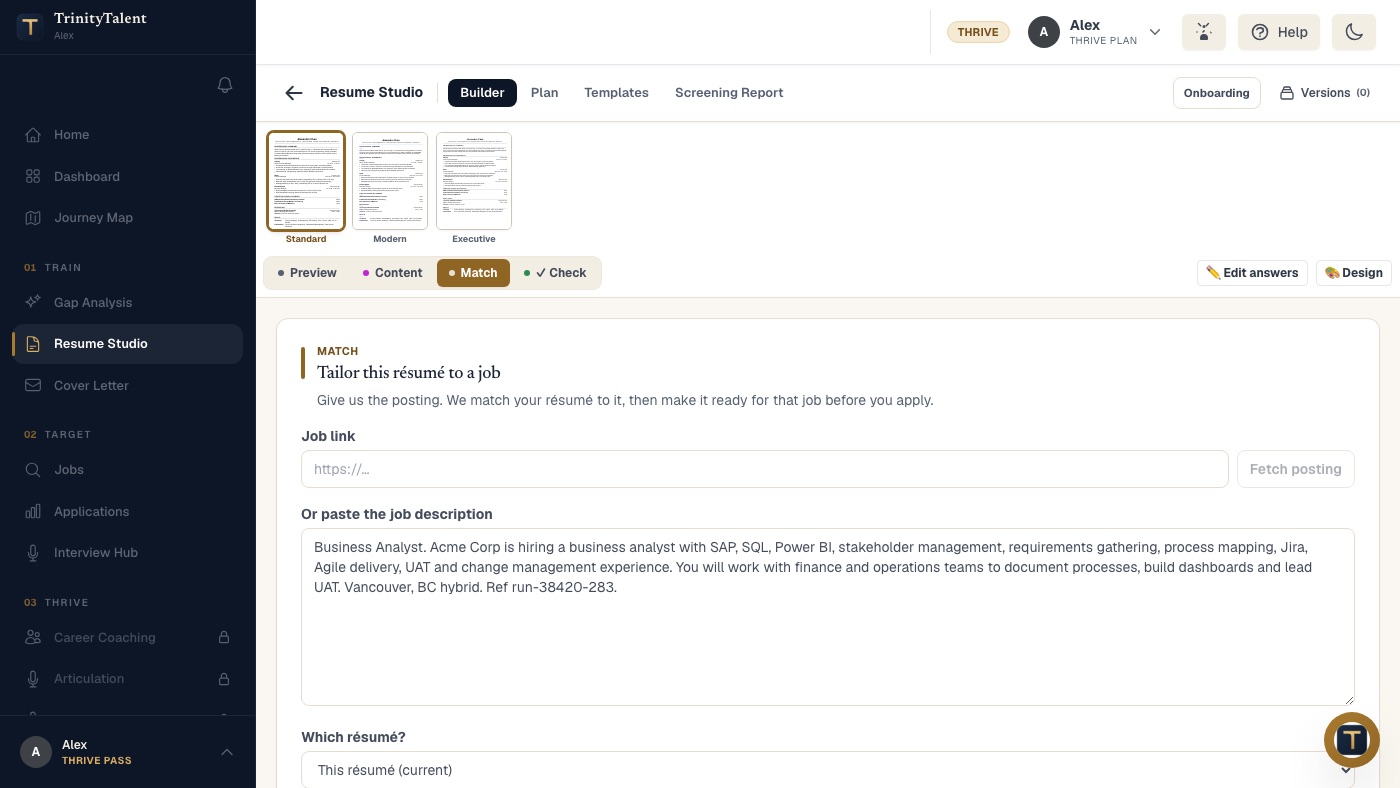
TrinityTalent's Match tab reads the real posting. You paste the link or the description, and it opens the actual page rather than a search-engine paraphrase, so the requirements it compares against are the employer's own words. The keyword audit shows which of the posting's terms your resume already carries and which are missing, which is the must-have and repeated-phrase step done for you.
When you are ready, one-shot tailoring rewrites the resume from your own facts to fit that posting, and the result is shown for you to review before anything is saved. Gaps come back as questions for you to answer, never as invented claims. The posting text is stored with the application in the tracker, so the words are still there when the page has been taken down. Editing and the on-device Check are free while the product is in beta.
Frequently asked questions
How do I tell must-have skills from nice-to-have skills in a job description?
Read the verbs. "Required", "must", "minimum" and "essential" mark must-haves, as does any requirement with a number attached. "Preferred", "an asset", "bonus" and "familiarity with" mark nice-to-haves. Eligibility items such as work authorization are knockout questions and must be met regardless of the rest.
Should I apply if I do not meet every requirement in a job description?
Yes, if you meet most of the must-haves and can show related evidence for the rest. Postings describe an ideal candidate who rarely exists. Do not apply if you fail an eligibility item or fewer than half of the must-haves; that time is better spent on a closer match.
Why do repeated phrases in a job description matter?
People repeat what is on their mind. A phrase that appears two or three times in a posting is the hiring manager's priority, whatever the order of the bullet list. Those phrases should appear, in the same words, in your summary and in at least one experience bullet.
Should I read the job posting on the company site or the job board?
The company site, or the portal it links to. Job boards often shorten or paraphrase the text and sometimes drop the requirements list. You will be matched against the employer's exact words, so read and save those. Save the text early, because postings disappear once the role fills.
Put this into practice
Paste a posting link into the Match tab. It reads the real page, shows the keyword audit, and tailors your resume from your own facts in one pass.
Tailor your resume to a posting