
Second Interview Tips: What Changes and How to Prepare
Most second interview tips repeat the advice for the first round, and that is why they fail. Useful second interview tips start from one fact: the question has changed. The first interview asked "can this person do the job?" The second asks "will this person do it here, with these people?" You have passed the skills screen. Now the employer is checking judgement, fit and commitment, usually with more people in the room. This guide explains what changes, what to prepare, and what to ask.
TL;DR: A second interview tests fit and judgement, not basic skills. Expect deeper behavioural questions, a meeting with future teammates, and often a short presentation or case. Prepare three new stories, a 30-60-90 day view of the role, and questions about how the team actually works. Let the employer raise salary first, but know your number before you walk in.
Why the second interview is a different test
In the first round, a recruiter or hiring manager confirmed the basics: your experience matches the posting and you can explain your work. The second round exists because capable is not enough. Several capable people are still in the process, and the employer needs a reason to pick one. So it measures three things the first could not:
- Judgement. How you decide when the rules do not cover the situation.
- Fit with the team. Whether the people you would work with want to work with you.
- Commitment. Whether you understand the role well enough to want it for real reasons.
Behavioural questions go one level deeper
Round one behavioural questions are broad: "Tell me about a time you handled conflict." Round two questions are narrower and follow threads from your first answers. If you said you improved a process, expect "What did you get wrong the first time?" or "Who disagreed with you?"
Prepare three stories you did not use in the first interview. Each should show a decision, not just an outcome. Spend most of the time on the action and the trade-off, because that is where judgement shows.
Example
Question: "You said you cut onboarding time for new hires. What did you have to give up to do that?"
Weak answer: "Nothing really, everyone was happy with the change."
Strong answer: "Two things. The old checklist had 40 items and the new one had 22, so I dropped some steps that one senior team member felt were important. I kept a written list of what we removed and reviewed it with her after the first three hires. One item went back in. The time to first independent shift still fell from 12 days to 8."
The second answer admits a cost, names a person who disagreed, and shows how the decision was checked. That is what a second-round interviewer listens for.
Meeting the team: what they are really assessing
Many second interviews include a session with two or three future teammates. It can feel informal. It is not. Teammates are asked one question afterwards: "Would you want this person on the team?" They answer based on how you treated them. Three habits help:
- Ask each person about their own work. "What does a normal week look like for you?" shows interest and gives you real information.
- Say "I do not know" when it is true. Teammates test for honesty more than knowledge.
- Do not talk down about a former employer. People assume you will speak about them the same way later.
If the team session is a panel with a fixed question list, read our panel interview tips for how to address several people at once.
If you are asked to present a plan
A common second-round task is a short presentation: "Tell us how you would approach your first 90 days," or a case built from a real team problem. The employer is not buying the plan. They are watching how you think with incomplete information. Structure a 30-60-90 plan in three parts:
- Days 1 to 30: learn. Whom you would meet, which systems you would study, which numbers you would want to see.
- Days 31 to 60: contribute. One or two small, visible pieces of work.
- Days 61 to 90: propose. A recommendation based on what you learned, with the trade-offs stated.
Keep it to one page or a few slides. Name your assumptions first, so a challenge becomes a discussion, not a correction. When someone pushes back, thank them and adjust out loud. Adjusting in real time is the skill being tested.
Salary timing: when to talk numbers
Salary often comes up in the second interview, usually near the end and raised by the employer. Do not open with it. If they ask for your expectation, give a range you can defend from postings for similar roles, and say you weigh the whole package: vacation, RRSP match, flexibility and a review date all count.
If the employer does not raise it, ask at the close: "What are the next steps, and when would you expect to discuss an offer?" The real negotiation happens after the written offer arrives.
Questions to ask in the second round
Your questions should now be specific to this team. General culture questions signal that you learned nothing in round one. Choose three or four:
- "What would make you say, six months from now, that hiring for this role worked?"
- "Where does this role sit when priorities conflict between two teams?"
- "What is the one thing the last person in this role found hardest?"
- "How does the team give each other feedback, and how often?"
The best question follows from something said earlier in the interview, because it proves you listened. For a longer list by stage, see questions to ask the interviewer.
Mistakes that lose the second interview
- Repeating first-round stories. The hiring manager has heard them and may be in the room.
- Treating the team lunch as a break. It is part of the interview.
- Over-preparing the plan, under-preparing for pushback. The plan is a prop; the discussion is the test.
- Raising salary in the first ten minutes. It signals that money is your only reason.
- Failing to follow up. Send a short thank-you within a day to each person you met, naming one thing each of them said.
How TrinityTalent helps
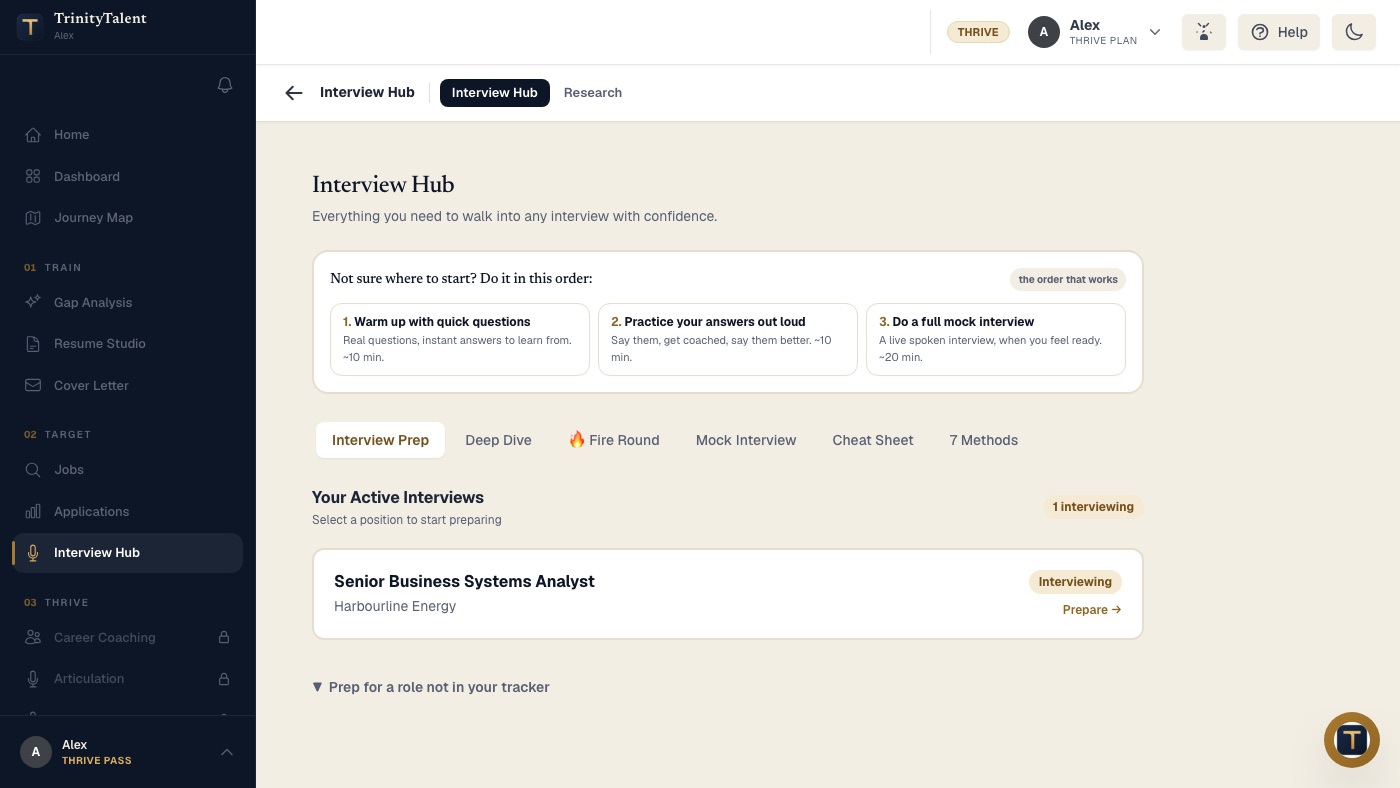
TrinityTalent's Interview Hub lists the roles you are interviewing for straight from your application tracker, so second-round preparation is built around the real posting and the resume version you sent. The suggested order is warm up with quick questions, practise your answers out loud, then run a full mock interview with a live spoken interviewer that asks the deeper follow-up questions a second round is known for.
The Fire Round bank of more than 700 questions gives you follow-ups on stories you already told. Voice Studio measures your pace, pauses and filler words from a recording that stays on your device, which matters when you present a plan to a room. Career Coaching's role reality briefings describe what the role demands day to day, which is where the best second-round questions come from. Free to build, edit and export your resume. AI tailoring, interview practice and coaching run on prepaid passes, and nothing renews by itself.
Frequently asked questions
What does a second interview usually mean?
A second interview means you passed the skills screen and the employer now wants to check fit, judgement and commitment. You are usually one of a few remaining candidates. Expect more people in the room, deeper behavioural questions, and often a short presentation or team meeting.
How is a second interview different from the first?
The first interview confirms you can do the job. The second decides whether the employer wants you to do it there. Questions become narrower and follow threads from your first answers, teammates join to assess how you work with others, and salary may come up near the end.
Should I bring up salary in a second interview?
Let the employer raise it. If they ask for your expectation, give a defensible range and mention that you weigh the whole package. If they do not raise it, ask about next steps and when an offer discussion would happen. The real negotiation belongs after the written offer arrives.
How should I prepare for a second interview presentation?
Build a 30-60-90 day plan: learn in the first month, contribute something small and visible in the second, propose a recommendation in the third. Keep it to one page or a few slides, state your assumptions first, and rehearse responding to pushback, because how you adjust is what the panel is judging.
Put this into practice
Open the Interview Hub, pick the role from your tracker, and run a spoken mock interview built around the deeper questions a second round asks.
Practise a mock interview