
Panel Interview Tips: How to Handle Three Interviewers
The panel interview tips that matter most are about attention, not answers. A panel interview puts three or four people in front of you, each with a different reason to be there, and the mistake most candidates make is to treat it as one interview with a bigger audience. It is three interviews happening at once. These panel interview tips cover how to divide your attention, how to answer the person who asked without ignoring the rest, and how to prepare for each panellist's agenda before you sit down.
TL;DR: Learn every name and use them. Answer the person who asked for the first sentence, then widen your eye contact to the room, then return to the asker to close. Work out before the interview what each panellist needs: the manager wants results, the peer wants a colleague, the neighbouring team wants reliability. Ask one question of each person. Follow up with all of them, separately.
Why employers use panels
Panels save time and reduce bias. One conversation replaces three, everyone hears the same answers, and no single opinion decides the outcome. They are common in the public sector, universities, health care and any role that works across teams.
For you, the panel changes two things. You cannot build rapport with one person and ride it. And the same answer lands differently with each listener: a manager hears "I reorganised the reporting process" as initiative; the peer who runs that process may hear a threat. Knowing who is in the room tells you how to frame what you say.
Before the interview: map the panel
Ask the recruiter who will be on the panel and what each person's role is. Most will tell you. Then, for each name, write one line about what they probably need from this hire.
- The hiring manager wants evidence you can deliver results with limited supervision. Prepare two stories with numbers.
- A peer or team member wants to know you will pull your weight and be easy to work with. Prepare a story about sharing credit or helping a colleague.
- A stakeholder from another team wants reliability: will you deliver what you promise, on time, and tell them early when you cannot? Prepare a story about managing a dependency.
- HR or a talent partner watches for consistency with your resume and for how you treat everyone in the room, including them.
If you cannot get names, prepare for these four roles anyway. The mapping is what matters; the names are a bonus.
In the room: names and notes
When you enter, greet each person, shake hands if that is the norm, and repeat each name as you hear it: "Nice to meet you, Fatima." Then, as soon as you sit, write the names down in the order people are seated. A small notebook is normal and read as prepared, not rude.
Using a name once in an answer is powerful: "Fatima, you mentioned the migration earlier; the process I used would apply there too." Using names constantly is exhausting. Once or twice per panellist is enough.
Answer the asker, then the room
Candidates most often get this wrong in one of two ways: they answer only to the person who asked, so the others become spectators, or they scan the room like a lighthouse and connect with nobody.
Use a three-part rotation:
- Open to the asker. Deliver your first sentence, the direct answer, while looking at the person who asked.
- Widen to the room. As you give the evidence, move your eye contact to the others, holding each for a full thought, not a glance.
- Close to the asker. Return to the person who asked for your final sentence, so they know you have finished and can follow up.
A worked example
The peer on the panel asks Marcus Bell, applying for a logistics coordinator role, "How do you handle a colleague who keeps missing hand-offs?"
Marcus looks at the peer: "I start by assuming the process is the problem before the person is." He turns to the manager and the stakeholder as he continues: "At my last warehouse, two shifts kept missing the inbound hand-off. I sat with both leads, found that the paperwork arrived after the shift change, and moved the cut-off by 30 minutes. Missed hand-offs went from about ten a week to one or two." He returns to the peer: "Only when the process is fixed and it is still happening do I have the direct conversation."
Every person in the room heard the answer as addressed to them, and the peer got the close.
Handling the panel's dynamics
Panels have quirks that solo interviews do not. Prepare for these:
- Two people ask at once. Say, "I will take Priya's first, then come back to yours," and then actually come back to it.
- One panellist is silent. Do not force it. Direct one of your closing questions to them, which gives them a natural way in.
- One panellist is hostile. Stay even. Answer the content of the question, not the tone, and keep your eye-contact rotation going so you do not lock onto them.
- The panel disagrees with each other. Do not take sides: "It sounds like there are two views on that. Here is how I have balanced them."
- Rapid-fire questions with no follow-up. This is usually a structured interview where every candidate gets the same list. Give complete answers anyway; the scoring happens after.
For behavioural questions, which panels rely on heavily, /blog/behavioral-interview-questions/ lists the ones worth preparing.
Ask something of everyone
When the panel invites your questions, close the loop with each person: one question per panellist, addressed by name. Ask the peer what a good week looks like, the stakeholder what they need most from this role, the manager what a strong first 90 days would have finished. If time is short, ask one question to the room. More examples are in /blog/questions-to-ask-the-interviewer/.
Follow up with all of them
Send a thank-you email to each panellist, not one email to the group. Each note is three or four sentences and mentions something that person said or asked. If you only have the recruiter's address, ask them to pass on your thanks by name. The effort is small and most candidates do not make it.
How TrinityTalent helps
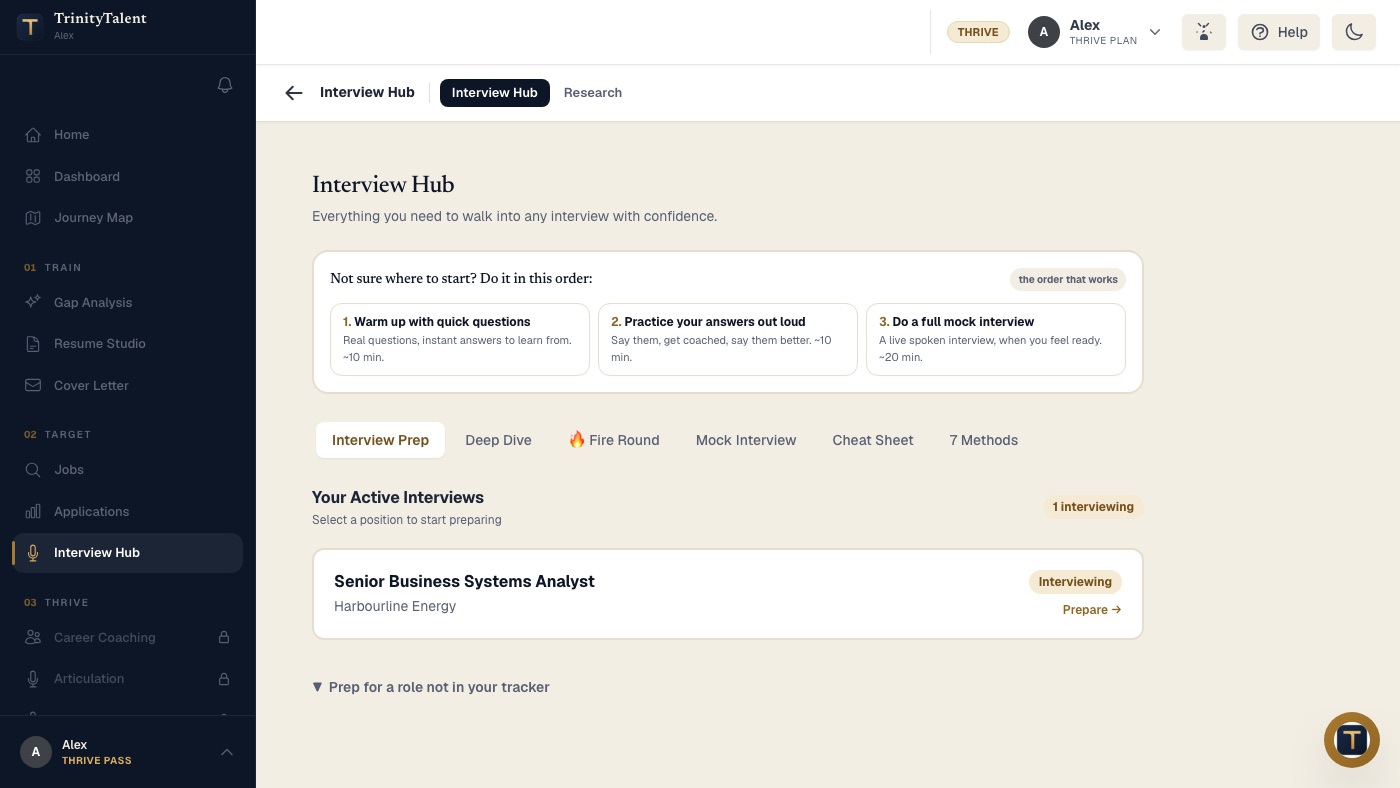
Panels are hard to rehearse because you cannot practise dividing your attention alone. What you can practise is the answers, until they are short enough to survive a room where everyone is judging them at once. The Interview Hub in TrinityTalent takes each role you are interviewing for from your Application tracker and suggests a sequence: warm up with quick questions from the Fire Round bank of more than 700, practise your answers out loud with coaching, then do a full mock interview with a live spoken interviewer. That last step is the closest thing to a panel you can do at home. The Hub also builds a cheat sheet of likely questions for the role, so you can map them to the panellists you expect. Building, editing and exporting your resume on TrinityTalent is free.
Frequently asked questions
Who should I look at in a panel interview?
Look at the person who asked while you give your first sentence, move your eye contact to the others as you give your evidence, and return to the asker for your final sentence. Hold each person for a complete thought rather than glancing around. This keeps everyone included and tells the asker when you have finished.
Should I send a thank-you email to every panel member?
Yes, and send them separately. Each note should mention something that person asked or said, so it reads as a real message rather than a template. If you only have the recruiter's address, send one email and ask them to pass your thanks to each panellist by name.
How do I prepare for a panel interview if I do not know who will be on it?
Ask the recruiter for names and roles; most will share them. If they will not, prepare for the four most common panellists: the hiring manager, a peer, a stakeholder from another team and someone from HR. Prepare one story that answers what each of them needs, and you will be ready for almost any combination.
Is a panel interview harder than a one-on-one interview?
It is harder to manage but not harder to pass. Your answers do not change; what changes is how you deliver them, dividing your attention and framing each story so it works for every listener. Candidates who prepare for the room, not just the questions, often find panels fairer because no single interviewer decides.
Put this into practice
Rehearse your panel answers out loud with the mock interview in the Interview Hub, then review the feedback before the real room.
Practise a mock interview