
Resume Formats Explained: Chronological, Functional, Hybrid
There are three resume formats in common use: chronological, functional and hybrid. Choosing between resume formats is mostly a decision about how much your work history helps you: chronological when it does, hybrid when it needs a skills summary in front of it, and functional almost never, because it hides the dates that recruiters and applicant tracking systems both need. This guide explains each format, when it helps and hurts, a two-minute way to choose, and why single-column layout matters more than the format label.
TL;DR: Use reverse-chronological for most applications: recent job first, dates on every role. Use hybrid when changing careers: a short skills summary with evidence, then the same dated history. Avoid functional resumes; they remove dates, parse badly and make recruiters suspicious. Whatever the format, keep it single-column.
What a resume format decides
A resume format decides which section leads and how work history is presented. It does not change your facts; it changes what the reader meets first and how easily they can check dates.
- Reverse-chronological leads with work history, most recent role first, with dates and bullets under each.
- Functional leads with skill groups and their achievements, and pushes the work history to a short, often undated list at the end.
- Hybrid (also called combination) leads with a skills summary, then presents the full dated work history underneath.
Recruiters and applicant tracking systems both read a resume in the same way: find the dates, find the titles, find the employers, then read the evidence. Any format that makes those three harder to find costs you.
Reverse-chronological: the default
Who it suits
Anyone whose recent roles point toward the job they want. That includes most people: someone moving up in the same field, a graduate whose co-op terms match the posting, a professional returning to a similar role after a short gap.
What it looks like
Contact details, a three or four sentence summary, a short skills block, then experience with the most recent role first. Each role carries the title, employer, city, month and year dates, and three to five result bullets. Education and certifications follow. See the guide on resume length for how many roles to show in full.
Its strength is trust. The reader can see progression, tenure and gaps at a glance, and the parser can map each role cleanly into the fields the system stores. Its weakness is that it shows everything in order, so a career change or a long gap is visible. That is a reason to explain, not to hide.
Functional: why it fails software and people
A functional resume groups achievements under skill headings ("Leadership", "Customer Service", "Analysis") and lists employers briefly, often without dates, at the bottom. It was designed to help career changers and people with gaps. In practice it does the opposite.
It fails parsing. Applicant tracking systems build a work history by pairing each employer with its dates and the bullets beneath it. A functional resume separates the three, so the parsed profile shows skills with no employer and employers with no dates. Recruiters opening that profile see empty fields and move on.
It fails trust. Recruiters have seen this format used to hide short tenures, long gaps and a lack of recent experience. Many treat it as a signal that something is being concealed, and the interview starts with that suspicion whether or not it is fair.
It removes context. "Reduced costs by 20 percent" under a "Leadership" heading tells the reader nothing about where, when or at what scale. The same line under a dated role tells them everything.
If you are tempted by the functional format, the problem it is meant to solve is better solved by a hybrid resume with honest dates and a clear summary.
Hybrid: the career changer's format
A hybrid resume keeps the full reverse-chronological history but places a skills summary between the summary paragraph and the experience section. That block does the translating for the reader: it names the three or four skill areas the target role needs and gives one line of evidence for each, drawn from your past roles.
Worked example
Daniel spent seven years as a restaurant manager and is applying for an operations coordinator role at a logistics company. His hybrid resume has three parts.
- Summary: "Operations professional with seven years running a high-volume restaurant, moving into logistics coordination. Managed scheduling, supplier orders and cost control for a 40-person team serving 600 covers a day."
- Relevant skills: "Scheduling: built weekly rosters for 40 staff across three shifts with overtime under 3 percent. Supplier management: negotiated with 14 suppliers and cut food cost by four points in a year. Reporting: produced weekly labour and cost reports for the regional director."
- Experience: the same two restaurant roles, dated, with bullets rewritten to use operations language.
The skills block tells the logistics recruiter why a restaurant manager belongs on the shortlist. The dated history proves it. The transferable skills guide covers how to find those lines in a past career.
How to choose in two minutes
Answer these in order and stop at the first yes.
- Are you applying for a role in the same field, at the same or the next level? Reverse-chronological.
- Are you changing fields, or returning after several years, with real evidence from your past roles? Hybrid.
- Are you a student or new graduate? Reverse-chronological, with education and co-op terms leading if they are your strongest evidence.
- Are you tempted to leave dates off? Do not. Use a hybrid format and explain the gap in one honest line.
There is no situation in a Canadian or American job search where the functional format is the better choice. Recruiters who receive one usually ask for the dates anyway.
Format is not layout: single-column always
Format is the order of sections. Layout is how they sit on the page. The two get confused, and the layout mistake is the more expensive one.
Two-column designs, sidebars, text boxes and tables look modern and parse badly. A parser reads left to right across the whole page, so a left column of skills and a right column of experience become one interleaved stream, and dates end up next to the wrong employers. Headers and footers are often skipped entirely, which is where many templates put the contact details.
Whatever format you choose, use a single column, standard headings, plain text and a common font. A conservative-looking resume that parses perfectly beats a designed one that arrives as a scrambled profile.
How TrinityTalent helps
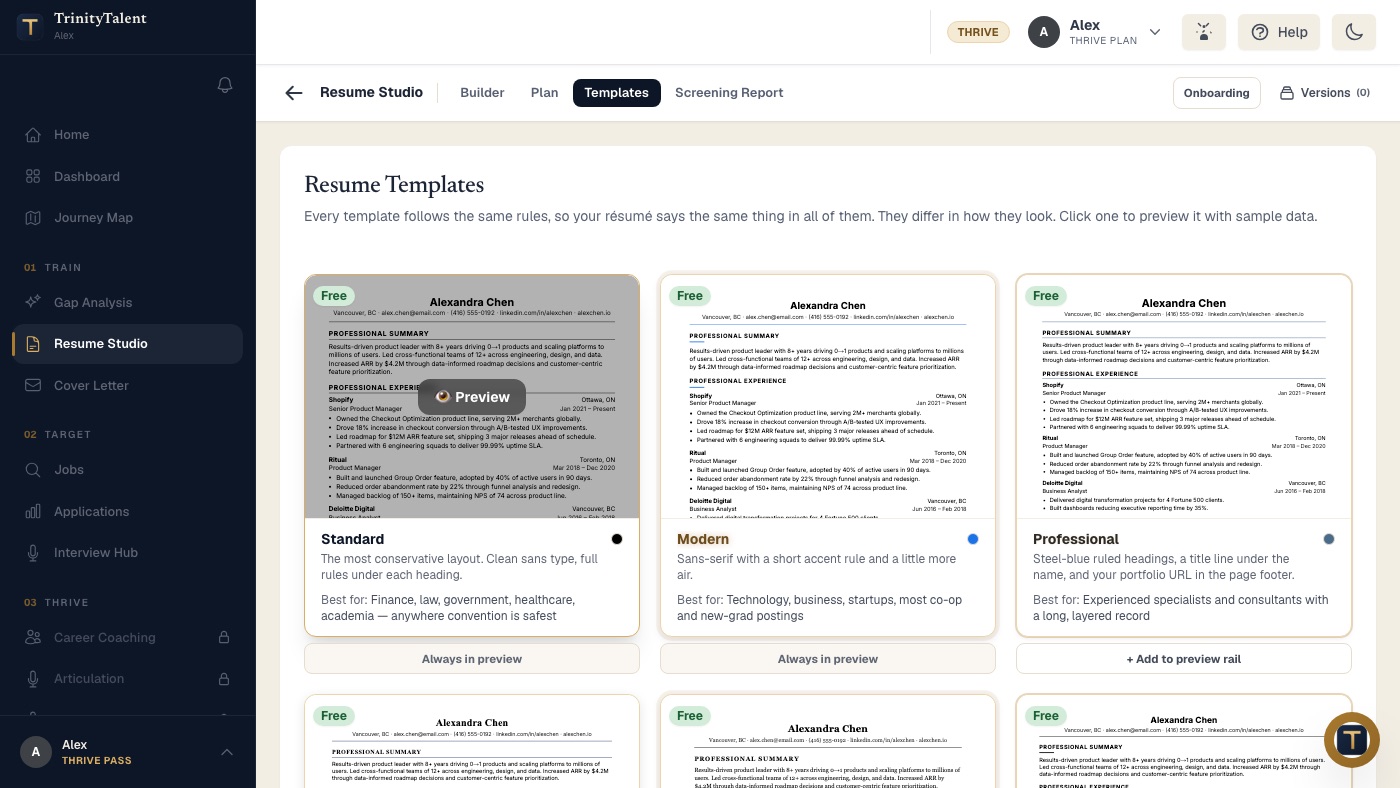
TrinityTalent's free resume templates take the layout risk off the table. There are eleven single-column templates plus an academic CV, and every one of them follows the same rules: your resume says the same thing in all of them and only the look changes, so you can switch between a conservative serif template and a modern sans-serif one without a section moving or a date detaching from its role. None of them can add a photo, a column or a sidebar, which is what makes them ATS-safe.
Format is a content choice you make in the builder: reorder sections, add a relevant-skills block for a hybrid resume, and hide the bullets a particular application does not need without deleting them. Preview any template, then export to Word or PDF. Building, editing and exporting your resume on TrinityTalent is free.
Frequently asked questions
Which resume format is best for ATS?
Reverse-chronological or hybrid, in a single column with standard headings. Both keep each employer, its dates and its bullets together, which is how a parser builds your work history. Functional resumes separate skills from dates and often produce a profile with empty fields.
Is a functional resume ever a good idea?
Rarely, and not for a standard job application in Canada or the United States. It removes the dates recruiters use to judge tenure and progression, and many read it as concealment. The situations it was designed for, career change and gaps, are better served by a hybrid resume with honest dates.
What is the difference between a hybrid and a combination resume?
Nothing; they are two names for the same format. A skills summary with evidence sits above a full reverse-chronological work history. The skills block translates your past for the new field, and the dated history proves the claims.
Should a student use a chronological resume?
Yes, with one adjustment: if education and co-op terms are your strongest evidence, they can lead. Keep dates on everything, use the same bullet style you would for a job, and place part-time work and projects in dated sections rather than under skill headings.
Put this into practice
Pick any free single-column template in the builder. All of them keep dates with their roles by design, so the format decision is already made safely.
Pick an ATS-safe template