
Resume Action Verbs: The List and How to Use Them
Resume action verbs are the first word of every bullet point, and they decide whether the line reads as work you did or a duty you were assigned. The best resume action verbs are specific, past tense for old roles, and different from each other; a section that starts four bullets with "Managed" tells the reader you had one verb, not four achievements. This guide groups the verbs by what they prove, explains the never-repeat rule, lists the weak openers to retire, and shows how a rules-based check catches the repeats you stop seeing after the tenth read.
TL;DR: Start every bullet with a specific past-tense verb that matches the kind of work: led, built, analysed, improved or communicated. Never use the same verb twice in one section. Retire "responsible for", "helped", "worked on" and "utilized". Follow the verb with a task, a method and a number, or the strong verb is only decoration.
Why the first word matters
Recruiters read bullets from the left. The first word sets the expectation for the rest of the line, and the eye often stops there when it finds nothing. "Responsible for" says a duty follows. "Reduced" says a result follows, and the reader keeps going to find the number.
Applicant tracking systems do not rank verbs, but they store every bullet as text, and a bullet built on a strong verb almost always carries more of the posting's language, because the verb pulls a task and a result after it. The verb is not decoration. It is the frame that forces the rest of the sentence to be specific.
The list, grouped by what it proves
Pick the group that matches the work, then pick the verb that matches the scale. "Chaired" is not "attended". "Built" is not "helped build". Use past tense for previous roles and present tense for the job you are in now.
Leading and managing
- Led, Directed, Coordinated, Supervised, Delegated
- Mentored, Chaired, Oversaw, Recruited, Onboarded
Building and creating
- Built, Designed, Developed, Launched, Drafted
- Established, Programmed, Assembled, Produced, Introduced
Analysing and researching
- Analysed, Audited, Assessed, Calculated, Diagnosed
- Forecast, Investigated, Mapped, Measured, Tested
Improving and fixing
- Improved, Reduced, Cut, Streamlined, Simplified
- Restructured, Automated, Resolved, Accelerated, Standardised
Communicating and persuading
- Presented, Negotiated, Wrote, Trained, Translated
- Persuaded, Advised, Briefed, Facilitated, Consulted
Serving and operating
- Processed, Delivered, Maintained, Operated, Dispatched
- Handled, Scheduled, Inspected, Fulfilled, Administered
The never-repeat rule
Read one section of your resume and circle the first word of each bullet. If any verb appears twice, replace one. University career centres publish this rule in their annotated sample resumes, and the reason is simple: a repeated verb signals a repeated thought. Five bullets that start with "Managed" read as one achievement written five times.
The fix is rarely a thesaurus. Usually the second "Managed" is hiding a more precise verb. Managed a budget becomes "Controlled". Managed a rollout becomes "Led". Managed a vendor becomes "Negotiated". Managed a schedule becomes "Coordinated". The more precise verb also makes the line more believable, because it tells the reader what kind of managing it was.
Apply the rule per section, not per resume. A verb may reappear under a different job if it is honest there. But it must not appear twice under the same job title.
Weak verbs to retire, and what to use instead
Some openers are so common that they carry no information. Retire them.
- Responsible for. A duty, not an act. Replace with what you did: "Ran", "Owned", "Delivered".
- Helped, assisted, supported. These hide your contribution inside someone else's. Name your part: "Drafted the report that", "Ran the tests for".
- Worked on, involved in, participated in. Presence without action. Say what you produced.
- Utilized, leveraged. Say "used", or better, name the outcome the tool produced.
- Handled, dealt with. Vague on their own. "Resolved 40 escalations a week" is specific.
- Various, multiple, numerous. Not verbs, but the same disease. Give the count.
- Successfully, effectively. Cut the adverb; the number proves success.
A test: if the first two words could sit in a job posting's duties list, they belong to the job, not to you. Replace them with a verb that only you can claim.
Match the verb to the posting
Job postings use verbs too. "Lead cross-functional projects", "analyse customer data", "develop training materials". When the posting and your bullet share a verb family, the recruiter sees the fit without translating. Read the posting, list its verbs, and where you honestly did that kind of work, use the same verb. This is not keyword stuffing; it is using the reader's vocabulary. The resume keywords guide shows how to build that list from a posting in ten minutes.
Do not borrow a verb you cannot defend. If the posting says "led" and you contributed, write "contributed to", name your piece, and let the interview sort out the rest. A verb you cannot back up in conversation costs more than a weak one.
A verb is a promise; the rest of the line must keep it
A strong verb followed by nothing is worse than a weak one, because it raises an expectation and then breaks it. "Spearheaded initiatives" is two grand words and no content. The verb promises a result; the line has to deliver one.
Weak, strong, and complete
- Weak: "Responsible for social media."
- Strong verb, empty line: "Spearheaded social media strategy."
- Complete: "Launched a three-channel posting schedule and grew engagement by 45 percent in a year by testing formats monthly."
A second example
- Weak: "Helped with month-end close."
- Strong verb, empty line: "Optimised month-end close."
- Complete: "Cut month-end close from nine days to five by building a reconciliation checklist the four-person team now uses."
The pattern is verb, task, method, number. The resume bullet points guide walks through it for six roles.
How TrinityTalent helps
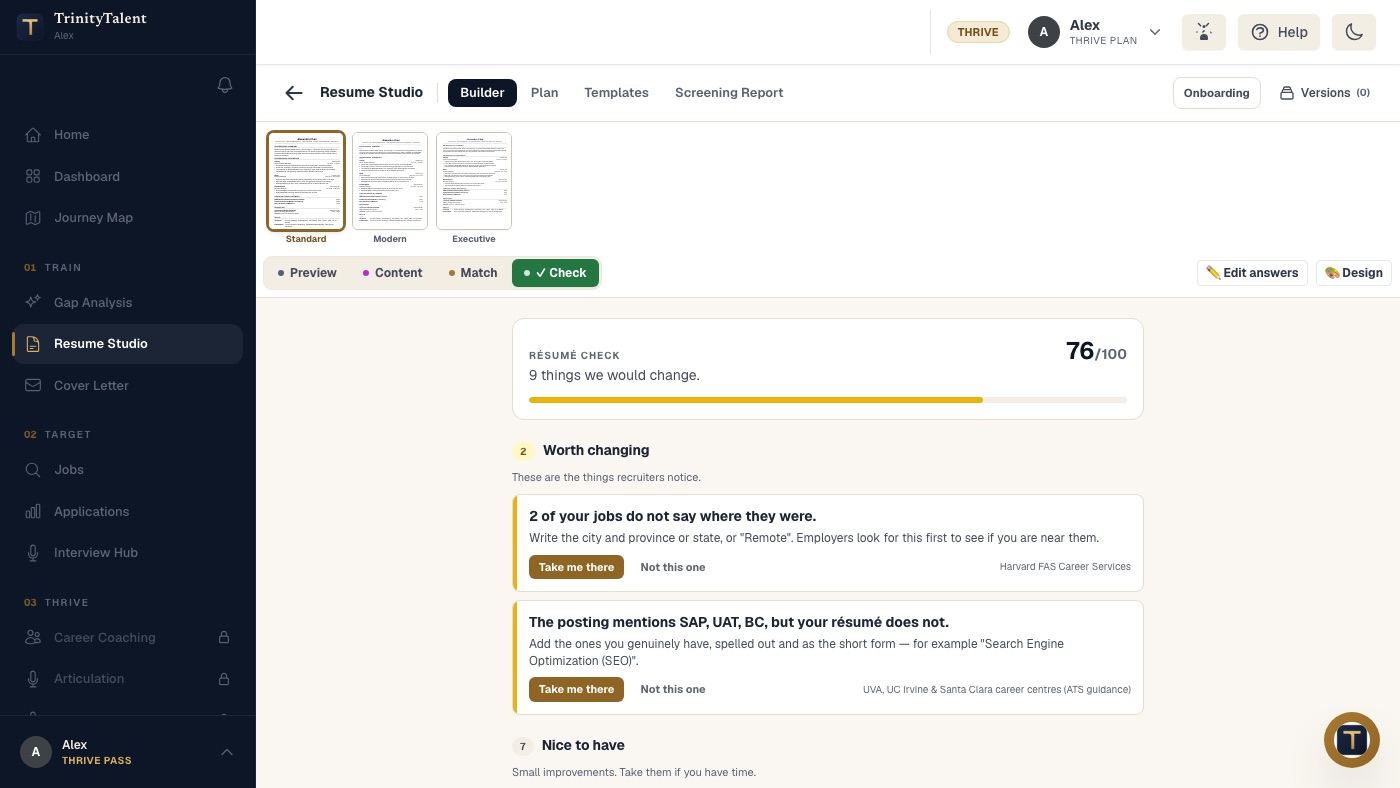
TrinityTalent's free ATS resume checker reads the verbs for you. The Check tab in the resume builder runs a rules-based scan on your device, with no upload and no waiting: it flags bullets that start with a weak opener, verbs repeated within one section, bullets with no number, past tense under a current job, and small numbers written both as words and digits. Each finding cites the career-centre guidance it is based on, and a "Take me there" button moves you to the exact line so you can rewrite it yourself.
Editing is free and unlimited; nothing is sent anywhere until you choose to export to Word or PDF from a single-column, ATS-safe template. When you tailor the resume to a real posting, the builder rewrites bullets in the posting's own language using only the facts on your page, and you review every change. Building, editing and exporting your resume on TrinityTalent is free.
Frequently asked questions
How many action verbs should a resume use?
One per bullet, and no verb twice within the same job section. A resume with five roles and 15 bullets might use 12 to 15 different verbs. The goal is not variety for its own sake; each different verb should reflect a different kind of work you did.
Should resume verbs be in past or present tense?
Past tense for every role you have left and present tense for the job you hold now. Keep one tense within each role. A current job with a mix of "manage" and "managed" reads as an unedited draft, and most checkers flag it.
Are power words the same as action verbs?
Not quite. Action verbs describe what you did: built, negotiated, reduced. Lists of "power words" often include adjectives such as "dynamic" or "innovative", which describe how you want to be seen. Adjectives do not survive a recruiter's scan; verbs followed by numbers do.
Do applicant tracking systems care about action verbs?
Not directly. The system stores your bullets as text and matches them to the posting's terms. A specific verb helps indirectly, because it pulls a specific task and result after it, and those carry the keywords. The human reading the shortlist cares a great deal.
Put this into practice
Run the free Check on your resume. It flags repeated verbs, weak openers and bullets with no result, and takes you to the exact line to fix.
Check your resume free