
Resume Bullet Points: How to Write Them, With Examples
Resume bullet points are the lines under each job title, and they are where a recruiter decides whether your experience is real. Strong resume bullet points follow one pattern: an action verb, the task, the method, and a measurable result, all on a single line. Most bullets fail because they describe a duty ("responsible for reporting") instead of an outcome ("cut reporting time from three days to one"). This guide gives you the formula, a way to find numbers you think you do not have, six before-and-after rewrites, and the formatting mistake that hides good work from software and people.
TL;DR: Every bullet is one line: verb + task + method + result. Start with a past-tense action verb, name the thing you did, say how, and end with a number. Write three to five bullets per role, strongest first. Never merge two achievements into one paragraph, because parsers and readers both lose the second one.
What a resume bullet point is for
A bullet point is a claim with evidence. A recruiter reads it in about two seconds and asks one question: could this person do that for us? A duty statement ("Responsible for customer inquiries") does not answer it, because every person in that job had the same duty. An achievement statement ("Answered 70 customer inquiries a day and kept the response time under two hours") does, because it shows scale and a standard.
Bullets also feed the software. An applicant tracking system stores each line as text and matches it against the posting's keywords. A bullet that names the tool, the method and the outcome gives the system more to match, and gives the human more to believe.
The four-part formula
Write each bullet in this order. Keep it to one line.
- Action verb. Past tense for previous roles, present tense for the job you still hold. "Reduced", "Built", "Negotiated", "Trained". Avoid "Responsible for", "Helped with" and "Worked on", which describe presence, not action.
- Task. The specific thing you acted on. "The weekly inventory count", "the onboarding guide for new hires", "the vendor contract for cleaning services".
- Method. How you did it. This is the part most people skip, and it is the part that proves you did the work. "By switching to barcode scanning", "by writing a ten-page checklist", "by comparing three quotes".
- Measurable result. A number, a percentage, a time saved, a count of people, or a before-and-after. "From four hours to 90 minutes", "for 35 new staff", "saving about 12 percent a year".
Put together: "Cut the weekly inventory count from four hours to 90 minutes by switching the team to barcode scanning." One line. Every part can be checked in an interview.
Find the number you think you do not have
The most common objection is "my job had no numbers". Almost every job has some. Ask these questions about each task:
- How many? Customers a day, orders a week, files a month, staff you trained, sites you covered.
- How often? Daily, weekly, every quarter, every shift.
- How big? Budget size, team size, number of locations, volume of stock.
- How long? The time a task took before and after you changed something.
- How accurate? Error rate, complaints, returns, audit findings.
- Compared to what? The previous person, the previous year, the team average.
A careful estimate is acceptable when you can explain how you reached it: "about 40 calls a shift" is honest if you counted for a week.
Six before-and-after rewrites
Each pair shows a duty statement rewritten with the formula. Names and employers are invented. Replace the figures with your own.
Administrative assistant
Before: "Responsible for scheduling and office supplies."
After: "Managed calendars for four directors and cut double-bookings to zero by moving all requests into one shared scheduling form."
Warehouse associate
Before: "Picked and packed orders in a fast-paced environment."
After: "Picked an average of 180 orders a shift with a 99.6 percent accuracy rate, the highest on a 12-person team for three consecutive quarters."
Software developer
Before: "Worked on the payments API and fixed bugs."
After: "Rewrote the payment retry logic for a subscription service, reducing failed renewals by 30 percent and billing support tickets by a third."
Registered nurse
Before: "Provided patient care on a busy medical ward."
After: "Coordinated care for a 28-bed medical unit on night shift and led the change to bedside handover, which cut medication queries at shift change by half."
Retail supervisor
Before: "Supervised staff and handled customer complaints."
After: "Supervised a team of nine sales associates and raised the store's mystery-shopper score from 71 to 88 in six months by running ten-minute coaching huddles before each shift."
Marketing coordinator
Before: "Managed social media accounts."
After: "Planned and published 20 posts a month across three channels and grew engagement by 45 percent in one year by testing posting times and formats."
How many bullets, and in what order
Three to five bullets for each recent role. Two for older or less relevant roles. More than six and the reader stops before the end.
Order them by relevance to the posting, not by time. Read the job description, mark the three things it repeats, and move the bullets that prove those things to the top. This is why you should keep more bullets than you show; the resume keywords guide explains how to find the terms that matter.
The merged-paragraph mistake
A common problem, especially in resumes converted from another format, is the merged bullet: three achievements written as one paragraph.
"Managed the front desk and scheduled appointments for six practitioners. Reduced no-shows by 20 percent through reminder calls. Trained two new receptionists on the booking system."
To a person, that is a dense block that gets skimmed. To a parser, it is one item, so the second and third achievements are attached to the first and the keywords inside them are diluted. Split it: three lines, three verbs, three results.
Before you send, read each bullet and ask: does it start with a verb, does it contain a number, does it say how, and is it one sentence? If a bullet describes a duty with no outcome, either find the outcome or delete the line. Interview stories are built the same way; the STAR method examples show how a good bullet expands into a two-minute answer.
How TrinityTalent helps
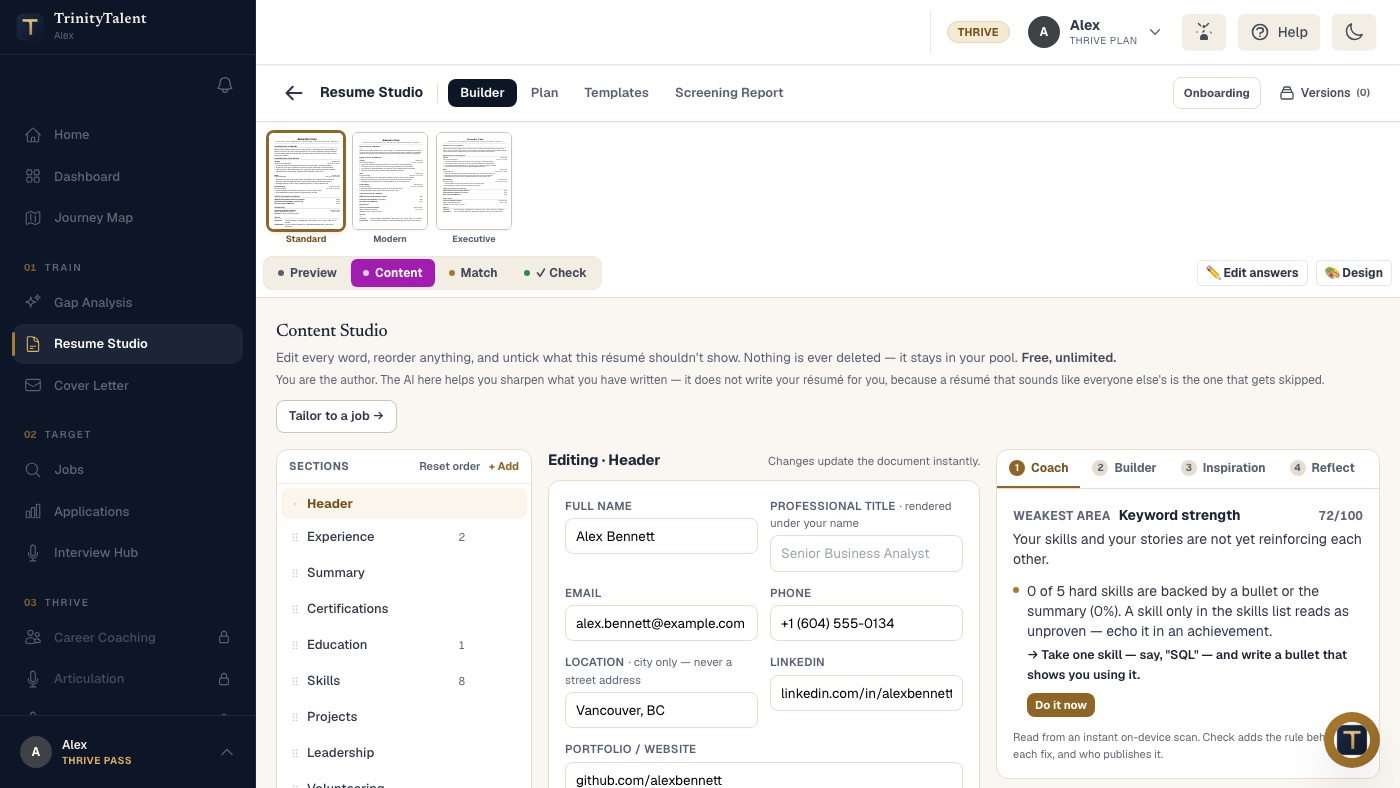
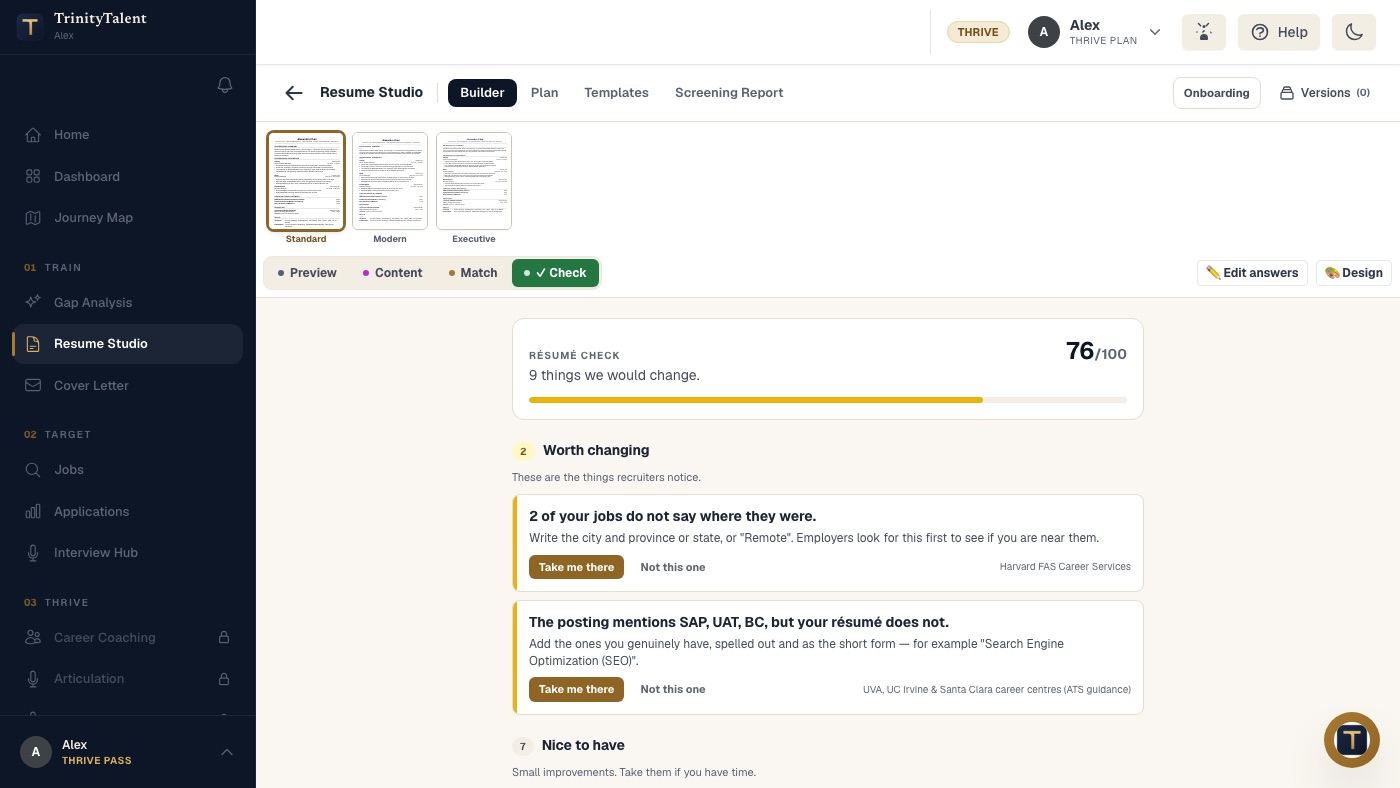
TrinityTalent's free resume builder is built around the bullet. In the Content tab you edit every line in place, reorder roles and bullets, and untick lines this version should not show; nothing is deleted, so hidden bullets stay in your pool for the next application. The rules-based Check runs on your device, is free, and flags what this guide describes: bullets with no verb, no number, a paragraph that should be three lines, tenses mixed under one job, and small numbers written both as words and digits. Each finding cites the career-centre guidance behind it and offers a one-click fix.
When you tailor the resume to a real posting, the builder rewrites bullets around that posting's language using only the facts already on your page, and you review every change before it is saved. Export to Word or PDF from a single-column, ATS-safe template. Building, editing and exporting your resume on TrinityTalent is free.
Frequently asked questions
How many bullet points should each job have on a resume?
Three to five for your most recent and most relevant roles, two for older ones, and one for a short contract. The strongest bullet goes first, because recruiters often read only the top line of each role before deciding whether to keep going.
Should resume bullet points be full sentences?
No. Drop the subject and start with the verb: "Reduced processing time by 30 percent", not "I reduced processing time by 30 percent." Full stops at the end are optional, but be consistent across the whole resume so it does not look careless.
What if my job had no measurable results?
Look for counts, frequency, scale, time and accuracy instead of revenue. Calls handled a day, staff trained, sites covered, error rate and time saved are all measurable. A careful estimate you can explain in an interview is acceptable; an invented figure is not.
Should I use the same bullet points for every application?
Keep a master list with every bullet you have written, then show the three to five per role that best match each posting. Hide the rest rather than deleting them. The facts stay the same; which ones you lead with changes with the job.
Put this into practice
Paste your resume into the free builder and run the Check tab. It flags bullets with no verb, no number or merged sentences, and you fix each one in place.
Build your resume free