
How Many Jobs to Apply to Per Day: A Realistic Plan
People ask how many jobs to apply to per day because the search feels like a numbers game, and in one sense it is. But the number that matters is not applications sent; it is applications that fit. The honest answer to how many jobs to apply to is three to five tailored applications a week for most people, with a plan for widening when the funnel says so. This guide explains why volume without fit fails, how to read your own funnel, which filters stop wasted effort, and when the right move is more applications rather than better ones.
TL;DR: Aim for three to five tailored applications a week, one a day, each to a posting where you meet most of the must-haves. Fifty untailored applications a week produce fewer interviews than five tailored ones and burn you out. Track every application by stage, read the funnel monthly, and widen your criteria only when fit is high and responses are still low.
Why fifty a week does not work
Sending a generic resume to every posting feels productive. It is not, for three reasons.
First, applicant tracking systems and recruiters both screen for fit against the posting's words. A resume not written for the posting ranks below the ones that were, so the fiftieth application is competing at a disadvantage against a handful of tailored ones.
Second, volume hides bad targeting. If you apply to everything, you never learn which role family responds to you, so you cannot fix the strategy.
Third, it is exhausting. Rejection at scale, with no signal about why, is the fastest route to stopping altogether. A sustainable pace is a pace you can keep for the three to six months a search often takes.
The number: one tailored application a day
One a day, five days a week, is a target most people can hold. Each application gets:
- Fifteen minutes reading the posting properly, marking must-haves and repeated phrases.
- Twenty to thirty minutes tailoring the resume from your base version.
- Ten minutes on a short cover letter where the form has a field.
- Five minutes recording the application, with the posting text saved.
That is about an hour of focused work. The rest of the day's job-search time goes to research, outreach and practice, not more applications. A companion article on building a weekly job search schedule shows how the blocks fit together.
If you genuinely cannot find one posting a day that fits, that is information. Either the criteria are too narrow or the role family is small, and both call for widening, covered below.
The funnel maths, with a worked example
A job search is a funnel: applications, then screens, then interviews, then offers. Ratios differ by field and level, so do not trust anyone who quotes you a universal number. Trust your own funnel after a month.
A fictional example. Amara Osei applied for 20 project coordinator roles in September. Six led to a recruiter screen, two to an interview, none to an offer. Her funnel is 20 to 6 to 2 to 0. The application-to-screen rate is healthy, which tells her the resume works. The screen-to-interview rate is weaker, which points at how she talks about her experience on the phone. The right fix is interview practice, not more applications.
Compare a second fictional case. Daniel Reyes sent 60 untailored applications in the same month and got two screens. His problem is at the top of the funnel: fit. The right fix is fewer, better-targeted applications, not more of the same.
Read your funnel stage by stage. The stage where the drop is steepest is the one to work on.
Filters that stop wasted applications
The fastest way to raise your ratio is to stop applying to postings you will not get. Before you tailor, check:
- Eligibility. Work authorization, licence, clearance, location, shift. A "no" on any of these ends the application at the knockout question.
- Must-haves. If you meet fewer than half, skip it. If you meet most, apply.
- Work arrangement. Remote, hybrid or on-site, and whether you can actually do it.
- Level. A posting that "owns" and "defines" is senior; one that "supports" is junior. Apply at your level and one step up.
- Posting age. A role open for many weeks may be filled internally or paused. Prefer fresh postings.
- Pay. Where a range is shown, decide before you apply whether you would accept the bottom of it.
When to widen
Widening means changing the criteria, not lowering the standard of each application. Widen when your fit is high and your response rate is still low after four to six weeks. Options, in order:
- Adjacent titles. A "business analyst" may also fit "process analyst", "operations analyst" and "reporting analyst" postings.
- Adjacent industries. The same role exists in sectors you have not searched.
- Level. One step down for a foot in the door, or one step up if the funnel shows screens but no interviews at your current level.
- Geography and arrangement. Hybrid roles within commuting distance, or remote roles registered in your province.
- Company size. Small employers post less on large boards and often read applications more carefully.
Do not widen by removing the tailoring step. That returns you to the fifty-a-week trap with a broader target.
Track every application
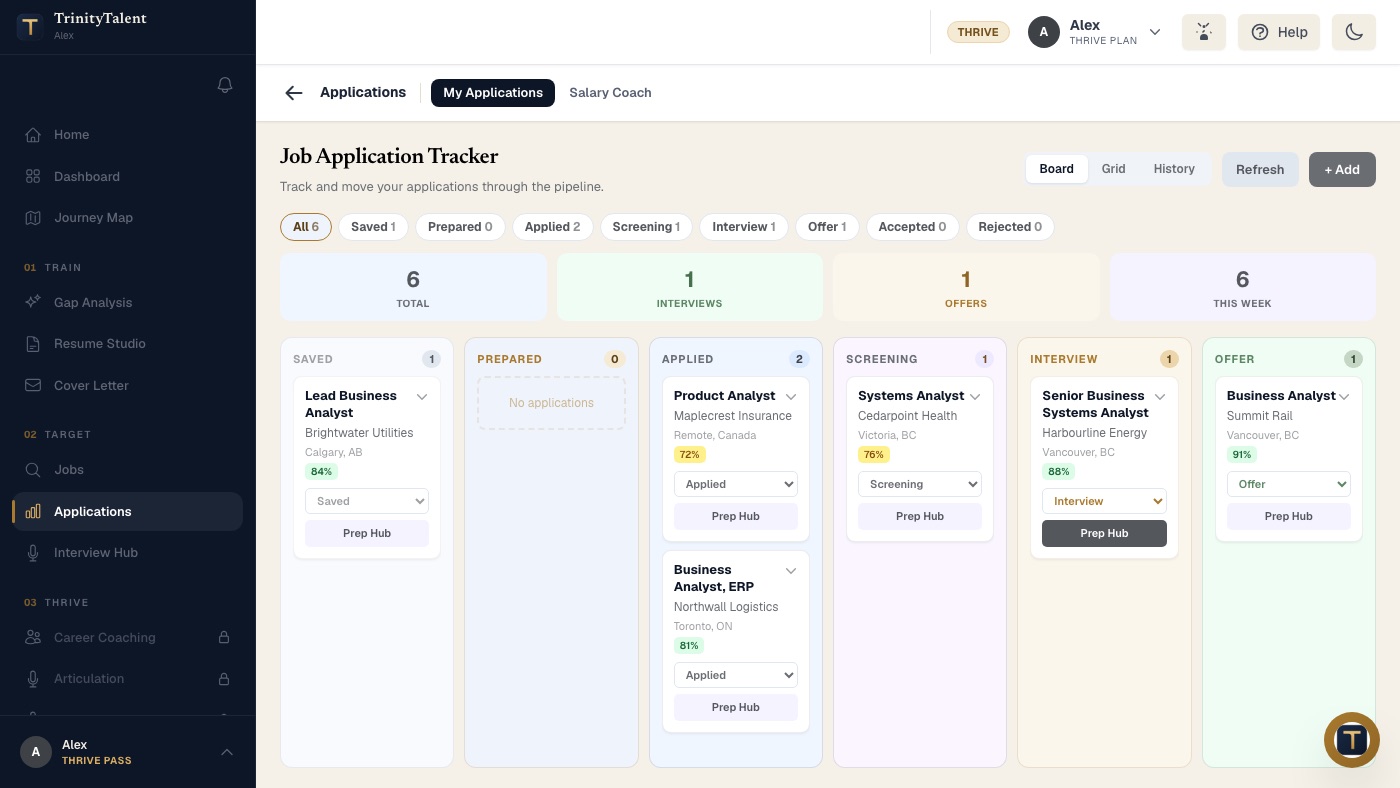
None of this works without a record. For each application, keep the posting text, the resume version sent, the date and the stage. Move the card as the stage changes. Once a month, count the cards at each stage and compare with the month before.
A tracker also stops double applications, which some employers treat as a red flag, and it tells you when to follow up. Our guide to organizing job applications covers the tracker in full.
A realistic weekly plan
- Monday to Friday: one tailored application per day, using the filters above before you start.
- Two mornings a week: thirty minutes of outreach, such as one message to a person at a company you have applied to.
- Two afternoons a week: thirty minutes of spoken interview practice.
- Friday: fifteen minutes updating the tracker and reading the funnel.
- Weekend: rest. The search runs for months and you need to be able to keep going.
Five good applications a week is 20 a month and 60 a quarter. For most people that is enough volume to read the funnel and enough time to make each one count.
How TrinityTalent helps
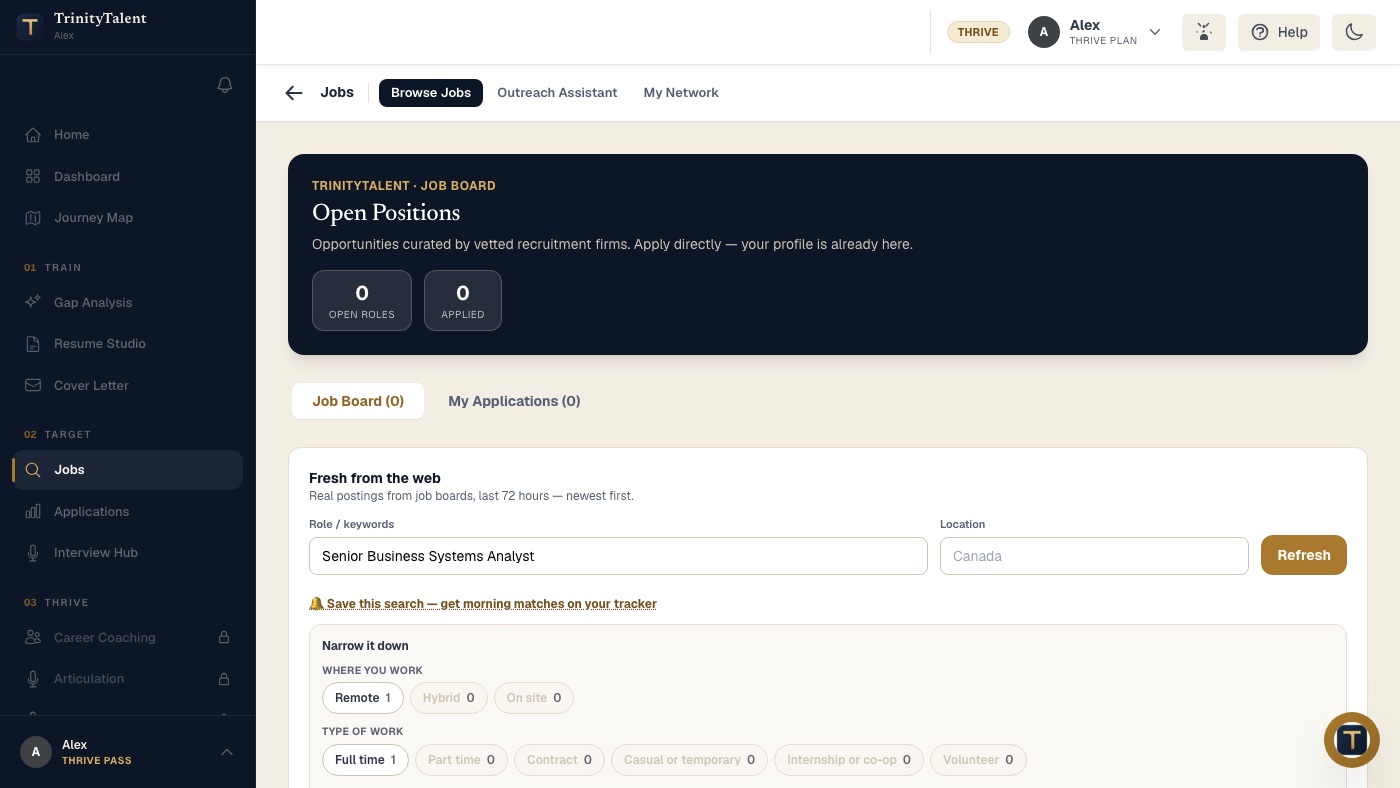
TrinityTalent's job board carries filters for work arrangement, type of work, level and whether the posting shows pay, each with a live count, so the eligibility step happens before you read a single posting in full. When a posting fits, the Match tab reads the real page and tailors your resume from your own facts in one pass, which is what makes one tailored application a day realistic. You review the result before anything is saved.
The Application tracker keeps each application on a board from Saved to Applied, Screening, Interview and Offer, storing the posting text and the resume version sent with each card, so the monthly funnel read is a count of cards per column. Resume editing and the on-device Check are free while the product is in beta, and nothing is ever submitted without you.
Frequently asked questions
How many jobs should I apply to per day?
One tailored application a day, five a week, is a realistic target for most people. Each takes about an hour: read the posting properly, tailor your resume, write a short cover letter if there is a field, and record it. More than that usually means the tailoring step is being skipped.
Is it better to apply to many jobs or a few tailored ones?
A few tailored ones. Screening, by software and by recruiters, is done against the posting's words, so an untailored resume competes at a disadvantage. Fifty generic applications a week typically produce fewer interviews than five tailored ones, and the rejection volume makes the search harder to sustain.
How do I know when to apply to more jobs?
Read your funnel by stage after four to six weeks. If your applications rarely lead to screens even though you meet the must-haves, widen your criteria: adjacent titles, adjacent industries, one level, geography or company size. If screens happen but interviews do not, the fix is practice, not volume.
Should I apply to a job if I do not meet all the requirements?
Yes, if you meet most of the must-haves and every eligibility item such as work authorization or a required licence. Postings describe an ideal candidate who rarely exists. Skip postings where you fail an eligibility item or meet fewer than half of the must-haves.
Put this into practice
Filter the job board to postings that fit, tailor your resume to each real posting in one pass, and track every application on the free board.
Tailor your resume to a posting