
A Weekly Job Search Schedule That Prevents Burnout

A job search schedule is a fixed weekly plan that says when you research, when you tailor and apply, when you reach out to people, when you practise, and when you stop. Without a job search schedule, most people do the same thing every day, which is scroll postings and apply to whatever appears, and they feel busy while the results stay flat. A schedule replaces that with time-boxed blocks, a small set of weekly numbers, and a rule for when the plan itself should change. This guide gives you a template for both a full-time and a part-time search.
TL;DR: Work in time-boxed blocks, not open-ended days: research, tailoring and applying, outreach, interview practice, and a hard stop. Aim for three to five tailored applications a week plus a fixed number of conversations. Track five numbers every Friday. Change the schedule only when two weeks of numbers say the same thing, not when one bad day does.
Why an open-ended search burns people out
Looking for work has no natural end to the day. There is always one more posting, one more profile to polish, one more message to send. People who search all day feel guilty when they stop and unproductive when they continue, and after a month the search itself becomes the thing they avoid.
A schedule fixes this by making the day finite. When the block ends, the work ends, and stopping is part of the plan rather than a failure.
The five blocks
Every productive search has the same five kinds of work. The schedule just gives each one a time and a limit.
- Research (about 20 percent of your time). Finding roles worth applying to, reading postings properly, learning about the employer. Use filters so you stop wasting time on postings that fail an obvious requirement; how many jobs to apply to explains why volume is the wrong target.
- Tailoring and applying (about 30 percent). One posting at a time: match the resume to it, write the letter if there is a field, complete the form, save the posting text. One tailored application is worth several generic ones.
- Outreach (about 20 percent). Messages to recruiters, hiring managers and contacts, informational interview requests, follow-ups on their due dates.
- Practice (about 15 percent). Spoken answers to common questions, one mock interview a week, reviewing a recording.
- Review and rest (about 15 percent). A weekly review of the numbers, and real time off with the search closed.
The percentages shift with the stage. Early on, research is heavier. Once interviews start, practice grows and research shrinks.
A full-time search: the weekly template
This assumes you are not working and can give the search about 25 focused hours. More is not better; the quality of the tailoring drops after about five hours in a day.
- Monday. 9:00 to 11:00 research and shortlist five postings. 11:00 to 12:00 outreach: two new messages, any follow-ups due. 1:00 to 3:00 tailor and submit two applications.
- Tuesday. 9:00 to 12:00 tailor and submit two applications. 1:00 to 2:00 practice: spoken answers to three questions, recorded. 2:00 to 3:00 research for later in the week.
- Wednesday. 9:00 to 10:00 outreach and follow-ups. 10:00 to 12:00 one application, done well. Afternoon off.
- Thursday. 9:00 to 11:00 research and shortlist. 11:00 to 12:00 one informational interview or the request for one. 1:00 to 3:00 practice: a full mock interview and a review of it.
- Friday. 9:00 to 11:00 clean-up: any application still open, any follow-up due. 11:00 to 12:00 weekly review. Afternoon off, search closed until Monday.
That is five tailored applications, four to six outreach messages, two practice sessions and one conversation, in 25 hours, with the weekend left alone.
A part-time search while working
If you are employed, the search gets about eight hours a week, and the schedule has to protect your current job.
- Two weekday evenings, 90 minutes each. One evening for research and shortlisting, one for tailoring and submitting one or two applications.
- One weekday lunch, 30 minutes. Outreach and follow-ups, from your own phone or laptop, never a work device.
- Saturday morning, three hours. Two applications, one practice session with a recording, and the weekly review.
- Sunday. Nothing.
The target drops to two or three tailored applications a week. That is enough, because each one is aimed.
What to track every Friday
Five numbers, written down in the same place each week. They tell you what to change.
- Applications submitted, and how many were tailored to the posting.
- Outreach messages sent, and how many got a reply.
- Conversations held (informational interviews, recruiter calls).
- Interviews scheduled, by stage.
- Hours spent, honestly.
Keep the numbers next to the applications themselves, so a card that moves from Applied to Screening is a number changing. The pattern across weeks matters more than any single week; see how to organize your job applications for the tracker side.
When the schedule should change
Do not change the plan after one bad week. Change it when two consecutive reviews show the same pattern.
- Applications but no screens for three weeks. The resume or the targeting is the problem, not the volume. Move time from applying to fixing the resume against the postings you are not getting.
- Screens but no second interviews. The spoken answers are the problem. Move time from research to practice.
- Replies to outreach but no applications result. You are talking to the wrong people. Target the teams that are actually hiring.
- Hours climbing past the plan. Cut the research block first.
- Nothing for a month. Widen the target role or the location one notch, and read the layoff comeback plan if the search followed a job loss.
Protect the rest block
The rest block is not a reward for a good week. It is what keeps the other blocks working in week eight. Close the laptop, silence the job alerts, and do something that is not the search. A search that lasts three months needs a person who is still functioning in month three.
How TrinityTalent helps
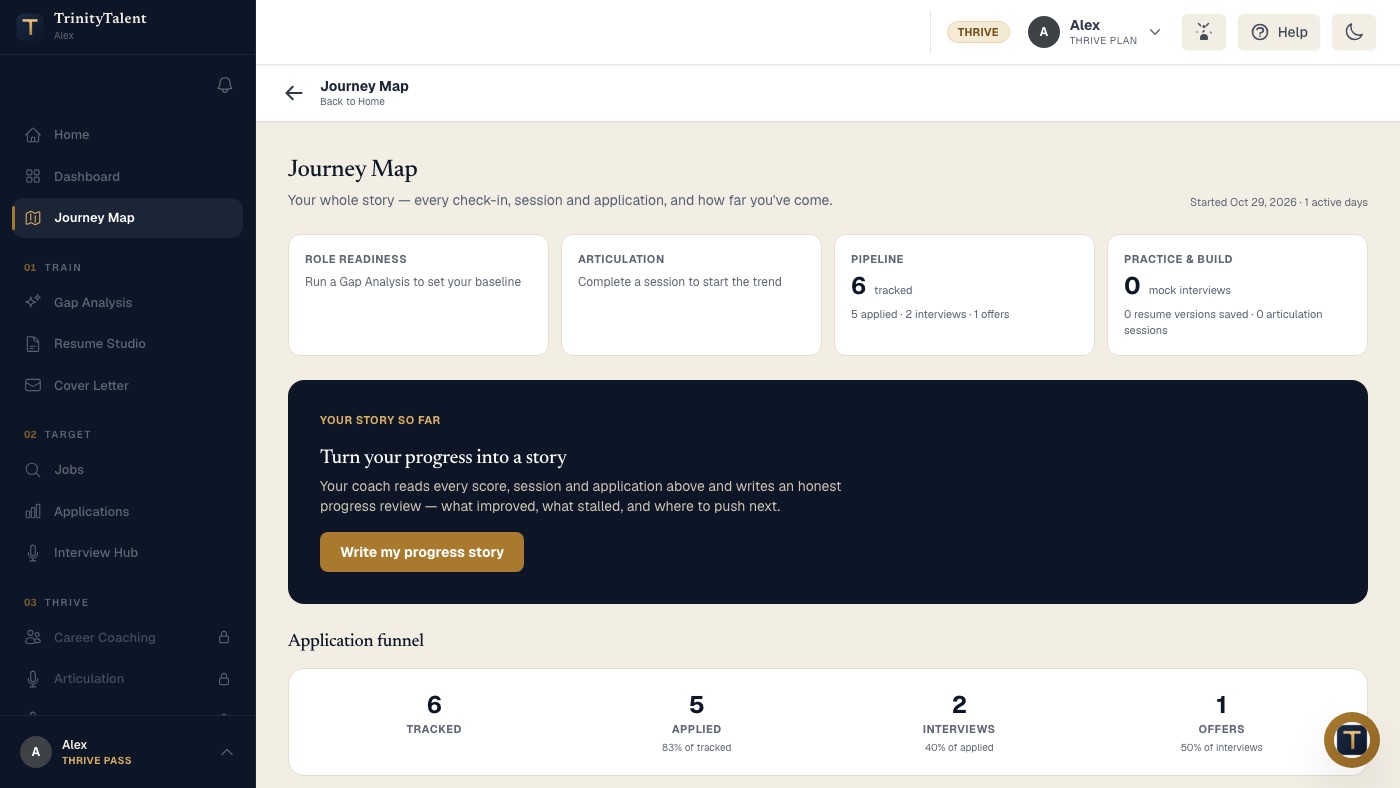
TrinityTalent's Journey Map is the progress record the Friday review needs. It keeps your readiness scores over time, your practice sessions, your application funnel and your milestones in one story, so the five weekly numbers are already there rather than reconstructed from memory. The Application tracker moves each card from Saved to Applied to Screening to Interview to Offer and keeps the posting text and the resume version you sent on the card.
The blocks themselves are shorter in the product: tailoring a resume to a real posting is one pass from your own facts, the cover letter comes from the resume and the posting, and the practice block has a live spoken mock interview plus 700+ rapid-fire questions. Nothing is ever applied or sent for you. Building, editing and exporting your resume on TrinityTalent is free.
Frequently asked questions
How many hours a week should I spend on a job search?
About 25 focused hours if you are not working, spread over five weekdays with afternoons and weekends protected. About eight hours if you are employed, in two evenings, one lunch break and a Saturday morning. More hours rarely produce more interviews; the quality of tailoring drops after about five hours in a day.
What should a daily job search schedule look like?
Two or three time-boxed blocks with a hard stop: for example, two hours of research and shortlisting, one hour of outreach and follow-ups, and two hours of tailoring and submitting one or two applications. Practice gets its own block twice a week. When the last block ends, the search is closed for the day.
How do I stay motivated during a long job search?
Make progress visible and finite. Track five numbers each Friday, keep real days off, and change one thing only when two weeks of numbers point the same way. Motivation follows evidence of movement, and a schedule produces that evidence even in weeks when the inbox is silent.
How often should I change my job search strategy?
Review weekly but change only after two consecutive weeks show the same pattern. Applications without screens point to the resume or targeting; screens without second interviews point to spoken answers; a month of nothing means widening the target by one notch. One bad week is noise, not a signal.
Put this into practice
The Journey Map records every application, practice session and check-in in one place, so your weekly review takes five minutes instead of an hour.
Build your resume free