
Upskilling vs Reskilling: Which One Your Career Needs
The upskilling vs reskilling question sounds like a vocabulary lesson, but the answer decides how you spend the next six months. Upskilling vs reskilling comes down to one distinction: upskilling deepens the skills for the path you are already on, while reskilling builds a new set of skills for a different role. Most people who feel stuck need one of these, not both, and the wrong choice costs time and money. This guide defines each, shows when each applies, and gives a method for deciding from real postings instead of trend articles.
TL;DR: Upskilling means getting better or more current in your existing path: new tools, a higher level, a specialism. Reskilling means learning a new set of skills for a different role. Decide by comparing postings for the next role in your path with postings for the role you are curious about, and counting how much of each you can already prove. Learn free first, build a project, avoid collecting certificates.
The definitions, plainly
Upskilling is adding depth or currency to what you already do. A payroll specialist who learns the new version of the payroll system, a nurse who trains in a specialised unit, a junior accountant who moves toward a designation: all upskilling. The role family stays the same. The level or the breadth grows.
Reskilling is building the skills for a different role family. A retail store manager becoming a logistics coordinator, a teacher becoming a corporate trainer, a customer service lead becoming a business analyst: all reskilling. Much of the previous experience transfers, but the core skills the new role requires are new.
The distinction is about the target, not about how hard the learning is. Some upskilling is harder than some reskilling.
When upskilling is the right answer
Upskilling fits when you like the work, the role family is stable or growing in your region, and the thing standing between you and the next level is a specific, nameable skill or credential. Signs:
- Postings for the next level in your path list two or three requirements you cannot yet prove, and the rest you can.
- Your current employer has a role above yours that you would take.
- Your industry is changing its tools, and the people who learn the new tool early become the people others ask.
Example
Amara has been a marketing coordinator for three years. Postings for marketing specialist roles ask for the same skills she has, plus experience running paid campaigns and reporting on them. That is a two-item gap in a path she enjoys. Upskilling, with a small paid campaign for a local nonprofit as the project, closes it in a season.
When reskilling is the right answer
Reskilling fits when the role family itself is the problem: it is shrinking in your region, it no longer suits your life, or you have found work you want to do that sits in a different family. Signs:
- Postings for your current role are fewer each year, or pay has stalled.
- You have tried the next level and do not want it.
- You keep volunteering for tasks that belong to another team.
Example
Tomas has managed a retail store for eight years. Store manager postings in his area are down, hours are hard on his family, and he enjoys the scheduling, inventory and vendor work most. Logistics coordinator postings ask for inventory systems, carrier scheduling and basic data reporting. He can prove about half of that list today. That is reskilling, with a large transferable base.
Decide from postings, not from trends
Trend articles will tell you what skills are "in demand" nationally. Postings tell you what employers in your region will pay for this quarter. Use postings.
- Collect ten current postings for the next role in your current path, and ten for the role you are curious about.
- List every skill each set names, and count how often each appears.
- For each list, mark the skills you can prove with a project, a result or a responsibility. Count the core skills, those in most postings, that you can prove.
- Compare. If you can prove most of list A and less than half of list B, upskilling is the shorter path. If list B is not much further away than list A, and you prefer the work, reskilling is realistic.
This is a two-role skills gap analysis. The result is a decision you can explain in an interview: "I chose this direction because I could already show most of what the role asked for."
Learn free first, then pay only for what postings require
For either path, start with free and official sources: vendor documentation, public university courses, library access to learning platforms, professional association material. Free resources let you test whether you like the work before you commit money to it.
Pay for a course or certification only when the postings you collected explicitly require it. A certification that appears in eight of ten postings is a requirement. One that appears in one is a preference you can ignore, however loudly it is advertised.
Prove new skills with projects, not certificates
A certificate says you attended. A project says you can do it. Every skill you learn should end in an artefact you can show and a two-minute story you can tell:
- A dashboard built on a public dataset, with a short write-up of what it shows.
- A process map for a real workflow you know, with the bottleneck identified.
- A campaign run for a community group, with the before-and-after numbers.
- A small tool or automation that saved someone an hour a week.
The artefact becomes a resume bullet, an interview story and, for reskillers, the bridge that makes a career change believable. Our guide on transferable skills for a career change covers how to describe the older experience in the new role's words.
Avoid certificate collecting
The most common failure in both paths is accumulating badges without a target. Five introductory courses in five tools produce a profile that looks busy and proves nothing. Fix the target role first, collect the postings, pick the two or three gaps that appear most often, and finish those, each with a project. Then re-run the comparison. If you are already competitive, stop learning and start applying.
How TrinityTalent helps
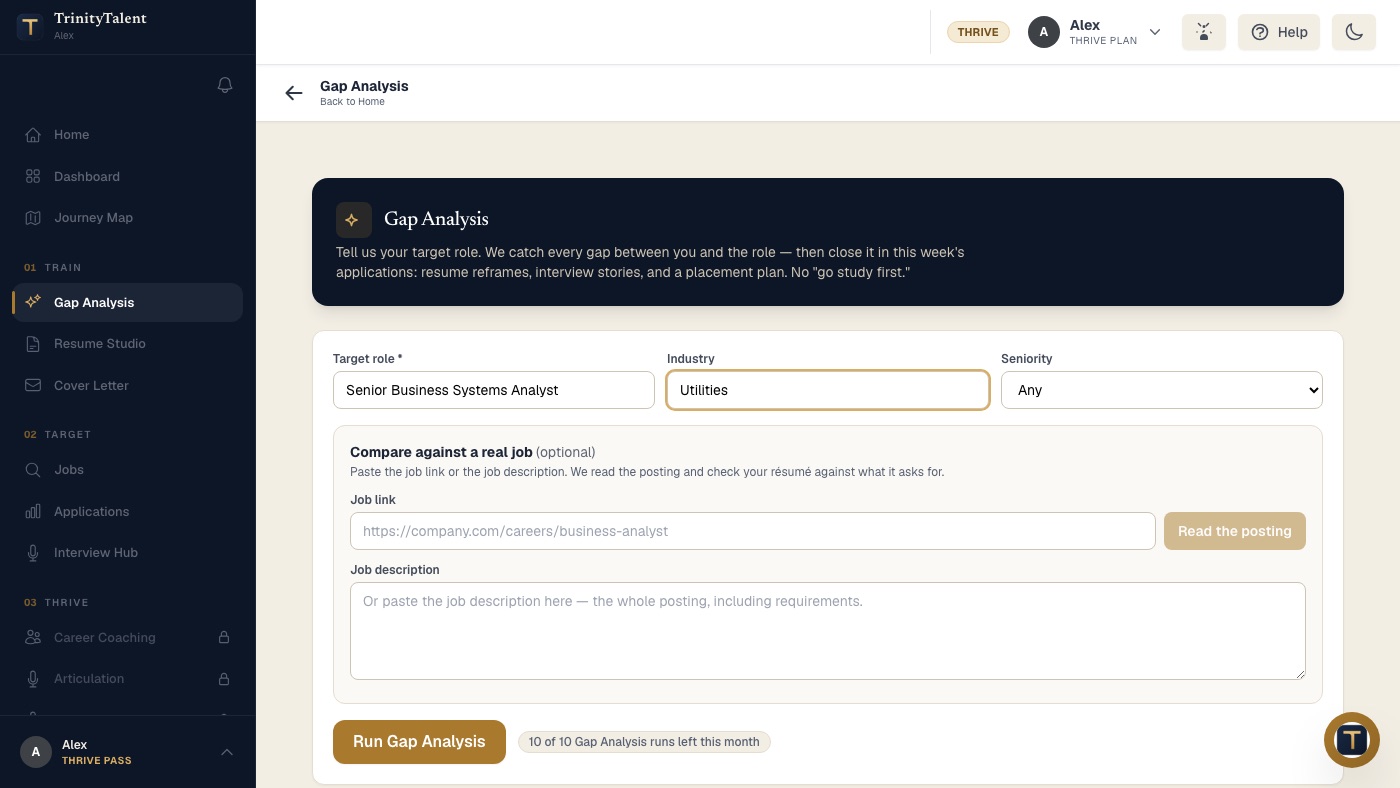
TrinityTalent's Gap Analysis is built for exactly this decision. You enter a target role, and it returns a readiness score, a ranked list of specific gaps and a dated 90-day plan with free and official resources first. Run it once for the next role in your current path and once for the role you are curious about, and the two readiness scores show whether you are looking at upskilling or reskilling. Paid courses appear only as non-endorsed examples, and a certification is recommended only when target-role postings explicitly require it.
For reskillers, the placement-first design matters: it mines your existing experience for transferable evidence and reframes it for the new role, rather than telling you to go and study first. Readiness is charted across runs, so you can see the score move as projects land. Free to build, edit and export your resume. AI tailoring, interview practice and coaching run on prepaid passes, and nothing renews by itself.
Frequently asked questions
What is the difference between upskilling and reskilling?
Upskilling adds depth or currency to the skills for the role family you are already in, such as a new tool, a higher level or a specialism. Reskilling builds the core skills for a different role family. The difference is the target, not the difficulty; some upskilling is harder than some reskilling.
How do I know if I should upskill or reskill?
Collect ten postings for the next role in your current path and ten for the role you are curious about. Count the core skills in each list that you can already prove. If you can prove most of the first list and less than half of the second, upskilling is shorter. If the second is close and you prefer the work, reskilling is realistic.
Is reskilling worth it later in a career?
Often, yes, because experienced people carry a large base of transferable skills, such as managing people, budgets, vendors and deadlines, that the new role also needs. The core technical gap is usually smaller than it feels. Measure it with postings, close the two or three gaps that appear most, and prove them with a project.
Should I pay for a certification to upskill?
Only when the postings you collected explicitly require it. A credential named in most postings is a requirement. One named by a single employer is a preference. Start with free and official material to test whether you like the work, and spend money on the credential only after the market has told you it matters.
Put this into practice
Run the free Gap Analysis against your target role to see whether your gaps are a few missing skills or a whole new set, and get a 90-day plan either way.
Build your resume free