
Skills Gap Analysis: How to Do One for Your Own Career
A skills gap analysis is the difference between a job search that guesses and one that knows. In a personal skills gap analysis you name a target role, list the skills that real postings for that role demand, find the evidence in your own history for each one, rank what is missing by how much it matters, and turn the top gaps into a dated plan. Companies do this for whole workforces. This guide shows how to do it for one career, in an afternoon, with a spreadsheet and ten postings.
TL;DR: Pick one target role. Collect ten current postings and list every skill they name, counting how often each appears. For each skill, write down your strongest evidence, or mark a gap. Rank the gaps by frequency and by how hard they are to fill. Build a 90-day plan for the top two or three, free resources first, and re-run monthly.
Step one: choose one target role
A skills gap analysis needs a fixed point. "Something in data" produces a list too long to act on. "Business systems analyst, mid-level, in a utilities environment" produces a list you can finish. If you are choosing between two roles, run two analyses; one will show fewer or cheaper gaps. Write the role, the level and the sector at the top of a sheet.
Step two: build the required-skills list from real postings
Do not start from a course catalogue or a trends article. Start from postings, because postings are what the hiring manager actually wrote down.
- Collect ten current postings for the role, from at least four different employers, in the region where you want to work.
- Copy every skill, tool, qualification and responsibility each posting names into a column. Keep the employer's words.
- Merge duplicates and near-duplicates, then count how many of the ten postings mention each item.
- Sort by count. Anything in seven or more postings is core. Three to six is common. One or two is a preference of one employer.
Example
Malik wants a mid-level business systems analyst role. From ten postings he lists 34 distinct items. Nine mention requirements gathering and stakeholder workshops. Eight mention SQL. Seven mention process mapping and a specific ERP family. Five mention data visualisation tools. Two mention a particular certification. Only the top group needs to be closed for him to be a credible candidate; the certification is a nice-to-have that one employer wants.
Step three: match your evidence, honestly
Add a column beside each skill and write your strongest single piece of evidence: a project, a result, a responsibility, a course with a graded assignment. Evidence is something you could describe for two minutes in an interview and that a reference could confirm. "Familiar with SQL" is not evidence. "Wrote the weekly reconciliation queries for a 40,000-row billing table for 14 months" is.
Rate each row:
- Strong: you have done this at the level the role requires and can prove it.
- Partial: you have done something adjacent, at a smaller scale, or in a different tool.
- Gap: no evidence.
Be strict here. Overrating a skill moves the gap into the interview, where it costs more. Career changers often find more partial rows than they feared; the guide to transferable skills for a career change shows how to describe adjacent evidence in the target role's words.
Step four: rank the gaps by impact
Not every gap matters equally. Score each gap on two things:
- Frequency: how many of the ten postings asked for it. A gap in a core skill blocks most applications; a gap in a preference blocks one.
- Cost to close: hours and money. Some gaps close in a weekend with free documentation and a small project. Some need a course of several months. Some need employment in the role, which means they are closed on the job, not before it.
Rank by frequency first, then cost. The result is usually two or three gaps worth working on now, a few to close on the job, and several to ignore. Malik's top gaps were SQL at a working level and the ERP family. Data visualisation was partial and ranked lower. The certification was ignored.
Step five: a 90-day plan, free resources first
Turn each top gap into a dated plan with three parts.
- Learn, from free and official material first: vendor documentation, public courses, library resources. Paid courses are worth considering only when postings explicitly require the credential.
- Build, a small project that produces an artefact: a query set against a public dataset, a process map for a real workflow you know, a short write-up. The artefact becomes a resume bullet and an interview story.
- Prove, by getting the work in front of someone: a colleague who does the job, a volunteer organisation, a portfolio page.
Assign dates. Malik gives SQL weeks one to six, with a project in week five, and the ERP family weeks five to twelve, using the vendor's free training portal and a process-mapping exercise from his current role.
Re-run the analysis monthly
A gap analysis is a measurement, not a one-time exercise. Every month, re-rate your rows against the same list, and refresh the posting sample if the market has moved. Two numbers tell you whether the plan works: how many core skills are rated strong, and how many applications reach an interview. If the first rises and the second does not, the gap is in how you present the evidence.
Keep a simple readiness score: strong rows as a percentage of core rows. Watching it move from 55 to 80 percent over three months is more motivating than any course badge, because it is measured against what employers asked for.
Mistakes that waste the effort
- Analysing against a job title instead of postings. Titles vary; requirements are specific.
- Using one posting. One employer's preferences look like the whole market.
- Rating yourself on what you know instead of what you can show. Evidence is the unit.
- Closing gaps in the order they are easiest. Close the ones that appear most often.
- Collecting certificates instead of building artefacts. A project you can talk about beats a badge you cannot.
- Never re-running it. Progress you do not measure is progress you cannot describe.
How TrinityTalent helps
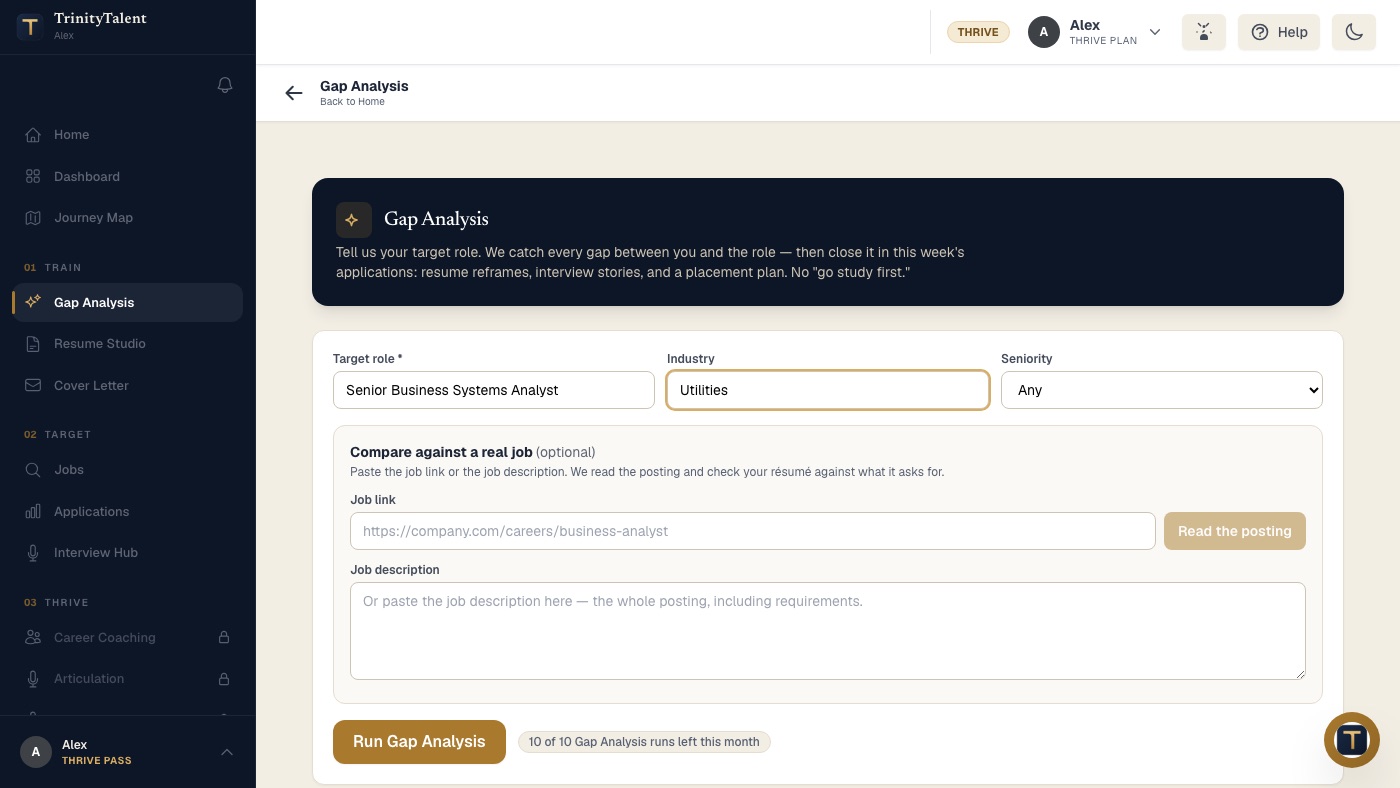
TrinityTalent's Gap Analysis runs these five steps from your resume. You enter the target role and, optionally, paste a real posting or its link, and it returns a readiness score, a ranked list of specific gaps, a description of what excellence looks like in the role, and a dated 90-day plan with free and official resources first. Paid courses appear only as non-endorsed examples, and a specific certification is recommended only when target-role postings explicitly require it.
The analysis is built to be re-run monthly, and readiness over time is charted so you can see the score move across runs. The Journey Map records those scores beside your practice sessions and application funnel, so the number you improve is connected to the interviews you get. Free to build, edit and export your resume. AI tailoring, interview practice and coaching run on prepaid passes, and nothing renews by itself.
Frequently asked questions
What is a skills gap analysis for an individual?
It is a structured comparison between the skills a target role requires and the evidence you have for each one. You list requirements from real job postings, rate your evidence as strong, partial or missing, rank the gaps by how often they appear and how hard they are to close, and build a dated plan for the top few.
How do I identify my own skill gaps?
Collect ten current postings for one target role, list every skill they name, and count how often each appears. For each skill, write down your strongest single piece of evidence. Any core skill, one named in most postings, where you have no evidence you could describe in an interview is a gap worth working on.
How often should I repeat a skills gap analysis?
Monthly while you are actively working toward a role, using the same skills list so the comparison is fair. Refresh the posting sample every few months in case the market has moved. Track the share of core skills rated strong as a readiness score, and watch whether applications reaching interviews rise with it.
Do I need to close every skill gap before applying?
No. Close the two or three gaps that appear in most postings and can be filled in weeks. Gaps that need on-the-job experience are closed after you are hired, and gaps named by only one employer can usually be ignored. Apply once your core skills are mostly rated strong, not when the list is empty.
Put this into practice
Enter your target role in the free Gap Analysis to get a readiness score, ranked gaps and a dated 90-day plan built from your resume.
Build your resume free