
Talking Too Fast in Interviews: How to Fix Your Pace
Talking too fast in interviews is one of the most common delivery problems and one of the few with a measurable fix. Nerves push the pace up, the listener loses the thread, and the candidate finishes with the feeling that the answer went badly without knowing why. If you have been told you are talking too fast in interviews, the solution is not to "relax". It is to know your number, put pauses where the punctuation is, and use an answer structure that removes the reason to rush. This guide covers all three.
TL;DR: A comfortable interview pace is about 140 to 160 words per minute. Record a 60-second answer and count the words to find yours. Pause one beat at every comma and two at every full stop. Answer the question in one sentence first, so you are never racing to the point. Measure again after a week; the number, not the feeling, tells you whether it worked.
Why nerves speed you up
Under stress, the body prepares to act. Breathing becomes shallow, the heart rate rises, and speech accelerates because the brain treats the moment as something to get through. Fast speech also fills silence, and silence feels dangerous when you are being judged.
There is a second cause that has nothing to do with nerves. Many people rush because they have not decided what the point of their answer is. They start talking to find it and speed up as they go. Both causes look the same and have different fixes: the first needs pauses, the second needs structure.
Know your number
Most conversational speech sits between 120 and 160 words per minute. A pace around 140 to 160 is a common coaching target for interviews: fast enough to sound engaged, slow enough for the listener to process each sentence. Above 180, most listeners begin to lose detail. Above 200, they stop trying.
To find yours, record a 60-second answer to "Tell me about yourself" on your phone and count the words from a transcript. That number is your baseline, and it is usually a surprise, because fast speech feels normal from the inside. Write it down. Everything below is a way to move it, and the only proof it moved is measuring again.
Pause at the punctuation
Slowing down by stretching each word sounds unnatural and is hard to sustain. Slowing down by pausing at the punctuation is natural, because that is how written language already marks where a reader would breathe.
The rule is simple. One beat at every comma. Two beats at every full stop. A full breath between the paragraphs of an answer, which in speech means between the answer, the evidence and the close.
Try it with this sentence from a fictional answer: "I took over the vendor reconciliation in March, cleared the backlog by June, and cut the monthly close from nine days to five." Say it without pauses and it takes about eight seconds and sounds like a list read aloud. Say it with a beat at each comma and it takes about eleven seconds and sounds like a person who knows what they did.
Pauses have a second benefit: they are where fillers would go. A speaker who pauses at the punctuation rarely says "um", because the mouth is closed at exactly the moments the brain is catching up. /blog/stop-saying-um/ covers that connection.
Answer first, so there is nothing to race toward
The second cause of fast talking, not knowing the point, disappears when you decide the point before you speak. Use a three-part shape for every answer:
- Headline. One sentence that answers the question directly.
- Proof. Two or three sentences of evidence: what you did, how, and what changed.
- Close. One sentence that connects it to the role you are interviewing for.
When the first sentence is the answer, the rest of the response is support, and support can be delivered at any pace. You are no longer running to reach the conclusion, because you already gave it.
A worked example
Question: "How do you handle competing deadlines?"
Rushed, unstructured: "So, um, there is usually a lot going on, and I kind of try to figure out what is most urgent, like last quarter we had the audit and the board pack at the same time and I was kind of juggling both and I ended up staying late a few nights but we got it done and..."
Answer first, at pace: "I rank by consequence, not by who asked loudest. Last quarter the audit and the board pack landed in the same week. I confirmed with my manager that the audit deadline was fixed and the board pack could move by two days, then worked the audit first. Both went out complete. The habit I bring is checking which deadline is actually fixed before I start."
The second version is 62 words. Spoken at 150 words per minute with pauses, it takes about 25 seconds and lands every point. The first was still speeding up when it ran out of road.
A one-week practice plan
- Day one: measure. Record a 60-second answer, count the words, write down the number.
- Days two and three: punctuation pauses. Take three answers from your resume, write them out with commas and full stops, and read them aloud with one beat and two beats. Record each once.
- Days four and five: answer first. Take five common interview questions and write the headline sentence for each. Practise saying the headline, pausing, then the proof.
- Day six: combine. Record two full answers with both techniques. Do not read; speak from the headline.
- Day seven: measure again. Record the same 60-second answer as day one. Count. Compare.
The habit takes longer to hold under pressure than to learn, so repeat the measurement before each real interview.
What not to do
- Do not slow every word. It sounds like a recording played at the wrong speed. Slow the gaps, not the words.
- Do not count in your head while speaking. You will lose the thread. Measure recordings, not live speech.
- Do not aim for slow. Aim for the range. Below 120 words per minute sounds hesitant, which is a different problem.
- Do not fix pace and fillers and structure at once. Pick one for the week. Measure. Then the next.
How TrinityTalent helps
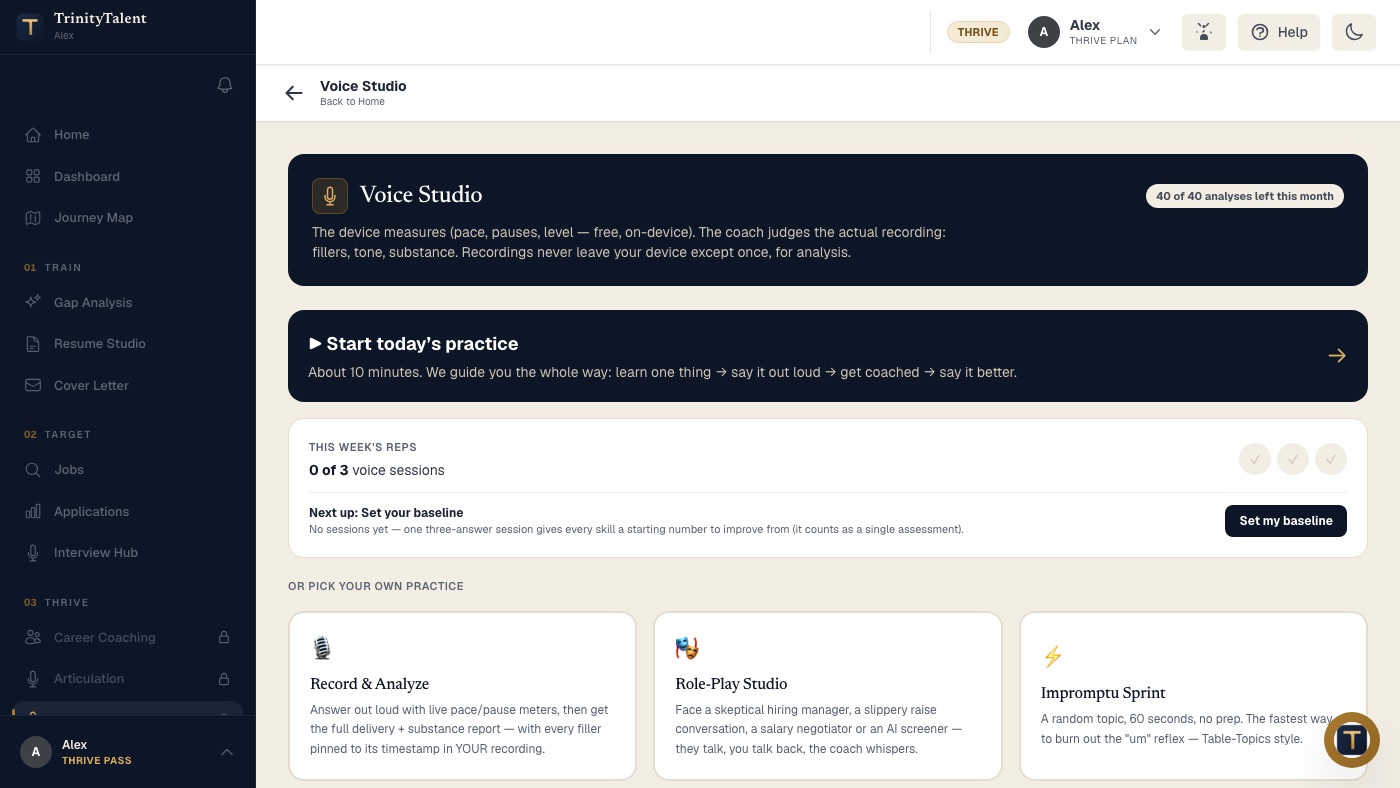
Voice Studio in TrinityTalent measures pace from the actual recording, not from a transcript you type yourself. You record an answer, and it reports your words per minute, your pauses and your filler words, with a verbatim transcript that shows each filler where it happened. That gives you the day-one number and the day-seven number without counting by hand. The recording stays on your device. ESL Clarity Mode coaches clarity and pace and never comments on accent. When you are ready to test the new pace under pressure, the Interview Hub's mock interview puts you in front of a live spoken interviewer, and the Fire Round's bank of more than 700 questions gives short, timed practice. All of it is free while the product is in beta, with no credit card required.
Frequently asked questions
What is a good speaking pace for an interview?
A common coaching target is 140 to 160 words per minute. That range sounds engaged without losing the listener. Below 120 tends to sound hesitant; above 180, most listeners begin to lose detail. Find your own number by recording a 60-second answer and counting the words, then practise toward the range rather than toward "slow".
How do I know if I am talking too fast in interviews?
Measure it. Record a one-minute answer to a common question and count the words in the transcript. If the number is above 180, you are likely being heard as rushed. Other signs include interviewers asking you to repeat things, running out of breath mid-sentence, or finishing answers without remembering what you said.
Why do I talk faster when I am nervous?
Stress shortens the breath and raises the heart rate, and the brain treats the moment as something to get through, so speech accelerates to fill the silence. Rushing also happens when you have not decided the point of your answer and are talking to find it. Pauses at the punctuation fix the first cause; an answer-first structure fixes the second.
Will slowing down make me sound less enthusiastic?
No. Enthusiasm comes from specific content and a voice that varies in tone, not from speed. A well-paced answer with a clear headline, real numbers and a confident close sounds more engaged than a rushed one, because the listener can actually follow it. Fast speech is heard as nerves far more often than as energy.
Put this into practice
Record a 60-second answer in Voice Studio and read your measured words per minute before you try to slow down.
Practise a mock interview