
How to Sound Confident in an Interview (Even When Nervous)
You do not need to feel calm to sound confident in an interview. Confidence, as a listener hears it, is a small set of mechanical habits: a steady pace, pauses where fillers would go, sentences that end by going down rather than up, and shorter sentences that finish. Each one can be practised. Most people who sound confident in an interview are nervous too; the difference is that their nerves do not reach their voice. This guide explains the five habits, what confidence is not, and how to hear your own progress.
TL;DR: Slow down to a pace where you can finish every word. Replace "um" and "like" with a silent pause. End statements with a falling tone, not a rising one. Keep sentences under 20 words and finish them. Breathe out before you answer. Volume is not confidence. Record yourself, listen once for each habit, and fix one at a time.
What listeners hear as confidence
Interviewers cannot see your heart rate. They hear your voice and infer a state from it. Listeners judge speakers as more credible when the pace is steady, the pauses are silent rather than filled, statements end with a downward tone, and sentences are complete. None of these signals require you to feel anything. They are habits of delivery, and anyone can learn them in any accent.
This matters for two groups in particular. People who are naturally quiet often believe confidence means becoming louder. People who speak English as a second language often believe it means sounding like a native speaker. Neither is true. Clarity and pace are the whole job.
Habit one: slow the pace
Nerves speed you up. The heart rate rises, the breath shortens, and words come faster because you want the answer to be over. The listener hears rush, and rush reads as uncertainty.
The fix is not to speak slowly in a general way, which sounds artificial. It is to finish every word. Say the last consonant of each word before you start the next one. That alone brings most people down to a comfortable pace without thinking about speed. If you talk quickly by habit, /blog/talking-too-fast-in-interviews/ goes deeper on measuring and fixing it.
Habit two: pauses instead of fillers
"Um", "uh", "like", "you know" and "so" at the start of a sentence are all the same thing: sound produced while the brain catches up. Fillers are not a moral failing, but a listener counts them without meaning to, and a high count reads as unprepared.
The replacement is silence. When you feel a filler coming, close your mouth for one second. A one-second pause feels enormous to the speaker and barely registers with the listener. It also reads as thinking, which is a confident thing to be seen doing. /blog/stop-saying-um/ has a full drill for this.
Habit three: end sentences downward
Listen to how you say "I led the migration." If your tone rises at the end, it sounds like "I led the migration?", a question, as though you are asking the interviewer to confirm it. This rising pattern is common under stress and it undercuts every fact you state.
Practise with three sentences from your resume. Say each one and let your voice drop on the final word, the way you would say "That is done." Record it. The difference between the rising and the falling version is the difference between hoping and knowing.
Habit four: shorter sentences that finish
Nervous speakers join sentences with "and" and "so" until the sentence never ends. The listener loses the point and the speaker loses the breath. Both sound uncertain.
Aim for sentences under 20 words. Make a full stop. Start the next one. This is easier if you use the answer-first structure: one sentence that answers the question, then two or three that prove it, then one that closes. Each part is a natural place to stop.
A worked example
Question: "Tell me about a time you handled a difficult customer."
Nervous version: "So there was this one time when a customer was really upset about a delivery and I was like trying to figure out what happened and so I checked the system and it turned out the address was wrong and so I, um, called the courier and..."
Confident version: "A customer's delivery went to the wrong address, and she was angry when she called. I checked the order and found the address error was ours. I called the courier, arranged a same-day redelivery, and phoned her back within the hour to confirm. She renewed her contract the following month."
Same story. Same person. The second version has shorter sentences, no fillers, a clear ending, and it took less time to say.
Habit five: breathe out first
Most people breathe in before they answer, which raises the shoulders and tightens the voice. Try the opposite. When the question ends, breathe out slowly for two seconds, then answer on the next natural breath in. The pause reads as consideration, and your first sentence comes out lower and steadier.
What confidence is not
- Volume. Loud is not confident; loud is loud. A steady voice at a normal level carries more authority than a raised one.
- Speed. Fast talkers are not read as sharp. They are read as nervous.
- Certainty about everything. "I do not know, but here is how I would find out" is a confident answer. Bluffing is not.
- An accent. Every accent can carry a steady pace, clean pauses and falling endings. Clarity is the goal; accent is not the problem.
- Big gestures or a firm handshake. These are surface. If the voice is uncertain, nothing else compensates.
Hear yourself before you change anything
You cannot fix what you cannot hear, and you cannot hear your own voice accurately while you are speaking. Record one answer to a common interview question on your phone. Listen to it three times, once for each of these: pace and fillers, sentence endings, sentence length. Write down one thing to change. Record the same answer again. Compare.
Most people are surprised twice: they sound better than they feared, and they have one habit they never knew about. Fix that habit first. One change, heard and repeated, does more than five noted and forgotten.
How TrinityTalent helps
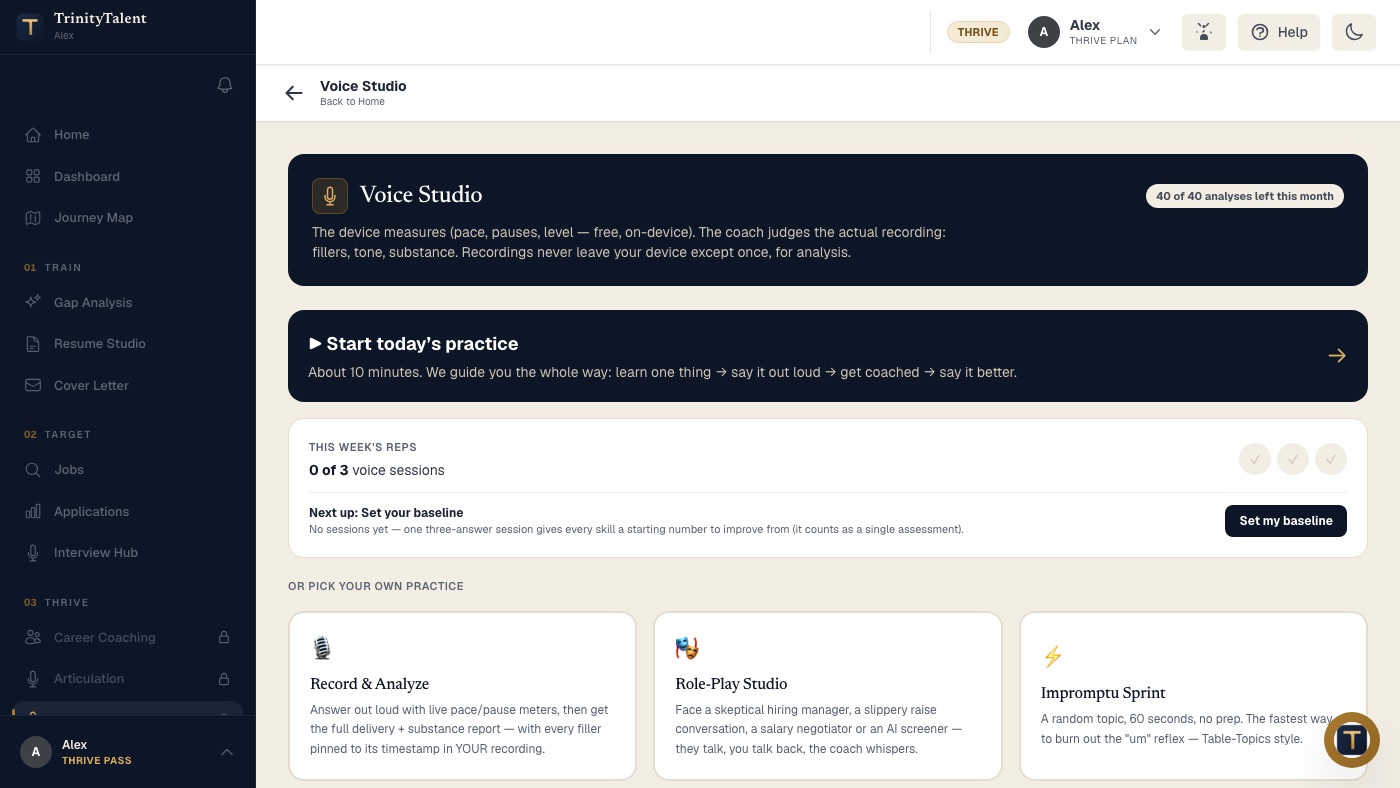
Voice Studio in TrinityTalent listens to the actual recording rather than a transcript. You record an interview answer and it reports your pace, your pauses, your filler words with a verbatim transcript showing each one where it happened, and a measure of vocal confidence. That gives you an honest baseline for the five habits above, so you know which one to work on first. The recording stays on your device. The ESL Clarity Mode coaches clarity and pace and never comments on accent, because accent is not the problem. When you want a full rehearsal, the Interview Hub offers a mock interview with a live spoken interviewer and more than 700 Fire Round questions for quick practice. Everything is free while the product is in beta, with no credit card required.
Frequently asked questions
How can I sound confident in an interview when I am nervous?
Focus on delivery habits rather than feelings. Finish every word so your pace steadies, replace fillers with a one-second silent pause, let your tone fall at the end of each statement, and keep sentences short enough to finish. Breathe out before you answer. Nerves can stay inside; these habits keep them out of your voice.
Does speaking louder make you sound more confident?
No. Listeners judge confidence from steadiness, not volume. A raised voice often sounds tense, and it can read as aggressive in a small room. Speak at a normal conversational level, slow enough to finish each word, and let your sentences end with a falling tone. That combination carries far more authority than volume.
Why does my voice go up at the end of sentences in interviews?
Rising intonation on statements is a common stress habit. It happens when part of you is asking the listener to approve what you just said. Practise three factual sentences from your resume with a deliberate drop on the last word, record them, and compare. Once you can hear the difference, the falling ending becomes easier to reproduce under pressure.
Do I need to change my accent to sound confident?
No. Confidence in speech comes from pace, pauses, sentence endings and sentence length, and every accent can carry all four. Interviewers understand clear, steady speech in any accent. Work on clarity and pace, and leave the accent alone; it is part of how you speak, not a barrier to sounding assured.
Put this into practice
Record one interview answer in Voice Studio and read the pace, pause and filler report before you change anything about how you speak.
Practise a mock interview