
Student Resume With No Experience: What to Put On It
A student resume with no experience is built from evidence you already have: course projects, part-time jobs, volunteering, co-op terms, clubs and coursework. The phrase "student resume with no experience" is misleading, because recruiters hiring students do not expect a job history. They expect proof that you can show up, finish things and learn quickly, and they accept that proof from anywhere. This guide covers what counts as experience, the one-page structure, how to write bullets for each kind of evidence, and the mistakes that get a student resume set aside.
TL;DR: Lead with education, because it is your strongest section. Then list projects, work of any kind, volunteering and leadership, each with bullets that name a task, a method and a result. Add a skills section with tools you have actually used. Keep it to one page, single column, no photo. Every line should be something you can talk about for two minutes.
What recruiters accept as experience
For student and early-career roles, "experience" means any situation where you were responsible for something and it got done. That includes:
- Course projects, especially group projects with a deliverable and a deadline.
- Part-time and summer work, including retail, food service, tutoring and warehouse shifts.
- Volunteering, from a food bank shift to running registration at a community event.
- Co-op terms and internships, which are work and belong in the work section.
- Clubs and student associations, where you held a role or ran an event.
- Personal projects: an app, a small business, a research poster, a fundraiser.
The test is not where it happened. The test is whether you can describe what you did, how, and what changed because of it. A cashier who cut the closing routine from 40 minutes to 25 has a better bullet than an intern who "assisted with various tasks".
The one-page structure
Students lead with education because it is the most relevant thing on the page. A typical order:
- Header: name, city and province, phone, email, LinkedIn. No street address, no photo, no date of birth.
- Summary (optional, two or three sentences): the role you want and your two strongest pieces of evidence.
- Education: institution, program, expected graduation date, and relevant coursework if it matches the posting. GPA only if it is strong.
- Projects: two or three, with bullets.
- Experience: any paid work, co-op or internship, most recent first.
- Volunteering and leadership.
- Skills: tools, software, languages, certifications you hold.
One page, single column, standard headings. Applicant tracking systems read that layout cleanly, and recruiters expect it. The Canadian resume format guide covers what to leave off.
Projects as experience
A project bullet has the same shape as a work bullet: verb, task, method, result. Add the course or context in the project title line, then two or three bullets.
Capstone project, Business Analytics (group of four)
- Built a demand forecast for a fictional grocery chain in a spreadsheet model, testing three methods against two years of sample data.
- Presented the recommendation to a panel of three instructors; the team received the top mark in a cohort of 22 groups.
- Owned the data-cleaning stage, cutting the dataset from 14,000 rows to 9,600 usable records with documented rules.
Notice that the last bullet names one person's share of a group project. Recruiters know group work is shared. Saying which part was yours is more credible than claiming all of it.
Coursework, part-time work and volunteering
Coursework goes under education as a short line: "Relevant coursework: Financial Accounting, Statistics, Database Design." List only courses that match the posting, and only courses you actually took, because interviewers ask about them.
Part-time work is real experience, and the bullets should say so. Compare:
Avoid this: "Responsible for customer service and cash handling."
Say this: "Served 150 to 200 customers per shift at a busy coffee counter; trained four new hires on the till and closing routine in 2025."
Volunteering follows the same rule. "Coordinated 12 volunteers for a weekend food drive that collected 900 kilograms of donations" is a leadership bullet that happens to be unpaid.
Clubs, co-op and the placement-first frame
A role in a club is a role. "Treasurer, Engineering Students' Society: managed the budget for nine events across two terms, with reconciled accounts presented at each general meeting" belongs on the page. Co-op terms are jobs and go in the experience section with the employer, dates and three bullets.
The frame that helps most is placement-first: for every line, ask what a hiring manager for the specific posting would want to see. A software co-op posting cares about the code you shipped in a project. A retail management trainee posting cares about the shifts you ran. The same student has two different resumes, and both are honest.
Skills section: only what you have used
List tools, software, languages and certifications you could use tomorrow. Group them: "Software: Excel (pivot tables, lookups), Python (pandas), Figma. Languages: English, Punjabi, French (intermediate). Certifications: First Aid, Serving It Right." Leave out "communication" and "teamwork"; the bullets should show those. Never list a tool you have only watched a video about, because a skills test will find it.
Mistakes that get a student resume set aside
- An objective statement about what you want. Replace it with a summary of what you offer, or drop it.
- High school on a university student's resume. Once you have a year of post-secondary, high school goes.
- Padding with duties. "Attended weekly meetings" is not a result. Cut anything without a task and an outcome.
- A two-column template with icons. Some parsers read the columns out of order. Single column, standard headings.
- References or "references available on request". Recruiters will ask when they need them.
- A photo, date of birth or full street address. Not expected in Canada and a privacy risk.
- Skills you cannot demonstrate. Every listed tool is a possible interview question.
Read the finished page and ask of every line: could I talk about this for two minutes? If not, the line is padding, and the internship interview questions you will face are built on exactly those lines.
How TrinityTalent helps
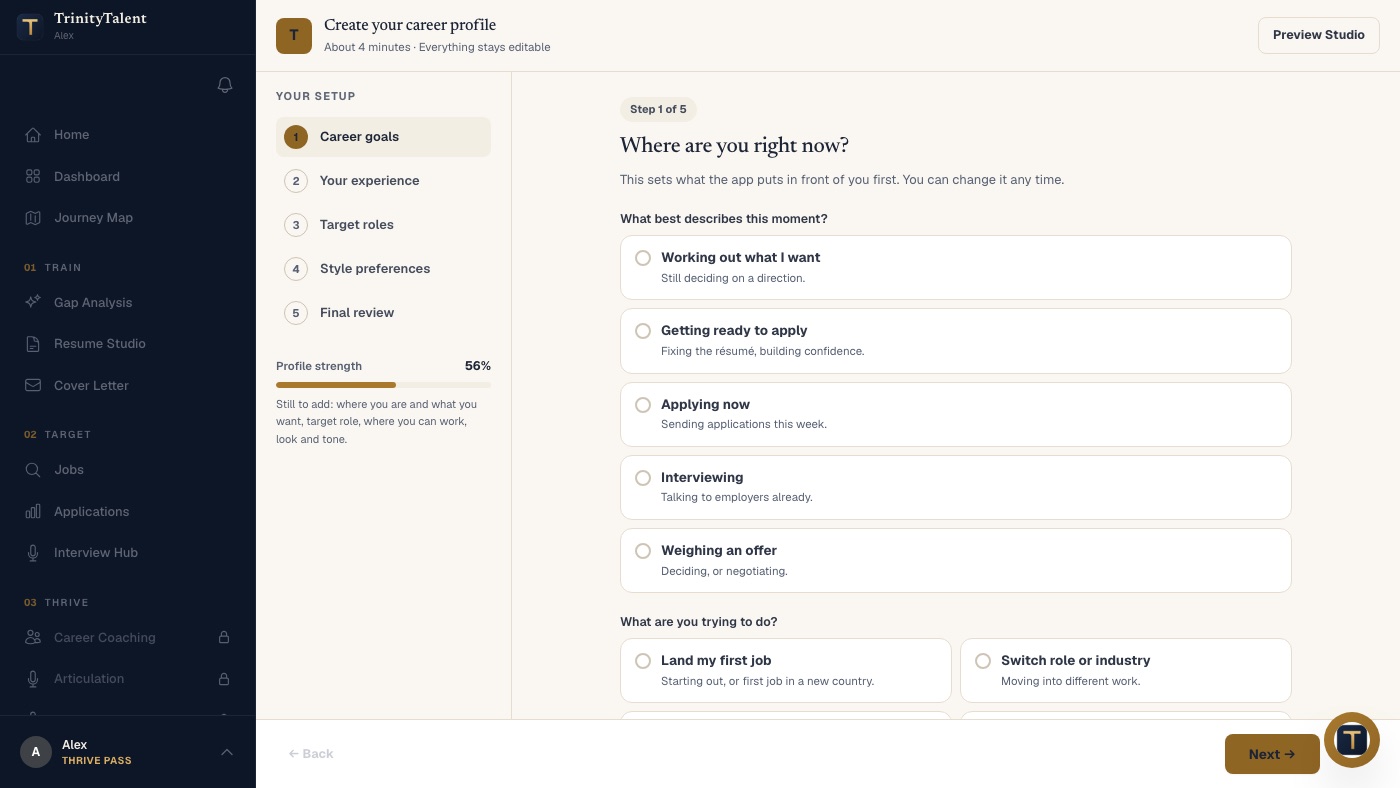
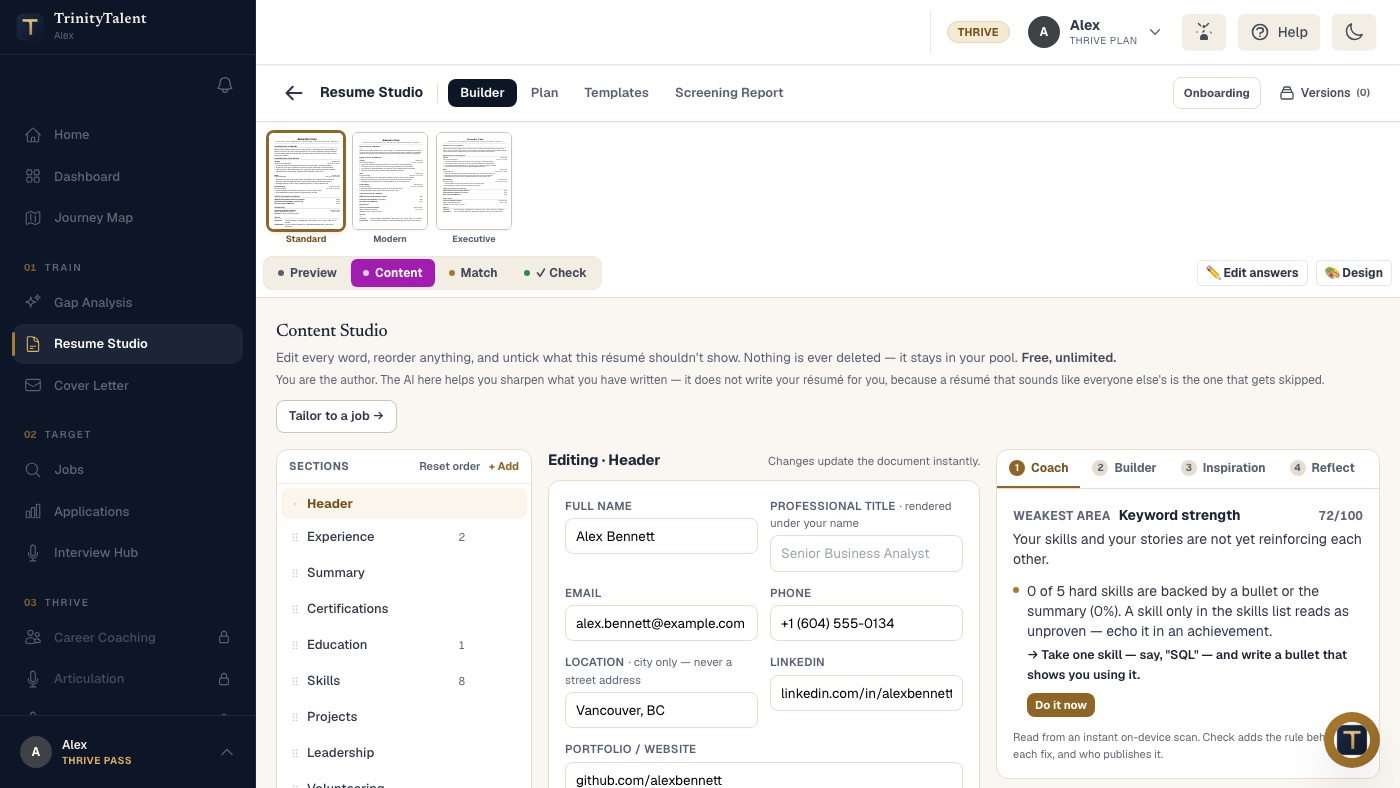
TrinityTalent's free resume builder is designed for first job searches. During onboarding you say where you are, for example a student looking for a co-op or internship, and that single answer decides whether education or experience leads the page. The templates are single-column and ATS-safe, editing is free and runs on your device, and a rules-based Check flags weak verbs, missing numbers and merged bullets as you type. Export to Word or PDF when you are done.
The placement-first Gap Analysis mines co-op terms, projects, part-time work and coursework for transferable evidence rather than telling you to take another course first. When you find a posting, one-shot tailoring rewrites your bullets toward it from your own facts, and the cover letter is drafted from your resume and the posting. Nothing is ever sent without you. Building, editing and exporting your resume on TrinityTalent is free.
Frequently asked questions
What do I put on a resume if I have never had a job?
Lead with education, then list course projects, volunteering, club roles and personal projects, each with bullets that name a task, a method and a result. Add a skills section with tools you have actually used. Recruiters hiring students expect no job history; they expect evidence that you finish things and learn quickly, from any source.
Should a student resume be one page?
Yes. One page, single column, standard section headings. A student with no full-time history rarely has enough material to justify a second page, and a longer document usually means padding. Applicant tracking systems and recruiters both read a one-page single-column layout most reliably.
Should I include my GPA on a student resume?
Include it only if it is strong for your program and the posting or employer is known to ask for it. If you leave it off, nobody assumes the worst; they assume it is average. Relevant coursework that matches the posting is usually more useful than the number.
Can I put a part-time retail or restaurant job on my resume?
Yes, and you should. Write the bullets as results: customers served per shift, new hires you trained, a closing routine you shortened, a shift you ran alone. Reliability, speed and dealing with people under pressure are exactly what employers hiring students want proof of.
Put this into practice
Tell the free builder you are a student and it leads with education, then helps you turn projects, coursework and part-time work into bullets with numbers.
See the student edition