
Internship Interview Questions and How to Answer Them
Internship interview questions are easier than most students expect, because interviewers are not testing what you know. They are testing whether you can explain what you have done, learn quickly, and work with other people. The 15 internship interview questions below cover almost every co-op and intern interview, and each comes with a frame for building the answer from coursework, projects and part-time work. Read the frame, write your own answer in four sentences, and say it out loud before the interview.
TL;DR: Interviewers hiring interns want three things: evidence you finish what you start, evidence you learn fast, and evidence you can work with people. Every answer should come from a real project, course, job or volunteer role. Use a short structure: situation, what you did, result, what you learned. Prepare two questions to ask back. Practise out loud, at speed.
What interviewers actually want from a student
An intern is a short-term hire with a long-term option. The interviewer is asking: will this person be useful in six weeks, and would we want them back? That means three signals. Reliability: did you finish things and meet deadlines. Learning speed: when you did not know something, what did you do. Working with others: group projects, customers, teammates.
Nobody expects you to know their systems. They expect examples, explained clearly. The student resume with no experience guide covers where those examples come from; every line on that resume is a possible question here.
The answer frame
Most internship questions are answered with the same four-part shape, in under 90 seconds:
- Situation: one sentence of context. "In my second-year database course, our group of four had to build a booking system in six weeks."
- What you did: two sentences on your own part. "I owned the schema and wrote the queries. When the report page was too slow, I added an index and rewrote the main query."
- Result: one sentence with a number if possible. "The page went from eight seconds to under one, and we got the top mark in the section."
- What you learned: one sentence. "I learned to test with realistic data early instead of at the end."
This is the STAR structure with a learning line added, because learning is what the interviewer is buying.
15 internship interview questions with frames
About you
1. Tell me about yourself. Program and year, one project or job you are proud of, why this internship. Under a minute. Not your life story.
2. Why do you want this internship? Name one specific thing about the work, one about the team or industry, and one skill you want to build. Avoid "it would be a great learning opportunity" on its own; everything is.
3. Why did you choose your program? A short honest answer with a moment of decision in it. "I took an elective in statistics and realised I liked finding the story in data more than the theory."
4. What are your strengths? Pick two you can prove with an example each. "I am organised: I ran the timeline for a four-person capstone and we delivered a week early."
5. What is a weakness you are working on? A real one, with the fix in progress. "I used to leave presentations to the last day. I now draft slides in the first week and rehearse twice."
Behavioural
6. Tell me about a group project that did not go smoothly. Describe the problem factually, what you did, and the result. Do not blame teammates; describe what you would do differently.
7. Describe a time you had to learn something quickly. A new tool, a new role at work, a course you found hard. Say how you learned it and how long it took.
8. Tell me about a deadline you struggled to meet. What happened, what you changed, and the result. If you missed it, say so and say what you learned.
9. Give an example of dealing with a difficult customer or teammate. Part-time work is ideal here. What they wanted, what you did, how it ended.
10. Tell me about something you did on your own initiative. A club event, a personal project, a process you improved at a part-time job.
Role and company
11. What do you know about us? Two facts from their website or a recent announcement, and one sentence on why it matters to you. Never nothing.
12. Which course or project is most relevant to this role? Choose one, describe it with the frame, and connect one specific skill to the posting.
13. How do you handle feedback? Give a real example of feedback you received and what you changed. Interviewers are checking coachability.
14. What tools or software have you used? Only the ones you have actually used, with the context. "Excel for a course budget model, including pivot tables. Basic Python from one course."
15. Where do you see yourself after graduation? A direction, not a job title. Connect it to the internship: "I want to work in supply chain, and this role would show me the operations side."
Questions to ask the interviewer
Prepare two or three that show you are thinking about the work, not the perks.
- What would a successful intern have done by the end of the term?
- What does a typical week look like for the intern on this team?
- How do interns get feedback, and how often?
- Have past interns returned as full-time hires?
- What is the team working on this quarter that the intern would touch?
Avoid asking about salary, hours or vacation in a first interview.
Rapid-fire practice
Knowing the answer and saying it are different skills. Students often prepare thoroughly and then freeze, because the first time they said the answer aloud was in the room. The useful form of practice is rapid-fire: a question, a spoken answer under 90 seconds, then the next question, with no time to over-think.
Consider Leila, a second-year commerce student with a co-op interview on Friday. She writes answers to all 15 questions, then has her roommate read them in random order while she answers out loud against a timer. Her first answers run past two minutes and start with "um, so basically". By the third round they are under 90 seconds and start with the situation. On Friday, question seven is asked almost word for word, and the answer is ready.
How TrinityTalent helps
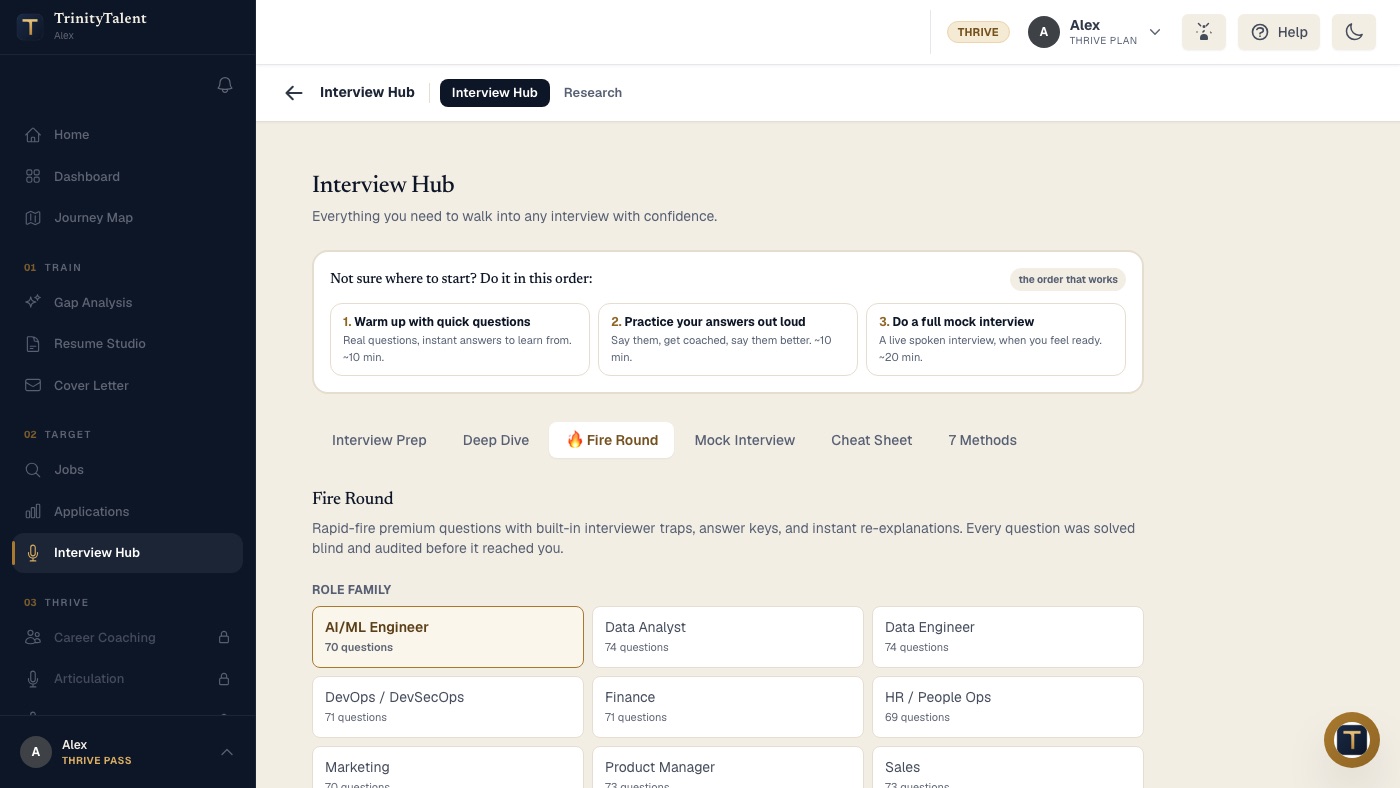
TrinityTalent's Interview Hub is built around exactly this order: warm up with quick questions, practise your answers out loud, then do a full mock interview when you are ready. The Fire Round draws on a bank of more than 700 questions by role family, so you can run rapid-fire rounds against questions for the roles you are applying to. The mock interview is a live spoken interviewer that asks, listens and gives feedback.
Articulation Training scores a spoken answer on structure, clarity, conciseness and confidence, quotes the evidence for each gap and rewrites your answer sharper. Voice Studio measures pace, pauses and filler words from a recording that stays on your device, with an ESL Clarity Mode that coaches clarity and never accent. Building, editing and exporting your resume on TrinityTalent is free. The behavioural interview questions guide covers the longer form of questions six to ten.
Frequently asked questions
What questions are asked in an internship interview?
Most internship interviews mix three kinds: questions about you (tell me about yourself, why this internship, strengths and weaknesses), behavioural questions about group projects, deadlines and learning quickly, and questions about the role and company. Interviewers expect examples from coursework, projects, part-time work and volunteering, not from previous internships.
How do I answer internship interview questions with no experience?
Use coursework, group projects, part-time jobs, volunteering and club roles as your examples. Structure each answer as situation, what you did, result and what you learned, in under 90 seconds. Interviewers hiring interns are testing reliability, learning speed and teamwork, and any of those sources can prove all three.
How long should my answers be in an internship interview?
Aim for 60 to 90 seconds for behavioural questions and under a minute for "tell me about yourself". Longer answers lose the interviewer and usually mean you have not decided what the point is. Practise out loud with a timer, because written answers run much longer when spoken.
What should I ask at the end of an internship interview?
Ask what a successful intern would have done by the end of the term, what a typical week looks like, how interns receive feedback, and whether past interns have returned as full-time hires. Prepare two or three, and save questions about pay, hours and vacation for after an offer.
Put this into practice
Warm up with the Fire Round, then practise your internship answers out loud with a live spoken mock interviewer that gives feedback on each one.
Practise a mock interview