
Skills Assessment Tests in Hiring: How to Prepare
A skills assessment test is the part of hiring where the employer stops asking and starts measuring. Interviews reward people who describe work well; a skills assessment test rewards people who can do it. Most employers now use at least one, and the type they choose tells you what they are worried about. This guide covers the five common types, what each one is actually scoring, how to prepare using nothing but the job posting, and how to find out before the test which requirements you can already prove.
TL;DR: There are five common types: work sample, situational judgement, cognitive, technical and software or typing tests. Each measures one thing the posting names. Read the posting for the verbs and tools it repeats; those are the test. Practise under time, in the same format, at least three times. Treat the result as information about a gap, not a verdict on you.
Why employers test
Resumes and interviews are self-report. Candidates choose what to say, and interviewers are often persuaded by fluency rather than skill. A test adds one piece of evidence that does not depend on how well you talk, and it lets employers compare candidates on the same task.
For you, this is good news more often than it feels like it. A test gives a quiet, well-prepared candidate a way to beat a confident one. It also tells you exactly what the job values, because nobody writes a test for a skill they do not need.
The five common types
1. Work sample
You do a small piece of the real job. A bookkeeper reconciles a short bank statement. A marketing coordinator drafts an email to a fictional customer. A support agent answers three mock tickets. Work samples are the easiest to prepare for, because the task is the job description made concrete.
What is scored: accuracy, judgment about what matters, and how you communicate the result. Finishing is less important than getting the important parts right.
2. Situational judgement
You read a short workplace scenario and choose the best and worst of four responses. "A colleague asks you to sign off on a report you have not read because the deadline is in ten minutes." There is rarely a perfect option. The test measures whether your instincts match the organisation's values: escalate or resolve, speed or accuracy, individual or team.
What is scored: alignment with the behaviours the employer has decided it wants. Read the company's stated values before the test; they are often the answer key.
3. Cognitive
Numerical reasoning, verbal reasoning, pattern recognition and logic, usually timed and usually multiple choice. These test how quickly you learn and process information, not what you know.
What is scored: speed and accuracy together. Most people lose marks by spending too long on a hard question. Practise skipping and returning.
4. Technical
Coding exercises, spreadsheet modelling, case studies, design tasks, language proficiency. The format varies by field, but the principle is the same: show the working, not just the answer.
What is scored: correctness, approach and clarity. A partial solution with clear reasoning often scores higher than a correct answer with none.
5. Software and typing
Speed and accuracy in a named tool: a spreadsheet program, a customer database, a point-of-sale system, a typing test for data entry or transcription. These are pass-or-fail more often than ranked.
What is scored: a threshold the posting usually states, such as words per minute or "advanced spreadsheet skills". If the posting names a tool, expect a test in it.
Prepare from the posting
The posting is the syllabus. Before any test, read it twice with a pen. Underline every verb that describes a task ("reconcile", "draft", "triage", "model") and every tool or standard it names. Then rank them by how often they appear and how near the top they sit. The top three are what the test will measure. For a full method, see /blog/how-to-read-a-job-description/.
A worked example
Amira Hassan applied for an operations analyst role. The posting repeated "build reports", "spreadsheet", "reconcile vendor data" and "present findings to managers". She predicted a spreadsheet work sample with a short written summary, and spent three evenings building a report from a messy sample dataset, timed at 45 minutes, with a five-line summary. The real test was a 60-minute spreadsheet exercise with a "summarise your findings" box. Close enough that the format held no surprises.
A practice routine that works
- Find the format. Ask the recruiter what kind of test it is and how long it runs. Most will tell you.
- Build a mock. Create or find a task in the same format and the same time limit. Free practice tests exist for cognitive and situational types; for work samples, invent one from the posting.
- Do it under time, three times. The first attempt shows you the gap. The second fixes the process. The third builds speed.
- Review the misses. For each error, write one line on why it happened: rushed, misread, did not know. Fix the "did not know" items first.
- Rest before the real thing. Cognitive tests in particular punish fatigue. Do not cram the night before.
Find your gaps before the employer does
The most useful preparation happens before you know a test is coming. Take the posting and ask, for each requirement, "Could I prove this in 30 minutes if asked?" Mark each one yes, partly or no. Practise the "partly" items this week. Be honest about the "no" items in the interview and plan around them over a longer period, which /blog/skills-gap-analysis/ explains. Knowing which requirements you can demonstrate also changes how you interview: you stop hoping the interviewer does not ask and start steering toward what you can prove.
Mistakes that cost marks
- Ignoring the instructions. Many tests score whether you followed the format asked for. Read every line before you start.
- Perfecting one part. A half-finished spreadsheet with a beautiful chart scores lower than a plain complete one.
- Silent working. In a live technical test, say what you are doing. Assessors score reasoning they can hear.
- Guessing when there is a penalty. Ask beforehand whether wrong answers cost marks.
- Treating the result as a verdict. A test measures one skill on one day. A low score is a gap to close, not a ceiling.
How TrinityTalent helps
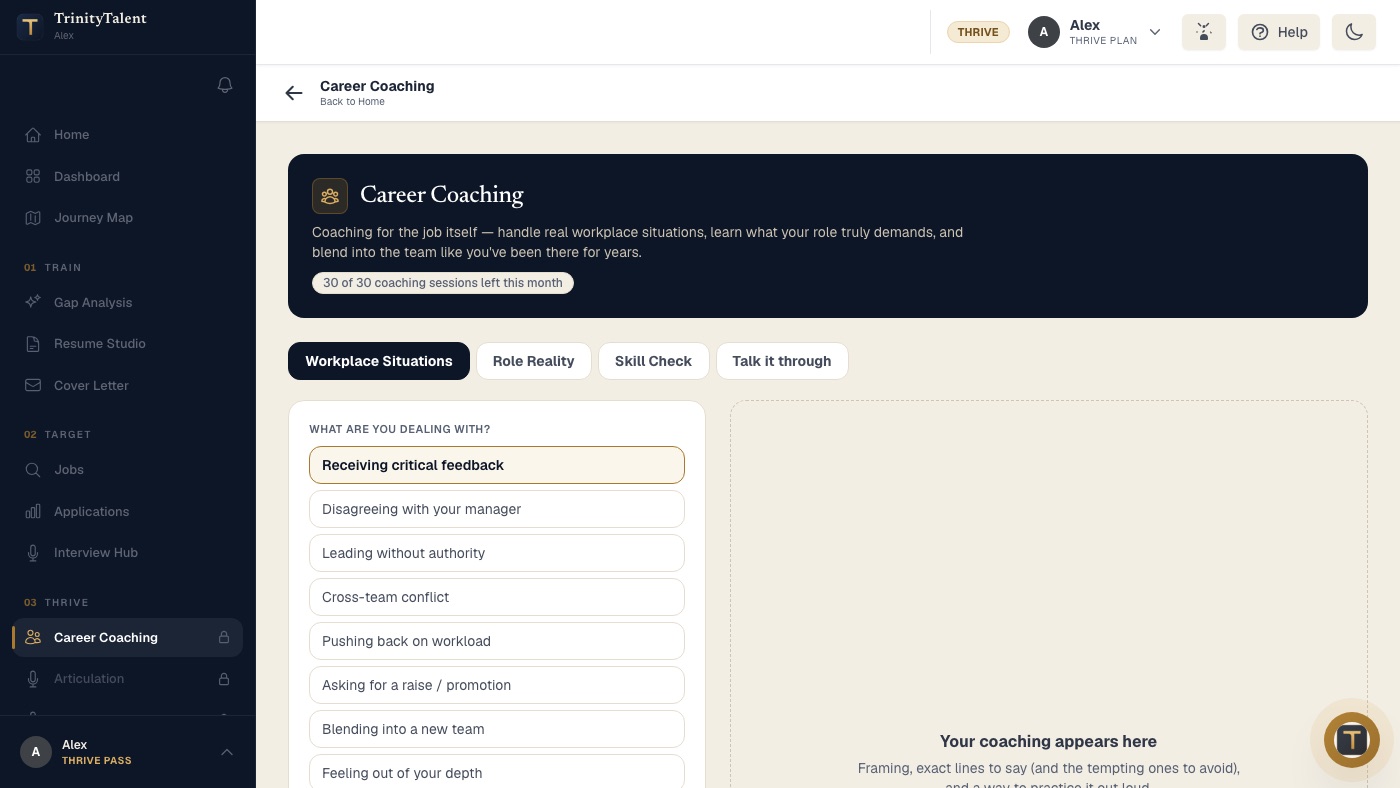
Career Coaching in TrinityTalent includes a Skill Check that builds eight practical questions from any job description you paste. It is a quick way to test the "could I prove this?" question against the real posting before an employer does, and to see which requirements you can already demonstrate. The Role Reality briefing in the same place explains what the job demands day to day, which is often a better predictor of the test format than the posting's headline. If the Skill Check shows gaps, the Gap Analysis gives you a readiness score, ranks the gaps and builds a dated 90-day plan with free resources first, so the work between now and the test has an order. All of it is free while the product is in beta, with no credit card required.
Frequently asked questions
How do I know what kind of skills assessment test to expect?
Ask the recruiter directly; most will tell you the type and the time limit. If they will not, read the posting for the tools and tasks it repeats. A named software tool suggests a software test, task verbs like "reconcile" or "draft" suggest a work sample, and phrases such as "fast-paced" or "analytical" often signal a timed cognitive test.
Can I fail a skills assessment test and still get the job?
Sometimes. Many employers use tests as one input alongside interviews and references, and a strong interview can outweigh a middling test. Software and typing tests are the exception: they usually have a fixed pass mark. If you score poorly, ask for the result and treat it as a gap to close before the next application.
How long should I spend preparing for a skills test?
Three timed practice attempts in the same format, spread over a week, is enough for most tests. The first attempt shows you the gap, the second fixes your process and the third builds speed. Spend any extra time on the requirements from the posting you cannot yet prove, rather than repeating what you already do well.
Are skills assessment tests fair to non-native English speakers?
Work samples, technical tests and software tests measure the skill itself and are generally fair. Timed verbal reasoning tests can disadvantage people who read English more slowly. If a test relies heavily on reading speed, you can ask whether extra time or an alternative format is available; many employers will accommodate the request.
Put this into practice
Paste the job posting into Career Coaching and take the eight-question Skill Check to see which requirements you can already prove and which need work.
Practise a mock interview