
Resume Skills Section: What to List and How to Order It
A resume skills section is a short block, usually under the summary, that lists the tools, methods and languages you can use at work. A good resume skills section does two jobs: it gives the applicant tracking system exact terms to match, and it gives the recruiter a fast answer to "can this person use what we use?". Most skills sections fail one test: they list things the rest of the resume never proves. This guide covers what to list, how to group and order it, how to match the posting, and the check that catches unsupported skills.
TL;DR: List hard skills first: tools, software, methods, languages, certifications. Group them under three or four short labels. Order each group to match the posting, most relevant first. Every skill you list should appear in at least one bullet that shows you using it. Show soft skills in the bullets; do not list them.
What belongs in a skills section, and what does not
The skills section holds things that can be named, learned and tested: software, tools, programming languages, methods, spoken languages, licences and certifications. "Spreadsheet modelling", "forklift licence", "French (professional working proficiency)" and "agile project delivery" all belong.
It does not hold personality. "Team player", "hard-working" and "excellent communicator" are claims about character. Recruiters skip them because everyone makes them and nobody can check them. Software ignores them because postings rarely use them as filters.
A useful test: if a skill could be the subject of a practical exam or a certificate, list it. If it could only be the subject of a reference check, show it in a bullet instead.
Hard skills first, grouped
An unsorted list of 25 items is hard to read and hard to match. Group them under three or four short labels that fit the role. For an accountant: "Systems", "Reporting", "Compliance". For a warehouse lead: "Equipment", "Systems", "Safety". For a developer: "Languages", "Frameworks", "Infrastructure".
Keep each group to a single line where possible, separated by commas. Six to twelve skills in total is typical for an early-career resume; up to twenty for a technical specialist.
Certifications and licences can sit in the skills block if there are one or two, or in their own section if there are more. Spoken languages get their own line with an honest level.
Order by the posting, not by your favourites
Open the job posting and mark every named tool, method and qualification. Those are the terms the applicant tracking system will search for and the terms the recruiter will scan for. Move the ones you genuinely have to the front of each group. The resume keywords guide walks through building that list.
Use the posting's spelling. If it says "MS Excel" and your resume says "spreadsheets", a keyword search may not connect them. Write the term the way the employer wrote it, and where a tool has both a full name and an abbreviation, include both once.
Do not add a skill because the posting names it. A skill you cannot demonstrate in the first week becomes a problem in the first week. If the posting requires something you are still learning, say so in a bullet or the cover letter, not in the skills list.
Every listed skill needs a bullet behind it
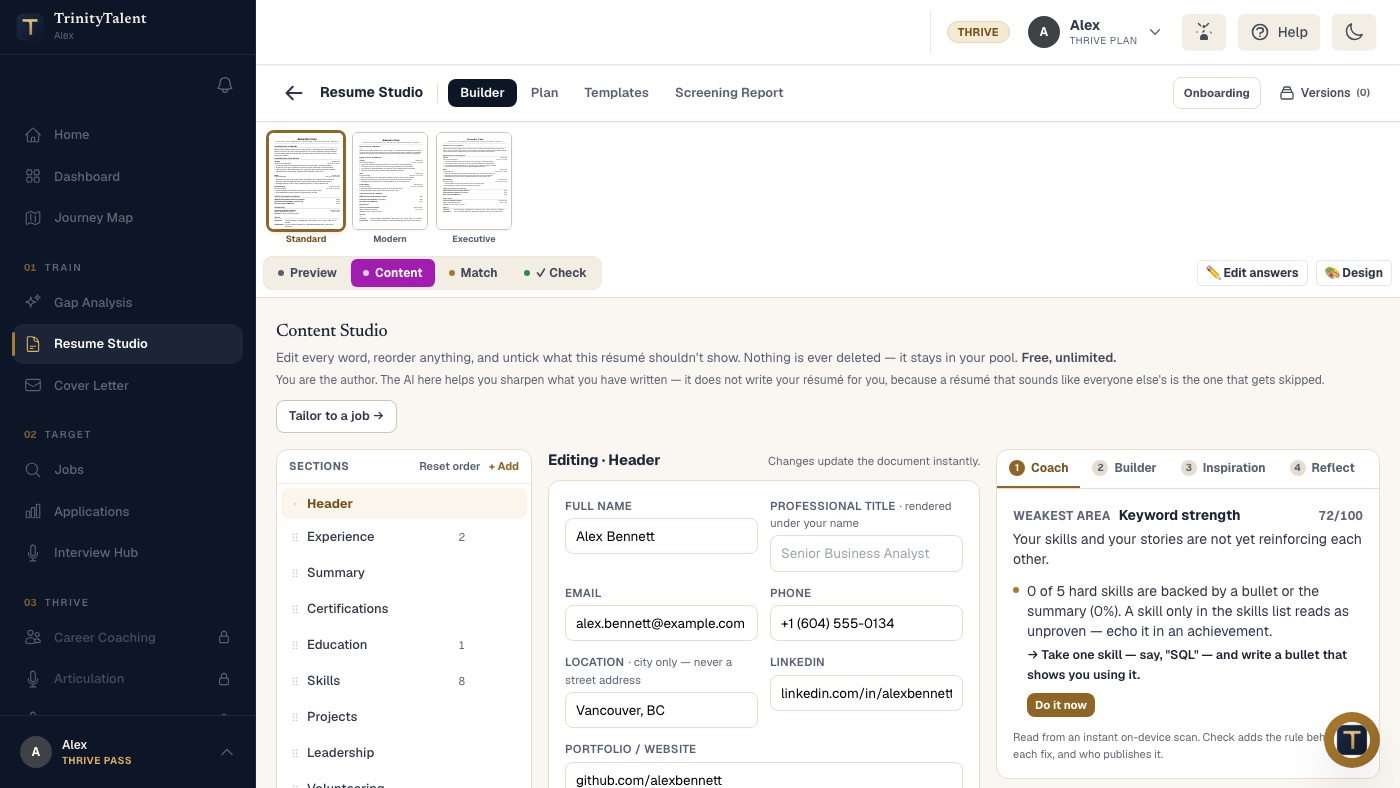
This is the rule most resumes break. A skills block that lists 23 tools while the experience section shows none of them in use is a list of things you have heard of. Recruiters notice, and a good screening tool measures it: "0 of 23 hard skills are backed by a bullet" is a real finding, and it is one of the most common on first drafts.
For each skill, ask: where on this page do I use it? If the answer is a bullet ("Built a weekly stock forecast in a spreadsheet model that cut over-ordering by 15 percent"), the skill is proven. If there is no bullet, either write one or move the skill down the list. If you cannot write one at all, remove the skill.
This rule also improves the bullets. Working backwards from the skills list often surfaces achievements you had forgotten, because you were thinking about duties rather than tools. The resume bullet points guide shows the verb, task, method, result pattern for those lines.
Soft skills: show, do not list
Communication, leadership, problem-solving and teamwork matter. They just do not belong in a list. Put them in the evidence.
- Instead of "Leadership", write "Led a team of six through a system migration with no missed deliveries."
- Instead of "Communication", write "Presented monthly results to 40 franchise owners and wrote the FAQ that cut repeat questions in half."
- Instead of "Problem-solving", write "Traced recurring invoice errors to a rounding setting and fixed it, ending 30 disputes a month."
Each bullet proves the soft skill and carries a hard skill and a number at the same time.
Worked examples by role
Data analyst, three years
Analysis: SQL, Python, spreadsheet modelling, A/B test design. Visualisation: dashboard tools, chart design for executives. Data: relational databases, data cleaning, documentation. Each item appears in at least one bullet, such as "Wrote the SQL behind a churn dashboard used weekly by 12 account managers."
Early childhood educator
Practice: play-based curriculum planning, observation and documentation, inclusive programming. Compliance: provincial licensing standards, first aid and CPR (current), safe food handling. Languages: English, Punjabi (fluent). The compliance line answers the posting's must-haves in one glance.
Project coordinator, career changer
Delivery: scheduling, risk logs, status reporting, vendor coordination. Tools: project management software, spreadsheet trackers, ticketing systems. Certification: project management associate credential (in progress, exam booked).
Mistakes that weaken a skills section
- Proficiency bars and star ratings. They mean nothing to software and the scale is invented. A recruiter cannot tell what four stars means.
- "Expert" and "advanced" on everything. If every skill is expert, none is. State a level only for languages, where levels are standard.
- Padding with basics. Email, typing, "internet research". Cut them.
- Skills from a job you left ten years ago. If you cannot use it today, do not list it.
- A block that never changes. The skills order should shift with each posting. The facts stay the same; which ones lead changes.
- Graphics. Icons, columns and tables in the skills block are the most common parsing failure on otherwise good resumes. Plain text, one column.
How TrinityTalent helps
TrinityTalent's free resume builder treats the skills section as evidence, not decoration. In the Content tab you edit skills and bullets side by side, reorder groups, and untick items this version should not show; nothing is deleted, so a skill you hide for one posting stays in your pool for the next. The rules-based Check runs on your device, is free, and reports how many of your listed hard skills are backed by a bullet, with a "Take me there" button that moves you to each one that is not, so you can write the line or move the skill.
When you tailor the resume to a real posting, the builder reads the actual page, audits which of its terms your resume already carries, and rewrites from your facts only; you review every change. Every template is single-column and ATS-safe, so the skills block stays plain text in Word and PDF export. Building, editing and exporting your resume on TrinityTalent is free.
Frequently asked questions
How many skills should I list on a resume?
Six to twelve for most roles, up to about twenty for a technical specialist. Group them under three or four labels so the recruiter can scan them. Every one should be proven by a bullet somewhere on the page; if it is not, it is a rumour, not a skill.
Should I put soft skills on my resume?
Yes, but in the bullets, not in a list. "Led a team of six through a migration with no missed deliveries" proves leadership. "Leadership" on its own proves nothing. Recruiters skip listed soft skills because every candidate lists the same ones.
Where should the skills section go on a resume?
For most people, directly under the summary and above experience, so the recruiter and the software see the matching terms in the top third of the page. Students and new graduates sometimes place it after education. Keep it to a few lines either way.
Should I use skill ratings or proficiency bars?
No. Bars and stars are graphics that parsers cannot read and recruiters cannot interpret, because the scale is your own. State a level only for spoken languages, where standard descriptions exist, and prove everything else with a bullet that shows the skill in use.
Put this into practice
Paste your resume into the free builder. The Check tab counts how many listed skills are backed by a bullet and takes you to the ones that are not.
Build your resume free