
How to Quantify Achievements on a Resume (No Data Needed)
You can quantify achievements on a resume without a single report or dashboard, because most of the numbers a recruiter wants are numbers you already know: how many, how often, how big, how long, and what changed. Learning to quantify achievements on a resume is mostly a matter of asking six questions about each task and writing down honest estimates. This guide gives you the six questions, the estimation rules that keep you safe in an interview, worked examples for jobs that "have no numbers", and a way to build a short Key Achievements section from your whole career.
TL;DR: Every task has a number: scale, frequency, time, errors, people served, or before-and-after. Estimate honestly, round sensibly, and say "about" when you counted rather than measured. Put one number in every bullet. Then pick four or five business-impact highlights from across your career for a Key Achievements section, written fresh, not copied from bullets.
Why numbers work
A number does three things a word cannot. It gives scale, so "managed inventory" becomes "managed 2,400 stock lines". It gives proof, because a figure implies you measured something. And it gives the recruiter a picture they can compare with their own operation. "Improved efficiency" is invisible. "Cut the order cycle from five days to two" is a story in nine words.
The six questions
Ask each of these about every task you did. Most tasks answer at least two.
- How many? Customers, calls, orders, files, patients, students, sites, machines. "Served 120 customers a shift."
- How often? Daily, weekly, per shift, per quarter. "Ran the weekly safety walk for 18 months."
- How big? Budget, team, floor area, stock value, number of locations. "Reconciled four tills and the nightly float for a 40-seat cafe."
- How long? The time a task took before and after you changed something. "Cut new-hire onboarding from three weeks to eight days."
- How accurate? Error rate, complaints, returns, rework, audit findings. "Held picking accuracy above 99 percent."
- Compared to what? The previous year, the team average, the target. "Beat the branch renewal target by 12 points."
Write the answers next to each bullet. Then rebuild the bullet with the verb, task, method, result pattern from the resume bullet points guide and keep the strongest number.
Honest estimation rules
You will not have exact figures for most of this, and you do not need them. You need figures you can explain.
- Count before you claim. Count calls for a week, orders for a shift, or files for a month, then scale up. "About 50 calls a day" from a week of counting is honest.
- Round to the nearest sensible unit. "About 50", not "52.3". "Roughly a third", not "33.7 percent".
- Say "about" when you estimated. It costs one word and it protects you.
- Use ranges when the work varied. "60 to 80 tickets a day."
- Prefer percentages for changes you drove and raw counts for scale. "Cut errors by 40 percent"; "trained 14 new staff".
- Never claim a team's number as your own. "Contributed to a team that shipped" is honest; "Shipped" alone is not, unless you did.
- Be ready for the question. Every number will be asked about in an interview. If you cannot describe how you got it in two sentences, remove it.
Worked examples for jobs "with no numbers"
Receptionist
Before: "Greeted visitors and answered the phone."
After: "Welcomed about 80 visitors a day and answered 60 calls a shift for a 30-person clinic, keeping the average hold time under a minute."
Line cook
Before: "Prepared food during busy service."
After: "Ran the grill station for a 90-seat restaurant serving 300 covers on a Friday night, with plate times under 12 minutes."
Elementary teacher
Before: "Taught grade four and supported struggling readers."
After: "Taught a class of 27 and moved nine students who started below reading level up to grade level by June through a daily 20-minute guided reading block."
IT support technician
Before: "Resolved user issues and maintained equipment."
After: "Closed about 45 tickets a week for 200 staff across two offices and cut repeat password tickets by two thirds by writing a self-service reset guide."
None of these people had a dashboard. Each of them counted something for a week, remembered a before and an after, and rounded honestly.
Before-and-after: the strongest form
The most persuasive number is a change you caused. "Reduced wait time" is a claim. "Reduced wait time from 14 minutes to six" is a result with a size the reader can picture, and the word "from" tells them you knew the starting point.
To find before-and-after figures, think about the first month in a role and the last. What was slow, wrong, expensive or frequent when you arrived, and what did it look like when you left? Then name the method, because the method is what you will be asked about: "by moving check-in to a tablet at the door".
Key Achievements: four or five highlights from the whole career
Once the bullets carry numbers, you can add a short Key Achievements section near the top of the resume: four or five lines that show the business impact of your whole career, not one job. These are written fresh. They are not bullets copied from the experience section, because a recruiter who reads the same line twice trusts the page less.
A Key Achievement synthesises: "Cut operating costs at three sites by a combined 18 percent over five years by standardising purchasing." It draws on several roles, and every figure in it must exist somewhere below, or in your notes. If your resume cannot support four honest highlights yet, that is a sign to go back to the six questions, not to invent.
Mistakes that undo the work
- Invented precision. "Increased sales by 47.3 percent" from a role with no sales reporting will be challenged.
- Numbers with no method. A result with no "by" reads as luck.
- Only one kind of number. A resume of nothing but percentages looks manufactured. Mix counts, time, accuracy and change.
- Team results claimed alone. Say your part.
- Mixed styles. Small numbers as words in one bullet and digits in the next. Pick one style and keep it; digits are easier to skim.
- Money you cannot defend. If you never saw the budget, do not quote it.
The STAR method guide shows how each quantified bullet becomes an interview answer, which is the real test of whether the number is yours.
How TrinityTalent helps
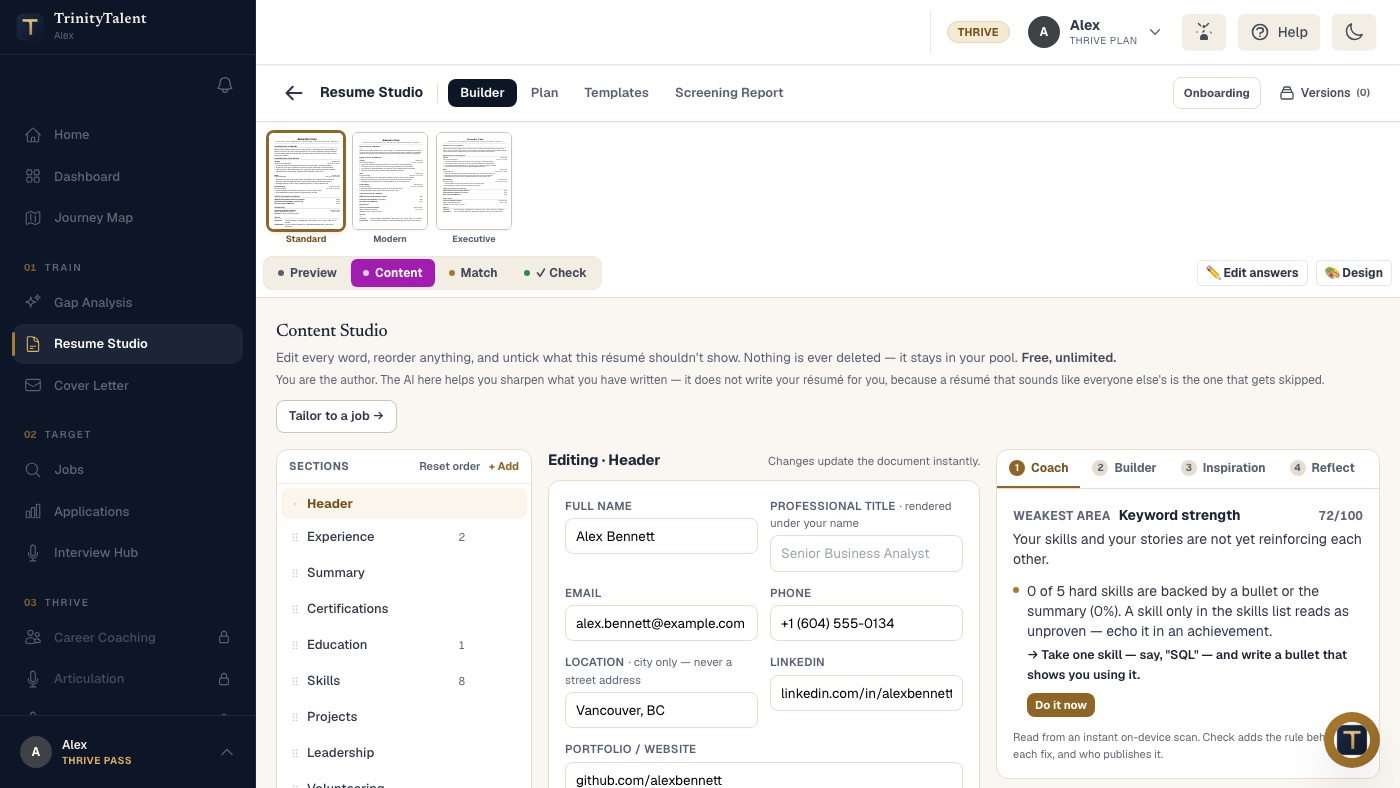
TrinityTalent's free resume builder is built to find the missing number. The rules-based Check runs on your device, is free, and flags every bullet that carries no figure, along with small numbers written both as words and digits; each finding cites the career-centre guidance behind it, and a "Take me there" button moves you to the line. You edit in place, and nothing is saved until you choose.
The Key Achievements tool works the honest way this guide describes: it drafts four or five business-impact highlights from your whole career rather than copying bullets, uses only figures that already exist on your page, and when the resume cannot support four, it asks you short questions instead of guessing. You answer, review the draft, edit it, and press "Use this". Building, editing and exporting your resume on TrinityTalent is free.
Frequently asked questions
What if I genuinely have no numbers for a job?
You have more than you think. Count how many people, calls, orders or files you handled in a typical day or week, how long a task took before and after you changed it, and how your results compared with a target. Estimate honestly, round, and say "about".
Is it acceptable to estimate numbers on a resume?
Yes, as long as the estimate is based on something you counted or observed, is rounded sensibly, and can be explained in an interview in two sentences. Use "about" or a range. What is not acceptable is a precise figure with no basis, because it will be challenged.
Should every bullet point have a number?
Aim for one in every bullet and accept that a few will not have one. A bullet without a number should still name a specific task and method. If a role has five bullets and none has a figure, the role reads as duties rather than achievements.
What is a Key Achievements section on a resume?
A short block of four or five highlights near the top that shows the business impact of your whole career. Each line is written fresh from several roles, not copied from a bullet, and every figure in it must be supported somewhere on the page.
Put this into practice
Paste your resume into the free builder. The Check flags every bullet with no number, and the Key Achievements tool asks you for the figures it cannot find.
Build your resume free