
Phone Screen Interview: What Recruiters Check in 20 Minutes
A phone screen interview is short, and it is not really about your skills. The recruiter running a phone screen interview has one job: confirm that you are worth the hiring manager's hour. In 20 minutes they check four things, eligibility, salary range, availability and basic fit, and they listen for how clearly you speak. Pass those checks and you advance. Fail one and the process ends politely. This guide explains each check, the questions that test it, and how to prepare short spoken answers.
TL;DR: A phone screen verifies four facts: you can legally work in the role, your salary range overlaps theirs, you can start when they need, and your background broadly fits. Answer each in under a minute. Take the call in a quiet place with the posting and your resume open. Prepare a 60-second introduction, a salary range with a reason, and two questions about the process.
What a phone screen is for
A hiring manager may have eight strong resumes and time to interview three. The screen decides which three. It is a filter, not a conversation about your career: the recruiter checks facts against the posting and forms one impression, would this person embarrass me in front of the manager?
Because of this, the screen rewards brevity. Recruiters run several screens a day and have a form to complete. A clear 60-second answer makes their job easier, and they remember who did that.
The four checks
1. Eligibility
Can you legally work where the role is based? Are you willing to move if needed? Do you hold any certification the posting names as mandatory? These are yes-or-no questions; answer them without a story. If your status has a condition, state it plainly: "I have a work permit valid until March 2028, and I am eligible to extend it."
2. Salary range
Most screens ask what you expect. The recruiter is checking overlap with the budget, not negotiating. Give a range with a reason: "Based on similar roles in Vancouver at this level, I am looking at X to Y, depending on the full package." If you do not want to go first, ask: "Could you share the range approved for this role?" Many recruiters will answer.
3. Availability
When can you start, and can you attend the next interviews? State your notice period. If you have a holiday booked, mention it now rather than in the final round; a surprise later costs goodwill.
4. Basic fit
Does your background broadly match the posting? The recruiter tests this with "tell me about yourself", "why this role" and one or two questions about the skills the posting repeats. They are not scoring depth; they are checking that the resume is true and that you can talk about it. For the opening question, see /blog/tell-me-about-yourself-answer/.
Keep every answer under a minute
Long answers are the main reason candidates fail screens, and they fail without knowing why, because the recruiter simply thanks them and moves on.
Use this shape for every question:
- Answer the question in one sentence.
- Give one piece of evidence: a number, a project, a timeframe.
- Stop. Let the recruiter ask for more if they want it.
A worked example
The recruiter asks Daniel Okafor, a payroll administrator, "How much experience do you have with unionized payroll?"
Too long: "So I started in payroll about six years ago at a small manufacturer, and at first it was just hourly staff, but then they signed a collective agreement, and I had to learn all the rules around premiums, and then when I moved to my current employer..."
Under a minute: "Four of my six years have been in unionized environments. I run bi-weekly payroll for 400 hourly staff under two collective agreements, and I have led two contract transitions without a missed pay run."
The second answer gives the recruiter something to write on the form. The first gives them a reason to check the clock.
Set up the environment
- Take the call in a quiet, closed room. Not a car, not a cafe, not a walk.
- Use headphones with a microphone, tested the day before.
- Sit upright or stand. Posture changes your voice more than you expect.
- Have the posting, your resume and your salary range open. The recruiter cannot see you look.
- Write down the recruiter's name as soon as they say it.
If the recruiter calls at a bad time, say so: "I want to give this my full attention. Could we speak in 15 minutes?" That is better than a screen taken in a stairwell.
The questions to expect
Screens are predictable. Prepare these eight:
- "Tell me about yourself." A 60-second summary: current role, one result, why this job.
- "Why are you interested in this role?" Name two specific things from the posting.
- "Why are you leaving your current position?" One honest, forward-looking sentence.
- "What are your salary expectations?" A range with a reason.
- "When could you start?" Notice period plus any fixed commitments.
- "Are you legally eligible to work here?" Yes or no, with any condition stated.
- "Walk me through your experience with [skill from the posting]." Years, scope, one example.
- "Do you have any questions for me?" Ask about the process and the team's shape.
For question eight, "What are the next steps?" and "What has made candidates a strong fit so far?" both show interest and give you information.
Practise the short spoken answer
Reading your answers is not the same as saying them. Spoken answers run longer than you plan, because you add connectors and repeat yourself while thinking. The fix is rehearsal with a timer.
Answer each of the eight questions aloud and time yourself. Past 60 seconds, cut the evidence to one example. Under 20 seconds, add the number or timeframe you left out. Repeat until each answer sits between 30 and 60 seconds without reading. Do this in the two days before the call, so the shape of each answer is familiar enough to adapt when the recruiter asks a slightly different version.
After the call, send a two-sentence thank-you the same day and record the recruiter's name, the salary range discussed and the next step in your application tracker. If the next stage is a video call, /blog/video-interview-tips/ covers what changes when the camera is on.
How TrinityTalent helps
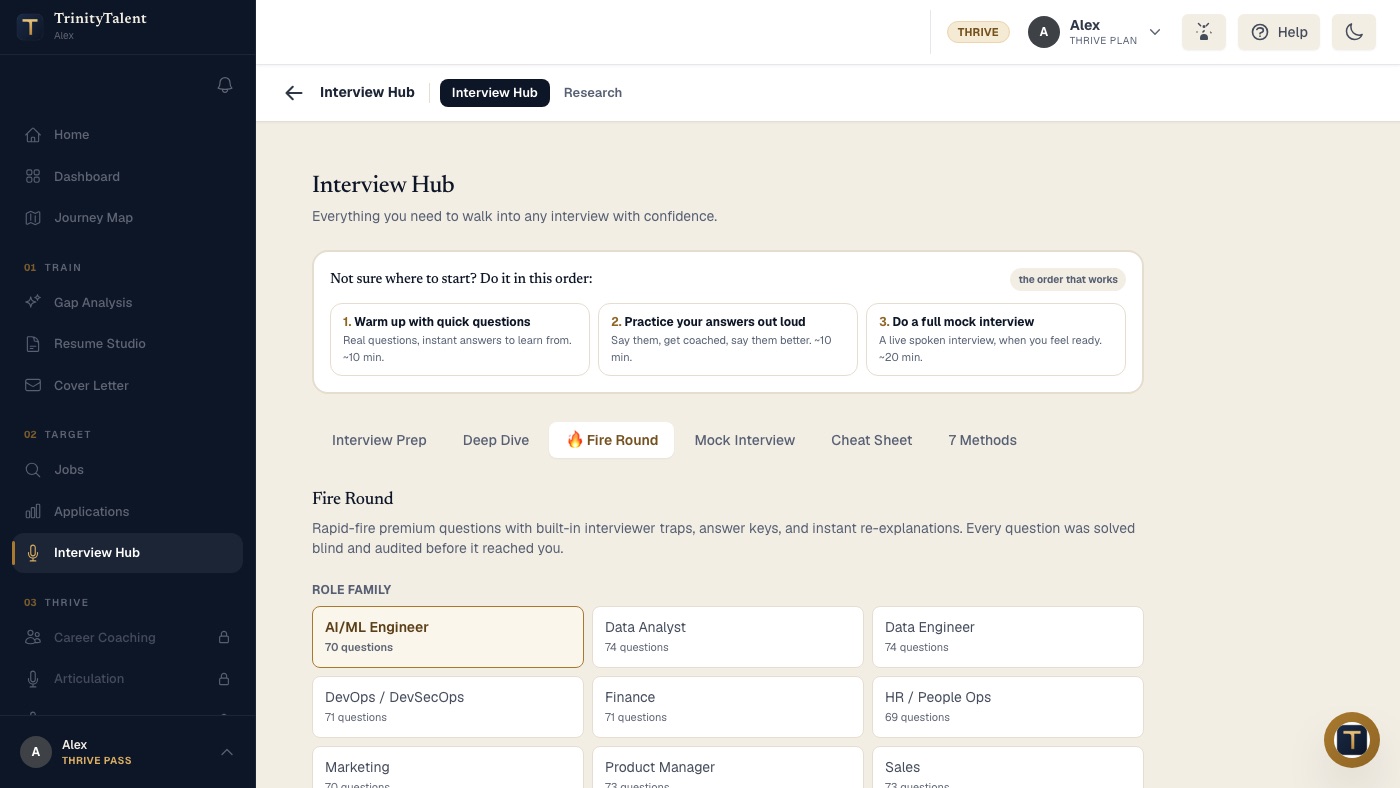
The Interview Hub in TrinityTalent is built around the order that works: warm up with quick questions, practise your answers out loud, then do a full mock interview when you feel ready. The Fire Round is the warm-up. It draws from a bank of more than 700 real interview questions and gives rapid practice with instant feedback, which is exactly the short spoken answer a phone screen rewards. When you want a longer rehearsal, the mock interview puts you in front of a live spoken interviewer. The Hub reads the roles you are interviewing for from your Application tracker, so the posting text is in front of you while you practise. Everything is free while the product is in beta, with no credit card, and nothing is sent to a recruiter unless you send it.
Frequently asked questions
How long does a phone screen interview usually last?
Most phone screens run 15 to 30 minutes. The recruiter has a short list of facts to confirm and a few questions about your background, so the call ends once those are covered. A screen that runs much longer is often a sign that the answers were too long.
Should I take a phone screen interview if I am at work?
Only if you can find a private, quiet room and give the call your full attention. If you cannot, ask to reschedule. Recruiters expect candidates to be employed and will usually offer another time. A screen taken in a hallway or car sounds distracted, and the recruiter has no picture of you to balance that impression.
Do I have to give a salary number in a phone screen?
You do not have to give a single number, but you should be ready with a range and a reason for it. Recruiters ask to confirm that your expectations overlap with the budget. You can also ask for the approved range first. Refusing to discuss salary at all can end the process, because the recruiter cannot complete their form.
What should I do if I miss the recruiter's call?
Call back as soon as you can from a quiet place. If it goes to voicemail, leave a short message with your name, the role and two times you are available, then send a brief email saying the same. A missed call is not fatal, but a slow or vague response to it can be.
Put this into practice
Open the Fire Round in the Interview Hub and practise 60-second spoken answers to real screening questions before the recruiter calls.
Practise a mock interview