
One-on-One Meeting Questions to Ask Your Manager
The best one-on-one meeting questions do one of five jobs: they confirm priorities, ask for feedback, open a growth conversation, remove a blocker, or check expectations. If you are searching for one on one meeting questions because your weekly meeting has become a status update that either side could cancel, the fix is to pick one job per meeting and bring two questions for it. This guide gives 25 questions grouped by those five goals, the agenda to bring, how to record what was agreed, and when the meeting is the right place to raise a promotion.
TL;DR: A one-on-one is your meeting, not your manager's. Bring a three-item agenda: one update, one question, one request. Choose the question by goal: priorities, feedback, growth, blockers or expectations. Ask about feedback every two to three weeks and about growth once a month. Write down what was agreed within an hour and send it in two lines.
Why most one-on-ones become status updates
When nobody prepares, the meeting defaults to the easiest content, which is what you did this week. Your manager already knows most of it. The meeting then feels optional, gets moved, and eventually disappears. The person who loses is you, because the one-on-one is the only regular slot where your priorities, your development and your problems are the whole agenda.
The fix is a smaller, sharper meeting: one update in two minutes, then a question that needs your manager's judgement, then a request that needs their authority.
The agenda you bring
Send three lines the day before, or put them at the top of a shared document:
- Update. The one thing that changed since last time that your manager needs to know. Two sentences.
- Question. One question from the lists below, chosen for the goal of this meeting.
- Request. A decision, an introduction, a resource, or feedback on one specific piece of work.
If your manager brings their own items, theirs go first. Yours still go in.
25 questions by goal
Pick one or two per meeting.
Priorities
- Of the three things on my plate, which one matters most to you this month?
- If I could only finish one thing before the quarter ends, which one should it be?
- Is there anything I am spending time on that you would drop?
- What is the team being measured on right now that I might not see?
- Has anything changed above you that should change what I am doing?
Feedback
- What is one thing I could do differently that would make your job easier?
- In the last two weeks, where did my work fall short of what you expected?
- How did the client meeting come across from where you sat?
- Is there anything you have been meaning to tell me but have not found the moment for?
- Who on the team does this well, and what do they do that I do not?
Growth
- What skill would make me more valuable to the team a year from now?
- What would I need to show for you to trust me with the next level of work?
- Is there a project coming up where I could take the lead on part of it?
- What did you learn in your first years in this role that you wish someone had told you?
- Which of my strengths do you think I underuse?
Blockers
- I am stuck on the vendor approval. Who has the authority to move it?
- Is there a decision waiting on you that I can prepare the options for?
- The two requests from the sales team conflict. How would you like me to choose?
- What would it take to get access to the reporting system?
- Is there anyone I should be talking to who I am not?
Expectations
- What does a good week look like for someone in my role, from your side?
- When something goes wrong, how and how quickly do you want to hear about it?
- How much detail do you want in the weekly update?
- Are there decisions you expect me to make alone, and others you want to be consulted on?
- What would make you say at the end of the year that hiring me was the right call?
Two worked examples
Amara, a junior accountant four months into her role, has a weekly one-on-one that has become a list of what she reconciled. She sends an agenda: an update on the month-end close, a feedback question ("Where did my work fall short in the last two weeks?"), and a request for access to the fixed-asset register. Her manager, who had not planned to raise it, tells her that her emails to auditors are too informal and shows her one. She fixes the next one. The access is granted in the same meeting.
Wei, a senior developer, wants to lead a project. He asks: "What would I need to show for you to trust me with leading the next migration?" His manager names two things, running the planning meeting and writing the risk log, and Wei asks to do both on the current project. Three months later the conversation about leading the migration is short, because the evidence already exists.
Record the outcome within an hour
An agreement that is not written down did not happen. Within an hour of the meeting, send two or three lines: what was decided, who does what, and by when. "Thanks for today. Agreed: I will draft the vendor options by Thursday; you will raise the access request with IT. Next time: my development plan."
This protects both of you from remembering the meeting differently, gives your manager a record to point to in your review, and builds the dated log of results a promotion case needs. Keep every note in one document.
When to raise a promotion
The one-on-one is the right place to start a promotion conversation, but not the place to demand one. Start early with growth questions: what would I need to show, and by when. Then use later meetings to report progress against exactly those things. By the time you ask for the promotion, your manager has heard the evidence in six meetings and nothing in the request is new.
Raise it at the start of a meeting, not in the last three minutes, and not in the same meeting as a difficult piece of feedback. If feedback is the hard part, see how to take feedback at work.
How TrinityTalent helps
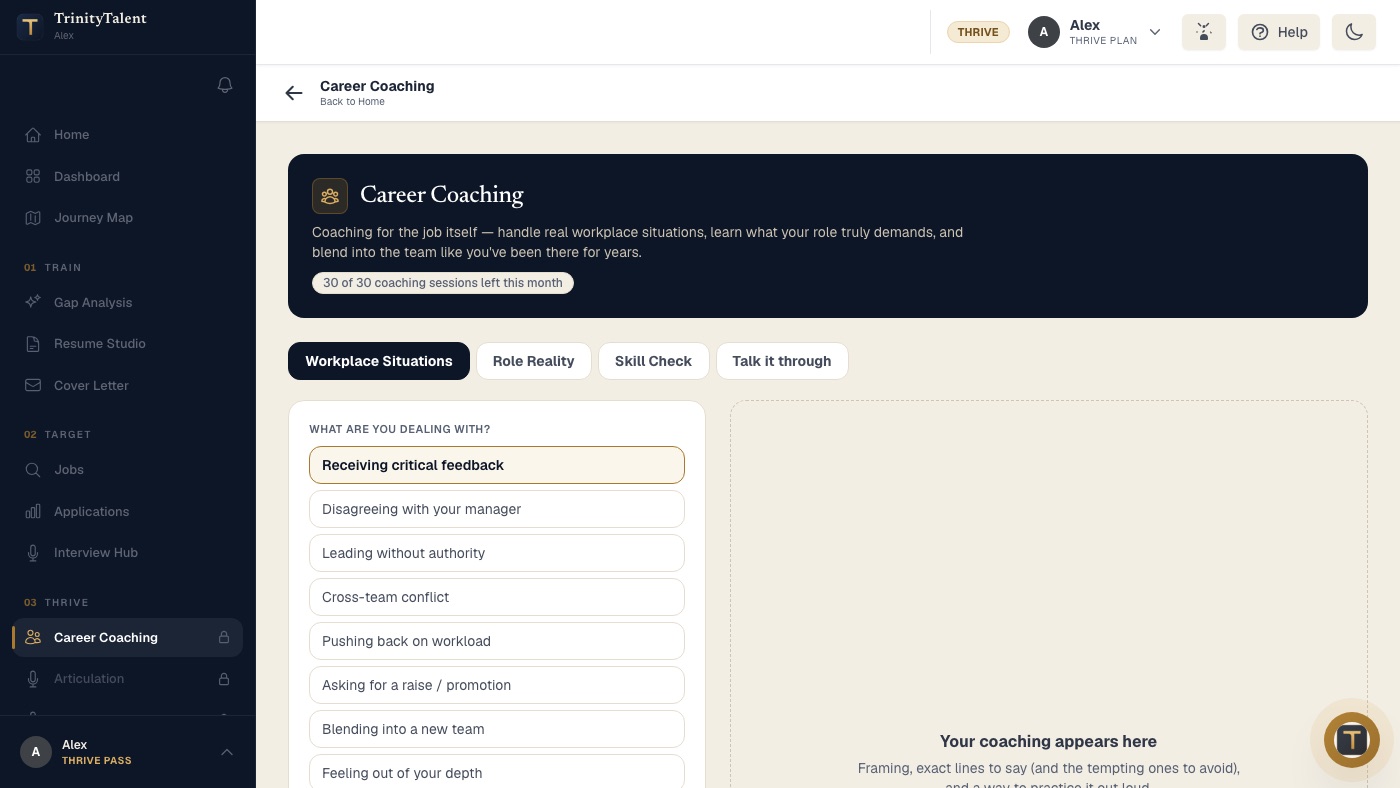
TrinityTalent's Career Coaching is coaching for the job itself, not only for getting one. Pick a workplace situation such as asking for a raise or promotion, receiving critical feedback, pushing back on workload or disagreeing with your manager, add a sentence of context about your role, and the coach gives you framing plus the exact lines to say and the tempting ones to avoid. You can then practise the conversation out loud before the real one.
Role Reality briefings describe what a role actually demands day to day, useful when a growth question becomes a real conversation about the next level. Skill Check turns any pasted job description into an 8-question practical check, so you can test yourself against the next role before you ask for it. Building, editing and exporting your resume on TrinityTalent is free.
Frequently asked questions
What should I ask my manager in a one-on-one?
Ask one question per meeting from one of five goals: priorities, feedback, growth, blockers or expectations. Good examples are "Which of my three current tasks matters most to you this month?" and "What is one thing I could do differently that would make your job easier?" Rotate the goals so feedback and growth come up regularly.
How often should I have a one-on-one with my manager?
Weekly or every two weeks is common, for 25 to 30 minutes. What matters more than frequency is that the meeting happens and has an agenda. A short weekly meeting with three prepared items is more useful than a long monthly one where both sides improvise.
Who should set the agenda for a one-on-one?
You should. The one-on-one is the employee's meeting, and your manager's items can go first if they have some. Send three lines the day before: one update, one question, one request. A manager who receives an agenda arrives prepared, and the meeting stops being a status report.
How do I bring up a promotion in a one-on-one?
Start months earlier with a growth question such as "What would I need to show for you to trust me with the next level?" Report progress against that answer in later meetings. When you finally ask, raise it at the start of the meeting, with the evidence your manager has already heard, and never alongside a difficult piece of feedback.
Put this into practice
Describe your next one-on-one in Career Coaching, from asking for feedback to raising a promotion, and get the exact lines to say and the ones to avoid.
Practise a mock interview