
How to Take Feedback at Work Without Getting Defensive
Learning how to take feedback at work comes down to four moves: listen to the end, clarify what was meant, thank the person, and decide what to do later. If you want to know how to take feedback at work without getting defensive, the last move is the one most people skip. Defensiveness is not a character flaw. It is a fast reaction to a perceived threat, and the fix is to slow the conversation down until the threat passes. This guide gives the method, the phrases that de-escalate, and the follow-up that makes feedback count.
TL;DR: When feedback arrives, listen without interrupting, then ask one clarifying question about a specific example. Thank the person for the information, not the opinion. Do not agree, disagree or explain in the moment. Say you will think about it and come back within two days. Then act on one thing and report back in two weeks.
Why defensiveness happens, and why it costs you
Critical feedback registers as a threat to your standing in the group. The body responds before the mind does: faster pulse, tighter voice, a sentence already forming that begins with "but". None of that is a decision, so telling yourself to stop being defensive rarely works.
The cost is real. When you explain or counter in the moment, the person learns that feedback is expensive to give you, and they give less of it. The next thing you hear is a line in a performance review, with no time left to fix it. People who are easy to give feedback to hear more of it, earlier, when it is still cheap.
The four-step method: listen, clarify, thank, decide later
- Listen to the end. Let the person finish the whole thought. Write down the words they use, because you will not remember them accurately later.
- Clarify with one question. Ask for a specific example or the effect. "Can you give me one instance where that happened?" or "What did that cost the team?" This moves the conversation from a judgement about you to a fact about the work.
- Thank them for the information. Not for the opinion, and not with a performance of gratitude. "Thank you for telling me directly" is enough. It signals that this was a safe thing to do.
- Decide later. Say when you will come back. "I want to think about this properly. Can I come back to you on Thursday?" The gap turns a reaction into a decision.
The method works because it separates hearing from judging. You can hear something fully and still, two days later, conclude that half of it was wrong.
Phrases that de-escalate
The words you use in the first thirty seconds set the temperature.
Say this:
- "Tell me more about that."
- "Which part concerned you most?"
- "I had not seen it that way. Give me a moment."
- "What would a good version have looked like?"
Avoid this:
- "Yes, but..." The "but" deletes the "yes".
- "That is not what I meant." Intent is not the subject. Effect is.
- "Everyone does that." Now you are defending a group instead of learning about yourself.
- "I already knew that." It closes the door on detail you need.
Ask for specifics, because vague feedback cannot be acted on
Most feedback arrives in adjectives: "too detailed", "not visible enough", "a bit abrupt". An adjective summarises several moments. Your job is to recover one.
Consider Priya, an analyst who is told by her manager that her presentations are "too much for the audience". She wants to say that the audience asked for the detail. Instead she asks: "Which slide lost them?" Her manager names the fourth slide, a table of 40 rows. That is a fact she can work with. The next deck has the table in the appendix and one chart in its place. The feedback was about one slide, not about her.
If the person cannot give an example, ask for the effect instead: "What happened as a result?" If they cannot give either, ask them to point it out next time it happens. That is a fair request.
Decide later: what to do in the two days
Use the gap for three things. First, separate the fact from the interpretation. "The report was two days late" is a fact. "You do not manage your time" is an interpretation. Second, look for a second source: an earlier comment, a pattern in your notes, a colleague you trust. Third, choose one action, not five.
Then go back as promised. A good return takes under two minutes: "I thought about what you said on Tuesday. You were right about the deadline, and I have moved my weekly planning to Monday morning. On the second point, I see it differently, and I would like to explain why." Agreeing with part and questioning part is more credible than agreeing with everything. If the disagreement is real, the guide on how to disagree with your manager covers that conversation.
Follow up in two weeks
The step that makes feedback count is the one nobody schedules. Two weeks after the conversation, tell the person what you changed and ask whether they have noticed a difference. "Since we spoke, I have sent the summary before the meeting each week. Is that landing the way you hoped?"
This shows the feedback was used, which makes people more willing to give it, and it turns a one-way judgement into a measured result you can put in your next self-assessment.
A worked example, start to finish
Daniel, a new project coordinator in his first 90 days, is told by a senior colleague that his status emails are "hard to follow". His instinct is to point out that the template was inherited. He does not. He asks which email was hardest, and she names one with the risks buried in the fourth paragraph. He thanks her and says he will look at it that evening. The next day he sends a revised format with a three-line summary at the top. Two weeks later he asks whether the emails are easier to follow now. She says yes, and mentions it to his manager. Nothing in that sequence required Daniel to agree with everything or to say anything clever.
How TrinityTalent helps
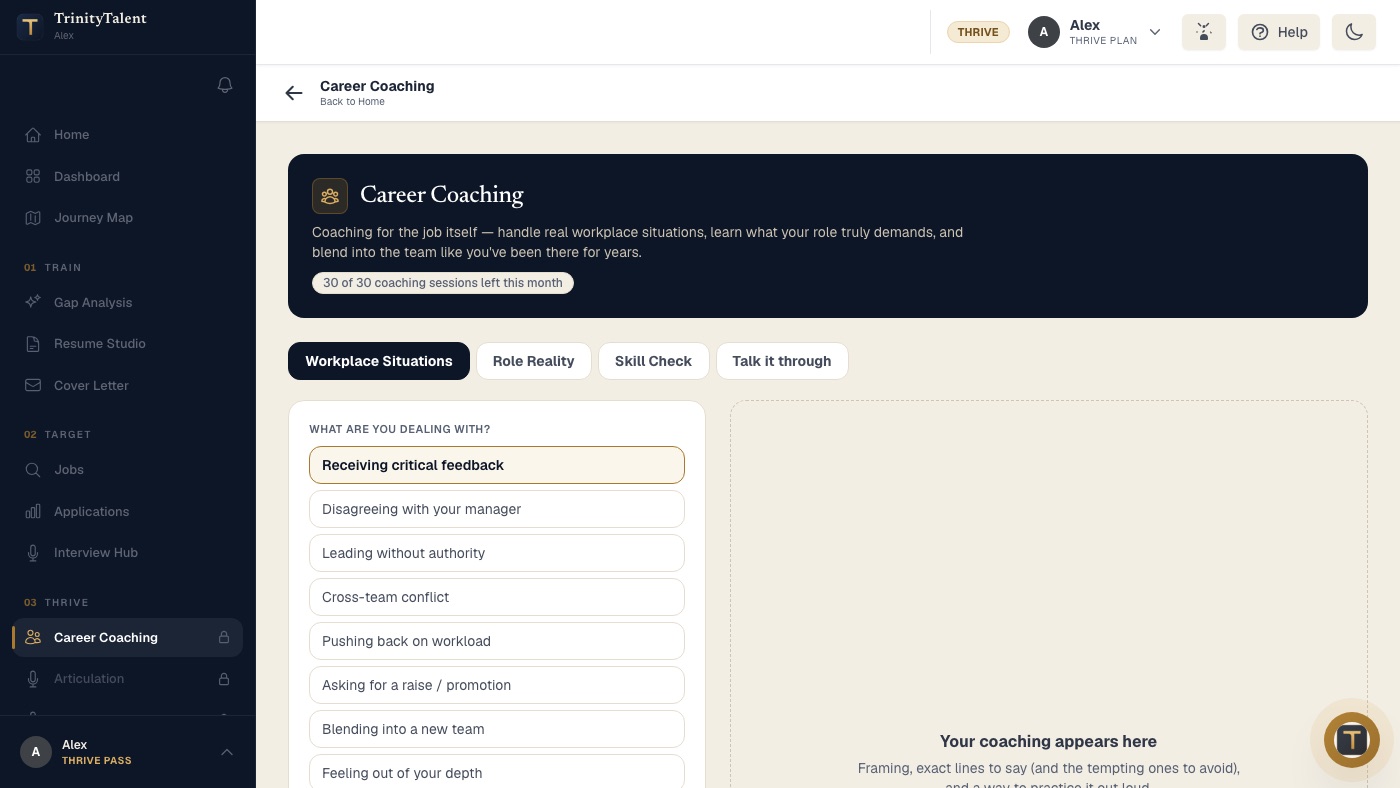
TrinityTalent's Career Coaching is coaching for the job itself. Choose "Receiving critical feedback" from the list of workplace situations, add a sentence of context about your role and what was said, and the coach gives you framing for the conversation plus exact lines to say and the tempting lines to avoid. You can then practise the return conversation out loud, so the words are ready before you need them.
Voice Studio covers how you sound when you deliver it, measuring pace, pauses and filler words from a recording that stays on your device, with an ESL Clarity Mode that coaches clarity and never accent. The same platform prepares you for the interview version of the question, "tell me about a time you received difficult feedback", with a live spoken mock interviewer. Building, editing and exporting your resume on TrinityTalent is free.
Frequently asked questions
What should I say when I receive negative feedback at work?
Say very little at first. Let the person finish, then ask one clarifying question about a specific example or effect, such as "Can you give me one instance?" Thank them for telling you directly, and say when you will come back with a response. Agreeing, disagreeing or explaining in the moment all work against you.
How do I stop getting defensive when I am criticized?
Accept that the first reaction is physical and will happen. Plan for it by having one sentence ready that buys time, such as "Give me a moment, I want to take that in." Write down the words used. The act of writing slows your response and moves your attention from yourself to the content.
Should I respond to feedback immediately or later?
Later, within two days. Acknowledge it immediately and promise a response by a named day. The gap lets you separate fact from interpretation, check with a second source, and choose one action. A considered response two days later is more credible than a fast one, and it shows the feedback was taken seriously.
What if I think the feedback is wrong?
Still follow the same four steps in the moment. Use the two days to check for a second source. When you return, agree with whatever part is fair, then explain your view of the rest with a specific example. Partial agreement is more credible than total agreement, and a clear disagreement delivered calmly is a sign of judgement, not defensiveness.
Put this into practice
Pick "Receiving critical feedback" in Career Coaching, describe the situation, and get exact lines to say and to avoid before your next one-on-one.
Practise a mock interview