
Interview Tips for Non-Native English Speakers
The most useful interview tips for non-native English speakers have nothing to do with accent. Interviewers do not hire accents; they hire people they could understand, and understanding depends on pace, sentence length and which words you stress. Most interview tips for non-native English speakers focus on sounding more like a native speaker, which is slow, discouraging and unnecessary. This guide focuses on being clear: how to slow down, shorten sentences, stress the words that carry meaning, ask for repetition without apology, and prepare phrases for the questions you know are coming.
TL;DR: Clarity is the goal, not accent. Speak slower than feels natural and finish every word. Keep sentences under 15 words, one idea each. Stress the nouns and numbers that carry the meaning. If you miss a question, ask for it again in a confident, prepared phrase. Write and rehearse short answers to the eight most common questions. Record yourself and listen for clarity, not for accent.
Clarity, not accent
An accent is how you pronounce sounds. Clarity is whether the listener receives the words. Only one of them matters in an interview. Many people with strong accents are perfectly clear, because they speak at a steady pace, finish their words and use short sentences. Many native speakers are unclear, because they rush, mumble and never finish a sentence.
Changing an accent in the weeks before an interview is not realistic and not needed. Becoming clearer is realistic, and it works within days. Everything below is about clarity.
Slow the pace and finish the words
Speaking a second language under pressure goes one of two ways: very fast, to get through it, or very hesitant, with long searches for words. Both hurt clarity.
The fix for speed is to finish every word. Say the last sound of each word before starting the next one. For English this often means the final consonant, which many languages do not stress: "worked" not "work", "projects" not "project". Finishing the word slows the pace on its own and makes the grammar audible, which is where many misunderstandings start. If you speak quickly by habit, /blog/talking-too-fast-in-interviews/ shows how to measure and fix it.
The fix for hesitation is preparation, covered below. A prepared answer has fewer searches in it.
Shorter sentences, one idea each
Long sentences are the enemy of clarity in any language, and in a second language they collapse more often, because the grammar has to hold for longer. Aim for sentences under 15 words with one idea each.
Compare:
"When I was working at my previous company which was a logistics firm in Mumbai I was responsible for the coordination of the inbound shipments and also for the documentation which was quite complex because of the customs."
"I worked at a logistics firm in Mumbai. I coordinated inbound shipments. I also handled the customs documentation, which was complex."
The second version says the same thing in three sentences, each understandable alone. If the listener misses one, they still have the other two.
Stress the words that carry meaning
English listeners follow meaning through stressed words, usually the nouns, numbers and main verbs. If every word gets the same weight, the sentence sounds flat and the listener works harder to find the point.
Take the sentence "I reduced late deliveries by 30 percent in six months." The words that carry the meaning are "reduced", "late deliveries", "30 percent" and "six months". Say those slightly louder and slightly longer. Let "I", "by" and "in" be quick and quiet. Practise with five sentences from your resume, marking the stressed words first.
Ask for repetition, confidently
Missing a question is not a failure. Guessing at a question you did not hear and answering something else is. The difference between candidates is how they recover.
Prepare two or three phrases and say them without apology:
- "Could you repeat the question, please?"
- "I want to make sure I answer the right question. Are you asking about X or Y?"
- "Just to confirm, you would like an example of a time I managed a conflict?"
The third phrase is the strongest, because it shows you understood most of the question and are checking one part. Say it at a normal pace with a falling tone. Do not say "Sorry, my English..." Nothing about your English needs an apology, and the phrase draws attention to the one thing that does not matter.
Prepare phrases for the questions you know are coming
Most interviews use the same eight to ten questions. For each one, write a short answer in simple sentences, then rehearse it aloud until you can say it without reading. You are not memorising a script; you are building phrases your mouth already knows, so fewer words have to be found live.
A worked example
Question: "Why do you want to work here?"
Nguyen Thi Lan, applying for an accounts payable role, prepared this: "Three reasons. First, the posting asks for someone who can handle high volume, and I processed about 400 invoices a week in my last role. Second, your team uses a system I already know. Third, I want to stay in the manufacturing sector, and this company is growing." Thirty seconds, short sentences, stressed numbers, and a structure that tells the listener when it will end.
Prepare the same way for "tell me about yourself", a strength, a weakness, a conflict, a mistake, a success with a number, why you are leaving, and your questions for them.
Environment and format
If the interview is by video, use headphones with a microphone and test them with a friend. Poor audio makes any speaker harder to understand and is often blamed on the speaker. Sit where the light is on your face; interviewers understand more when they can see your mouth. By phone, take the call in a quiet room and speak slightly slower, because the listener has no visual help.
Record yourself and listen for clarity
You cannot hear your own clarity while speaking. Record one prepared answer on your phone and ask only clarity questions: Did I finish the words? Were the sentences short? Did the important words stand out? Do not listen for accent; that is not the question. Fix one thing, record again, compare.
How TrinityTalent helps
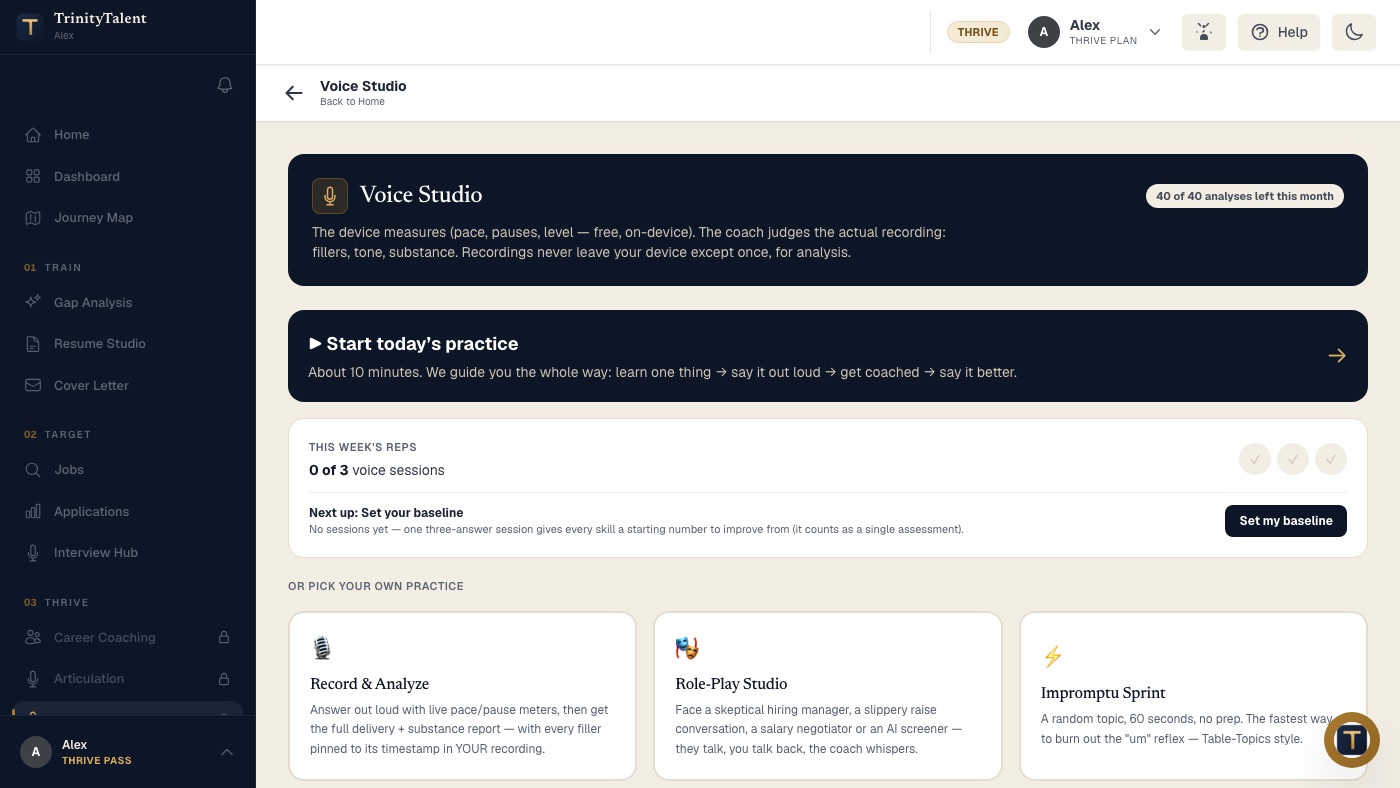
Voice Studio in TrinityTalent has an ESL Clarity Mode built for exactly this. It listens to your actual recording and coaches clarity and pace, and it never comments on accent, because accent is not the problem. You get your words per minute, your pauses and your filler words with a transcript that marks each one, so you can check whether the words were finished and the sentences were short. The recording stays on your device. Articulation Training lets you answer real scenarios for your target role and scores structure, clarity and conciseness with the evidence quoted back, then rewrites your answer sharper. The Interview Hub adds a full mock interview with a live spoken interviewer. Everything is free while the product is in beta, with no credit card required, and nothing is ever sent to an employer unless you send it.
Frequently asked questions
Will my accent cost me the job in an English interview?
Very rarely. Interviewers hire people they can understand, and understanding depends on pace, sentence length and stress on the right words, not on accent. Many people with strong accents are perfectly clear. Focus your preparation on clarity, which improves within days, rather than on accent, which takes years and does not need to change.
What should I say if I do not understand an interview question?
Ask, without apology, in a phrase you have prepared: "Could you repeat the question, please?" or "Just to confirm, you are asking about a time I handled a conflict?" The second is stronger because it shows you understood most of it. Say it at a normal pace with a falling tone. Never open with "Sorry, my English..."
How can I improve my English quickly before an interview?
You cannot change your overall English level in two weeks, but you can be much clearer. Write short answers to the eight most common questions in simple sentences and rehearse them aloud. Practise finishing every word, keeping sentences under 15 words and stressing the nouns and numbers. Record yourself and listen for clarity only.
Is it acceptable to speak slowly in an English interview?
Yes. A steady, slightly slower pace is easier to follow and is heard as thoughtful, not as weak. Rushing is the far more common problem, and it hurts clarity for every speaker. Aim to finish each word, pause at the end of each sentence, and let the interviewer ask for more if they want it.
Put this into practice
Turn on ESL Clarity Mode in Voice Studio, record one answer, and get coaching on pace and clarity that never mentions your accent.
Practise a mock interview