
Interview Anxiety: A Practical Plan for the 48 Hours Before
Interview anxiety is mostly a reaction to uncertainty, and uncertainty can be reduced. You cannot control the questions, the interviewer's mood or the outcome, but you can control whether your stories are ready, whether you know the route, and whether you have said your answers aloud before the day. Most interview anxiety fades when those three things are handled. This guide is a 48-hour plan: what to do two days before, the night before, the morning of, and in the room when your heart rate climbs anyway.
TL;DR: Two days before, finish your six stories and rehearse them out loud once, fully. The night before, pack, check the route and stop preparing by early evening. The morning of, eat, move and warm up your voice. In the room, use three resets: exhale before you answer, feet flat on the floor, repeat the question in your first sentence. Nerves stay; they do not run the interview.
Why preparation is the treatment
Anxiety rises when the brain predicts a threat it cannot map. An interview offers plenty: unknown questions, an unknown person, a judgment you cannot see. Preparation does not remove the stakes, but it removes the unknowns, which are what the body reacts to.
Write down what specifically you are worried about. "They will ask something I cannot answer." "I will forget my examples." "I will be late." Each has a concrete preventive action. Anxiety that has been turned into a list is already smaller than anxiety that is a cloud.
Two days before: remove the unknowns
- Finish six stories. Most behavioural questions can be answered from six stories: a result you are proud of, a conflict, a mistake, a deadline, a time you led, a time you learned fast. Write each as a headline plus three or four facts, not a script; scripts break under pressure.
- Prepare your opening. "Tell me about yourself" is almost certain. Have a 60-second version you can say without reading.
- Prepare three questions to ask. Written down. A planned ending removes one whole category of worry.
- Know the logistics. The address, the entrance, who to ask for, the video link and the software it needs. Test the link.
- Do one full spoken rehearsal. Say your opening, four stories and your three questions out loud, in order, as if it were real. Once. This is the most effective step in the plan, because it turns the interview from something imagined into something you have done.
If you have no one to rehearse with, /blog/mock-interview-practice/ covers how to do it alone or with a simulated interviewer.
The night before: stop early
The temptation is to keep preparing. Resist it. Anything you learn after about seven in the evening will be shallow and will cost you sleep, which affects your performance more than one more hour of notes.
- Lay out your clothes and pack your bag: resume copies, a notebook, a pen, water, ID.
- Check the route once more, including where you will wait if you arrive early.
- Read your six story headlines once. Do not rehearse them again.
- Do something unrelated for the last hour.
- Go to bed at your normal time. Earlier than normal often backfires.
If you wake in the night with a racing mind, write down whatever it is saying and go back to bed. Most of it will look small in the morning.
The morning of: body first
Eat something with protein, even if you do not feel hungry; an empty stomach and adrenaline together produce shakiness that reads as nerves. Move for ten minutes: a brisk walk, stairs, stretching. Movement burns off some of the adrenaline the body has already made.
Then warm up your voice. Read a paragraph aloud, slowly, finishing every word, and say your opening once. This means the first words you say to the interviewer are not the first words you have said that day. A cold voice cracks, and hearing your own voice crack raises anxiety further.
Arrive fifteen minutes early, no more. Forty minutes in a lobby feeds the nerves you just worked off.
In the room: three resets
Your heart rate will climb when you sit down. That is normal and the interviewer expects it. What you need is a way to bring it back in the first two minutes and to recover if a question knocks you sideways. Three resets do this.
Reset one: exhale before you answer
When the question ends, breathe out slowly for two seconds before you speak. Not in; out. The out-breath slows the heart rate, lowers the shoulders and gives you a beat to choose your first sentence. To the interviewer it looks like thought.
Reset two: feet flat, hands still
Put both feet flat on the floor and rest your hands on the table or your lap. Shaking legs and fidgeting hands are fed by the body's need to move. Grounding them removes the movement and most of the feeling behind it.
Reset three: repeat the question
If your mind goes blank, start your answer by restating the question: "How did I handle a disagreement with a manager? The clearest example is..." Repeating it buys three seconds and usually knocks the story loose. If it does not, say "Let me think for a moment", pause, then answer. Interviewers rate a considered answer above a fast one.
A worked example
Elena Sousa, interviewing for a laboratory technician role, was asked about a time she found an error in someone else's work. Her mind went blank. She exhaled, pressed her feet to the floor and said, "A time I found an error in a colleague's work. The one I think of first was a mislabelled sample batch." From there, the story came. The exhale felt like ten seconds to her; to the panel it looked like a second of thought.
What to do when it goes wrong anyway
If you hear yourself rambling, stop. Say, "Let me give you the short version," and give the one-sentence answer. Interviewers respect the recovery more than they mind the stumble. If you misstate a fact, correct it. Nobody loses a job for a corrected date; people lose jobs for pretending a wobble did not happen and letting the next three answers carry it.
If anxiety is severe, persistent and reaches beyond interviews into daily life, raise it with a doctor. This plan is for the ordinary kind most candidates carry into most interviews.
How TrinityTalent helps
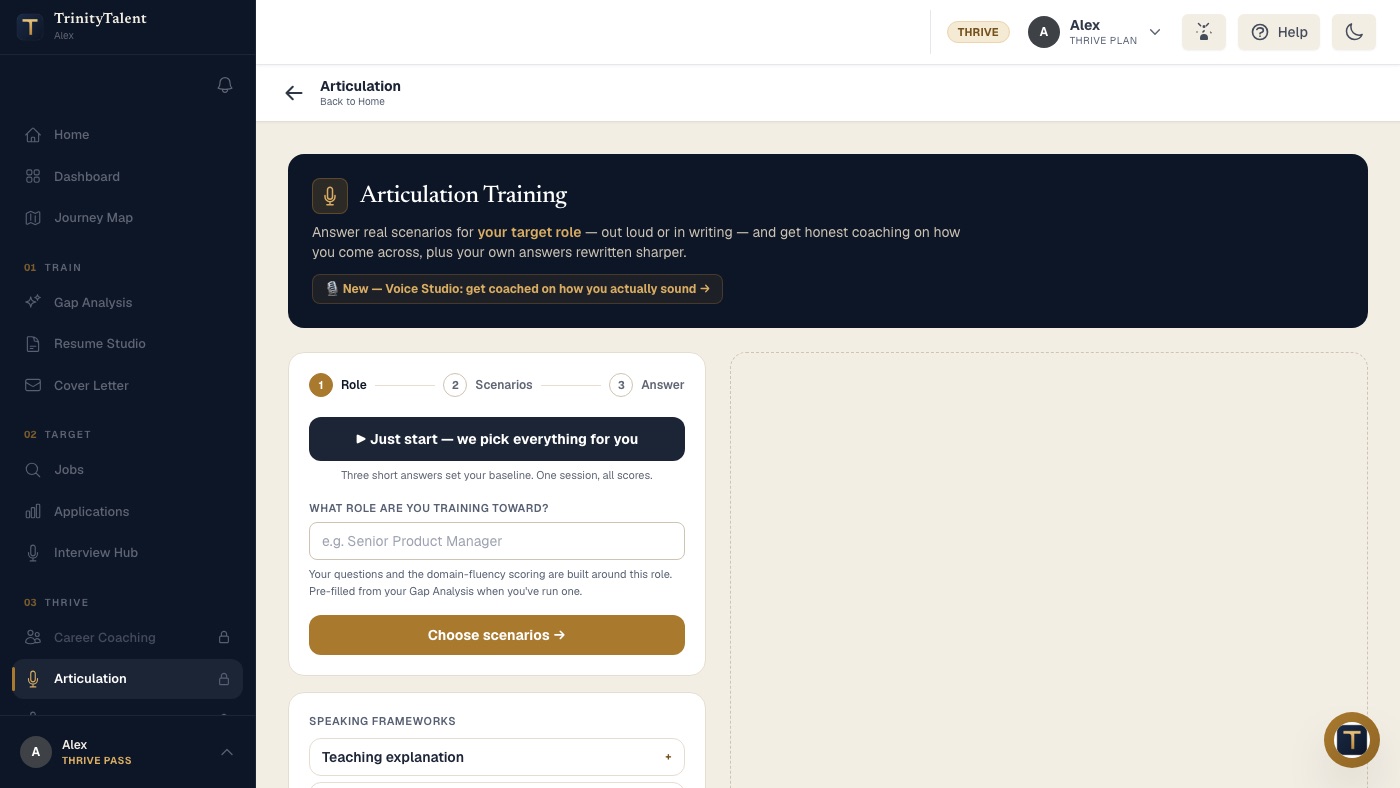
The full spoken rehearsal two days before is the step that does the most, and the one candidates most often skip because it is uncomfortable to do alone. Articulation Training in TrinityTalent gives you a real scenario for your target role and lets you answer out loud or in writing. It returns an honest rubric on structure, clarity, conciseness and confidence, quotes the evidence behind each score, rewrites your answer sharper and offers a practice plan. That is a rehearsal with feedback, not a rehearsal into silence. The Interview Hub's mock interview adds a live spoken interviewer, and Voice Studio measures pace, pauses and fillers from a recording that stays on your device. Building, editing and exporting your resume on TrinityTalent is free.
Frequently asked questions
How do I calm interview anxiety the night before?
Stop preparing by early evening, pack your bag and check the route, then do something unrelated for the last hour. Read your story headlines once but do not rehearse again. Go to bed at your normal time. Sleep affects performance far more than one extra hour of notes, and late preparation usually feeds anxiety.
Is it normal to feel anxious before a job interview?
Yes. Almost everyone feels some anxiety before an interview, and interviewers expect it. The goal is not to remove the feeling but to keep it from running the conversation. Preparation that lowers uncertainty, a body-first morning and a few in-room resets are enough for most people to perform well while still nervous.
What should I do if my mind goes blank in an interview?
Breathe out slowly, then restate the question as the start of your answer: "A time I managed a tight deadline? The clearest example is..." Repeating it buys a few seconds and usually brings the story back. If it does not, say "Let me think for a moment" and pause. A considered answer is rated higher than a fast one.
Does practising out loud really reduce interview anxiety?
Yes, more than any other single step. Anxiety comes from the unknown, and an interview you have only imagined is entirely unknown. One full spoken rehearsal, in order, turns it into something you have already done once. The second time, in the real room, the body recognises the situation and reacts less strongly.
Put this into practice
Do one full spoken rehearsal in Articulation Training the day before your interview and read the honest feedback while there is still time to adjust.
Practise a mock interview