
Imposter Syndrome, New Job: What Helps and What Does Not
If you typed "imposter syndrome new job" into a search bar this week, you are in the most common window for it: the feeling that everyone else knows what they are doing and you were hired by mistake. Imposter syndrome in a new job is not a sign that you are unqualified. It is the predictable result of being measured against people who have had months or years to learn what you are learning now. This guide explains why it peaks in weeks two to eight, what makes it worse, and the four things that reliably help.
TL;DR: Imposter feelings peak between weeks two and eight, when you know enough to see the gap and not enough to close it. Reassurance and overwork make it worse. Keep a dated log of what you did and learned. Ask questions in the first month, when they are free. Sort each worry into a skill gap with a plan or a confidence gap to check against evidence. Tell your manager about the first kind.
Why it peaks in weeks two to eight
In week one, everything is new and nobody expects anything. By week two you understand enough to notice how much you do not know, and you start comparing yourself with colleagues who had a head start. By week eight you are expected to contribute, but you are still slower than the people around you. That is the trough.
The comparison is the problem. You are measuring your day 20 against their day 800 and calling the difference a verdict on you. Most people come out the other side by month three or four, not because they became brilliant but because the comparison stopped being so uneven.
What does not help
- Seeking reassurance. Asking a colleague "am I doing okay?" produces a kind answer and no information. The relief lasts a day. The question returns.
- Overworking to compensate. Twelve-hour days in month one buy a little output and a lot of fatigue, and fatigue makes the feeling louder.
- Hiding what you do not know. Nodding in a meeting and searching afterwards costs you the answer and the chance to be seen learning. It also makes month three harder, when the same question is no longer free.
- Waiting to feel ready before contributing. Readiness follows contribution.
Keep an evidence log
The feeling says "I have done nothing useful here". The log says otherwise, in writing, with dates. Each day, in two minutes, write down one thing you did, one thing you learned, and one thing someone said to you that was specific and positive. Not adjectives: "good job" does not count, "the summary you sent saved me an hour" does.
Consider Farah, a policy analyst in her third week. Her log for one day reads: "Did: drafted the briefing note on the transit file, sent for review. Learned: how the approval chain works, and that the director reads only the first paragraph. Heard: Kwame said my table was the first one he did not have to redo." None of that is remarkable. Read back over three weeks, it is a record of someone who is doing the job.
When the feeling arrives at 11pm, you can check it against the entries rather than against your mood. Feelings are not evidence. The log is.
Ask questions early, when they are free
In the first month, every question is expected. "How does the approval process work?" from a new hire is normal. The same question in month four raises an eyebrow. So front-load them. Keep a running list, batch the small ones, and ask a senior colleague for fifteen minutes twice a week. Frame each question with what you already tried: "I looked at the shared drive and the handbook and could not find who signs off on vendor invoices. Who should I ask?"
Asking well is a visible skill. Colleagues remember the new person who asked clear questions and acted on the answers. This is also how the first 90 days build trust: through visible learning, not hidden effort.
Separate skill gaps from confidence gaps
Not all of the feeling is unfounded. Some of it points at a real gap, and treating a real gap as a mood is as unhelpful as the reverse. Write each worry down and sort it.
A skill gap is specific and testable: "I cannot build the monthly forecast without help." It has a plan: watch it done once, do it with supervision, do it alone, by a date. A confidence gap has no test: "I do not belong here." It has no plan, because nothing you could do would close it. It responds only to evidence, which is what the log is for.
Ramon, a developer six weeks into a new team, wrote down eight worries. Five were confidence gaps. Three were skill gaps: the deployment process, the testing framework, and the domain vocabulary. Those three became a four-week plan. The other five went back to the log. A structured skills gap analysis does the same sorting against the role, with a readiness score instead of a feeling.
When to talk to your manager
Tell your manager about skill gaps, with a plan. "I am slower on the reporting tool than I want to be. I have booked time with Aisha to go through it, and I expect to run it alone by the end of the month." That is a new hire managing their own development, which is what managers hope to see.
Do not bring confidence gaps to your manager as confidence gaps. "I feel like a fraud" asks them to reassure you, and reassurance from a manager carries a cost you cannot see. Bring the evidence question instead: "Which parts of the first month have gone as you hoped, and where would you like more from me?" That gets you real information and shows you can take it.
Look at the progress record
The feeling lives in the present tense. The cure is a longer view. Once a week, read the log from the start. Once a month, write three lines on what you can now do that you could not do on day one. By month three, the week-three version of you looks like a different person, which is the point.
How TrinityTalent helps
TrinityTalent's Gap Analysis is built for the sorting step. Tell it the role you have just started, and it scores your readiness, names the specific skill gaps, and builds a dated 90-day plan with free resources first, so a worry becomes either a plan or a confidence gap you can set aside. Re-run it monthly and the score moves.
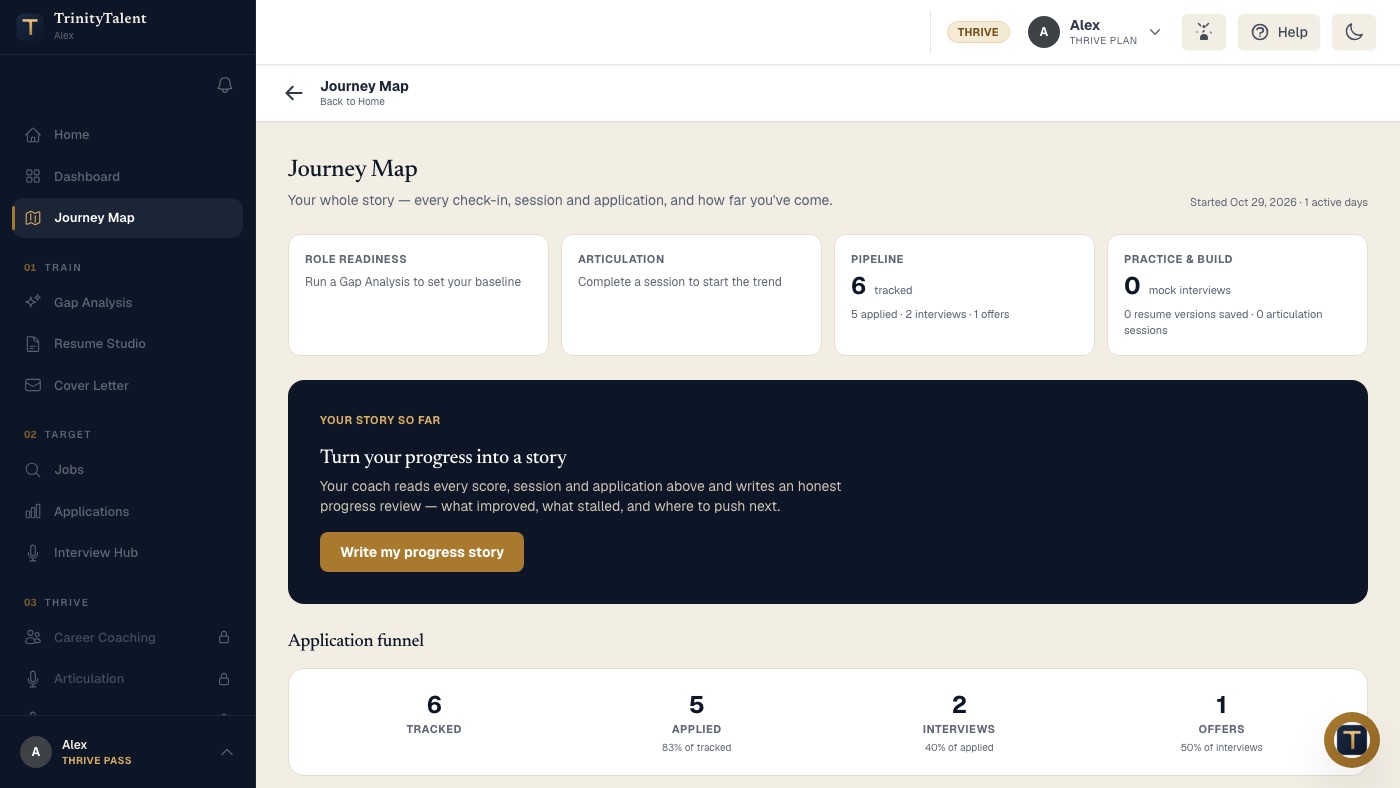
The Journey Map is the progress record: readiness scores over time, practice sessions, and milestones in one dated timeline, with an honest written progress review of what improved and what stalled. Career Coaching covers the conversations themselves, with say-this and avoid-this scripts for "feeling out of your depth" and "blending into a new team", and Role Reality briefings on what the role actually demands day to day. Articulation Training lets you practise the questions you are still nervous to ask out loud. Building, editing and exporting your resume on TrinityTalent is free.
Frequently asked questions
Is it normal to feel like a fraud in a new job?
Yes. Most people feel it between weeks two and eight, when they know enough to see how much they do not know and are comparing themselves with colleagues who have had months to learn it. It usually fades by month three or four as the comparison becomes fairer and the evidence of your own work builds up.
How long does imposter syndrome last in a new job?
For most people the acute phase lasts from about the second week to the end of the second month. It shortens when you keep a dated log of what you did and learned, ask questions early, and turn specific gaps into plans. It lengthens when you overwork, hide what you do not know, and seek reassurance instead of evidence.
Should I tell my manager I have imposter syndrome?
Tell your manager about specific skill gaps, each with a plan and a date. Do not ask them to fix the feeling itself, because reassurance from a manager carries a cost. Instead ask an evidence question: which parts of the first month went as they hoped, and where they want more from you.
What is the difference between imposter syndrome and actually being underqualified?
A real gap is specific and testable, such as not being able to run a process alone, and it has a plan that closes it by a date. Imposter syndrome is a general judgement with no test and no plan. Write each worry down and sort it. The specific ones get a plan; the general ones get checked against your evidence log.
Put this into practice
Run a Gap Analysis against your new role to separate real skill gaps from confidence gaps, then let the Journey Map keep the dated record of what you have already done.
Practise a mock interview