
How to Say No at Work Without Damaging Trust

The reliable way to say no at work is to turn the no into a choice: "I can do A or B by Friday, which matters more?" If you are searching for how to say no at work because every yes has left you with more than you can finish, the trade-off frame is the answer to most situations. It refuses nothing. It makes the cost of the request visible and hands the decision to the person who owns the priorities. This guide covers that frame, the not-yet no, when to escalate, and scripts for five situations.
TL;DR: Do not say no to the request. Say yes to the priority and show the trade-off: "I can do this or the report by Friday, not both." When the answer is not now, give a date. When two people's requests conflict, escalate the choice to your manager rather than deciding alone. Keep the no short, specific and free of apology.
Why a plain no damages trust, and why a plain yes does too
A flat "no" reads as a judgement about the request or the person. A flat "yes" that you cannot deliver is worse, because the failure arrives later, when it is harder to fix, and the person learns your yes means nothing. Trust is built by predictability: when you agree to something it happens, and when you cannot, people hear it early. The trade-off frame satisfies both. It says: I am willing, I am at capacity, and here is the decision that needs making.
The trade-off frame
The structure has three parts:
- Acknowledge the request as legitimate. "That makes sense, the client is waiting."
- State the constraint as a fact about time, not about you. "I have the audit file due Thursday, which takes the rest of the week."
- Offer the choice. "I can do the client deck or the audit file by Thursday. Which should come first?"
The third part is the whole method. You are not refusing. You are asking for a priority call from someone entitled to make it.
Consider Nadia, a marketing coordinator, asked on Wednesday to build a launch page by Friday, when she already owes the monthly report. Say this: "I can get the launch page done by Friday if the report moves to Monday. Can you check with Raj whether that works?" The product manager now owns the trade-off. Nadia said no to nothing.
The not-yet no
Some requests are reasonable but badly timed. The not-yet no accepts the work and moves the date: "Yes, and the earliest I can start is the 14th. Does that still help?"
Two rules make it work. Give a real date, not "when things calm down". And ask whether the date still serves the need, because often it does not, and the request goes elsewhere. If the person insists on the original date, you are back to the trade-off frame.
Escalate priorities to your manager
When two people with authority give you conflicting work, do not choose between them silently; one of them will be surprised, and surprise is what damages trust. Take the conflict to your manager as a decision, with the options laid out:
"Two requests landed this week that I cannot both finish by Friday: the vendor comparison for Priya and the board summary for you. I think the board summary matters more, but I want to check before I tell Priya it will be Tuesday."
This is not passing the problem upward. It is giving the person with the widest view the information they need. The one-on-one meeting is the place for the recurring version of this conversation, when the volume of requests itself is the problem.
Scripts for five situations
Each script follows the same pattern: acknowledge, constraint, choice or date.
Your manager adds an urgent task to a full week
Say this: "Understood, I will start on it. To make room, the process document slips to next Wednesday. Is that acceptable, or should something else move instead?"
Avoid this: "I am already completely swamped." It describes your state without giving anyone a decision to make.
A peer asks for help you do not have time for
Say this: "I want to help and I cannot this week. I can give you thirty minutes on Monday to walk you through the template, if that would get you started."
Avoid this: "Sorry, too busy." Closed, and it leaves the peer with nothing.
A client or stakeholder asks for scope that was not agreed
Say this: "We can add the export feature. It would move the release from the 20th to about the 30th, or we could put it in the next phase. Which would you prefer?"
Avoid this: "That is out of scope." Even when true, it sounds like a wall rather than a choice.
A meeting invitation you should not accept
Say this: "I do not think I add much to this one. If a decision needs my input, send me the question and I will answer in writing the same day."
Avoid this: Accepting and not attending. Silent absence costs more trust than a clear decline.
Work that belongs to someone else keeps arriving on your desk
Say this: "I have been covering the invoice queries since Sam left. I can keep doing it until the end of the month. After that we need an owner, and I would like to raise it with Dana."
Avoid this: Continuing indefinitely and then resenting it. The person asking may not know it was never your job.
What a bad no sounds like
- The apology cascade. "I am so sorry, I really wish I could, I feel terrible." Apology inflates the refusal and invites the other person to comfort you.
- The false yes. "Sure, I will try to fit it in." The other person hears yes. You meant probably not. The failure arrives on the deadline.
- The blame. "My manager will not let me." It moves the problem to a third person and makes you look like a messenger.
- The silent no. Ignoring the request and hoping it goes away. It rarely does, and the delay becomes the story.
A good no is short, names a constraint the other person can verify, and ends with a choice or a date. More than three sentences means you have started to defend rather than to decide. When the conflict is with your manager's view rather than their request, see how to disagree with your manager.
How TrinityTalent helps
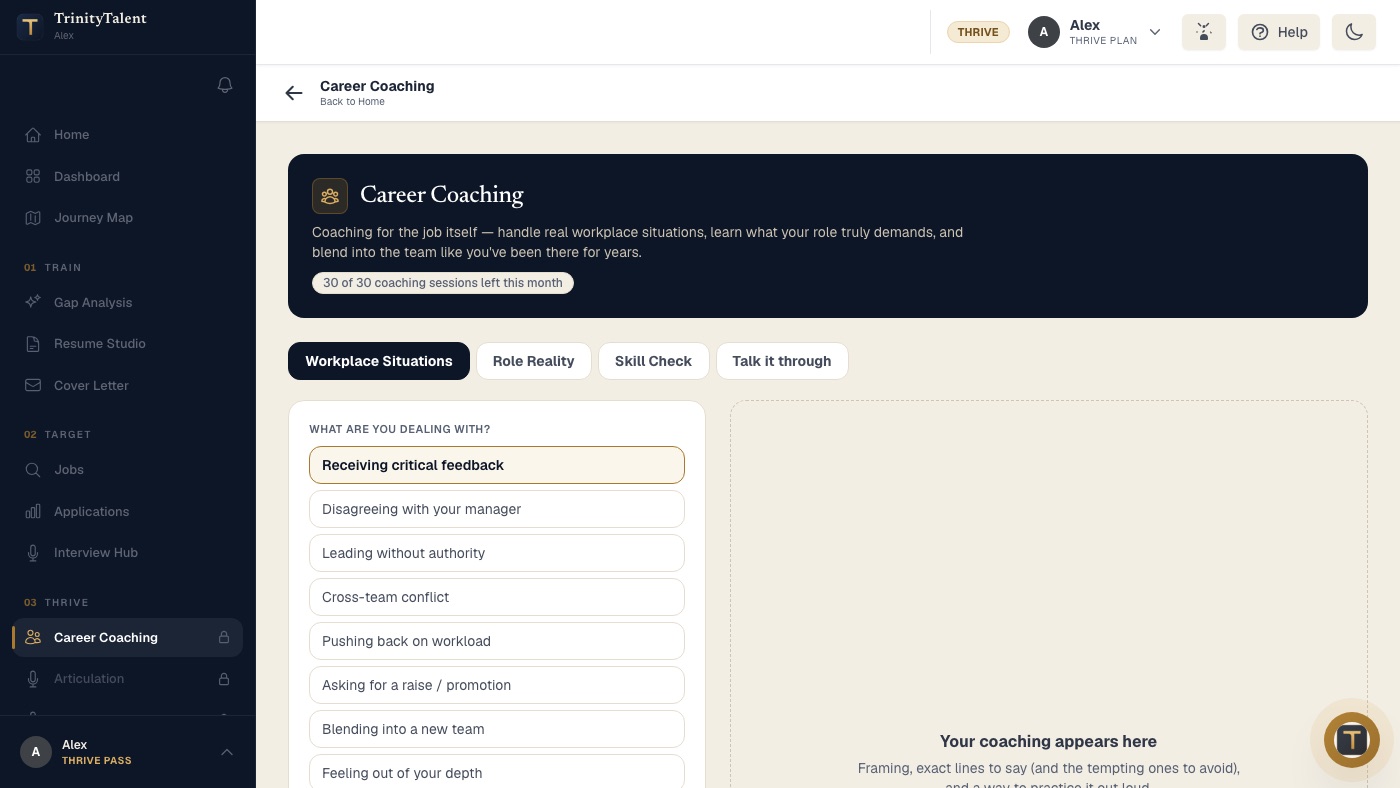
TrinityTalent's Career Coaching is built for this kind of conversation. Choose "Pushing back on workload" from the list of workplace situations, or describe your own, add a sentence about your role and what is being asked, and the coach gives you framing plus the exact lines to say and the tempting lines to avoid. Other situations include disagreeing with your manager, leading without authority and cross-team conflict, where most competing requests come from.
Because saying the words out loud is different from reading them, you can rehearse with Voice Studio's role-play for difficult workplace conversations, with a recording that stays on your device. The ESL Clarity Mode coaches clarity and pace, never accent. Building, editing and exporting your resume on TrinityTalent is free.
Frequently asked questions
How do I say no to my boss without sounding difficult?
Do not say no to the task. Say yes and show the trade-off: "I can do this if the report moves to Monday. Is that acceptable, or should something else move?" Your manager keeps the decision, you keep your credibility, and nothing about your willingness is in question.
Is it okay to say no to extra work?
Yes, when saying yes would mean failing on something already agreed. The honest answer protects the work that is already promised. Frame it as a choice between priorities, give a real date if the work can wait, and escalate to your manager when two people's requests conflict and you cannot decide between them alone.
How do I decline a request from a coworker?
Acknowledge that you would like to help, state the constraint as a fact about time, and offer a smaller alternative if one exists: thirty minutes on Monday, a template, a name of someone who can help. Avoid a long apology or a long explanation. A short, warm, specific no is remembered better than a reluctant yes that fails.
What if I keep saying no and it starts to look like a pattern?
If most requests get a no, the problem is the volume of work rather than your responses. Take that to your manager as a pattern, with a list of what arrived in the last month and what it displaced. That conversation is about capacity and ownership, and it belongs in a one-on-one rather than in each individual refusal.
Put this into practice
Pick "Pushing back on workload" in Career Coaching, add the request you are facing, and get the trade-off lines to say and the ones to avoid.
Practise a mock interview