
How to Respond to a Job Offer Email (Templates Included)
Knowing how to respond to a job offer is a small skill with a large effect on how your new employer sees you. The rules for how to respond to a job offer are simple: reply within one business day, ask for everything in writing, request a reasonable amount of time, and then send one of three emails, which accept, ask for more time, or negotiate. Most people get into trouble by doing these out of order. This guide gives the order, the timing and the exact templates.
TL;DR: Acknowledge the offer within one business day, with thanks and no decision. Ask for the full written offer if you have not received it. Request two to five business days to review it. Then send one of three emails: accept, ask for more time, or negotiate one or two specific points. Keep every email short, warm and in writing.
Step one: acknowledge within a day, decide later
The first email is not a decision. It is a receipt. Employers worry when a candidate goes silent after an offer, and a quick reply removes that worry while giving you time to think. Send it within one business day. Three sentences are enough: thank them, say you are pleased, and say when you will respond in full.
Subject: Re: Offer for Payroll Coordinator
Dear Ms. Okafor,
Thank you for the offer. I am very pleased and grateful for the confidence the team has shown in me. I would like to review the details carefully and will come back to you with a full response by Thursday, November 6.
Kind regards, Priya Raman
Notice what is missing: no "yes", no questions about salary, no mention of other offers. Those come later.
Step two: get the full offer in writing
A verbal offer over the phone is a promise, not a document. Before you evaluate anything, you need the written offer, which in Canada is usually an offer letter or an employment agreement. It should state the title, start date, salary, vacation entitlement, benefits and their start date, any probation period, the reporting manager and the work location.
If the phone call came first, ask for the letter in your acknowledgement email:
Could you send the written offer, including the benefits summary and the employment agreement, so I can review the full package?
A hesitation here is a warning sign. Any serious employer expects this request. See how to evaluate a job offer for what to check once the document arrives.
Step three: ask for time, and name a date
Two to five business days is a normal review period. Most employers will grant it without comment when you name a specific date. "I need some time" invites a follow-up; "I will confirm by Thursday" does not.
If you are waiting on another process, say so briefly and honestly, without describing it as a competition.
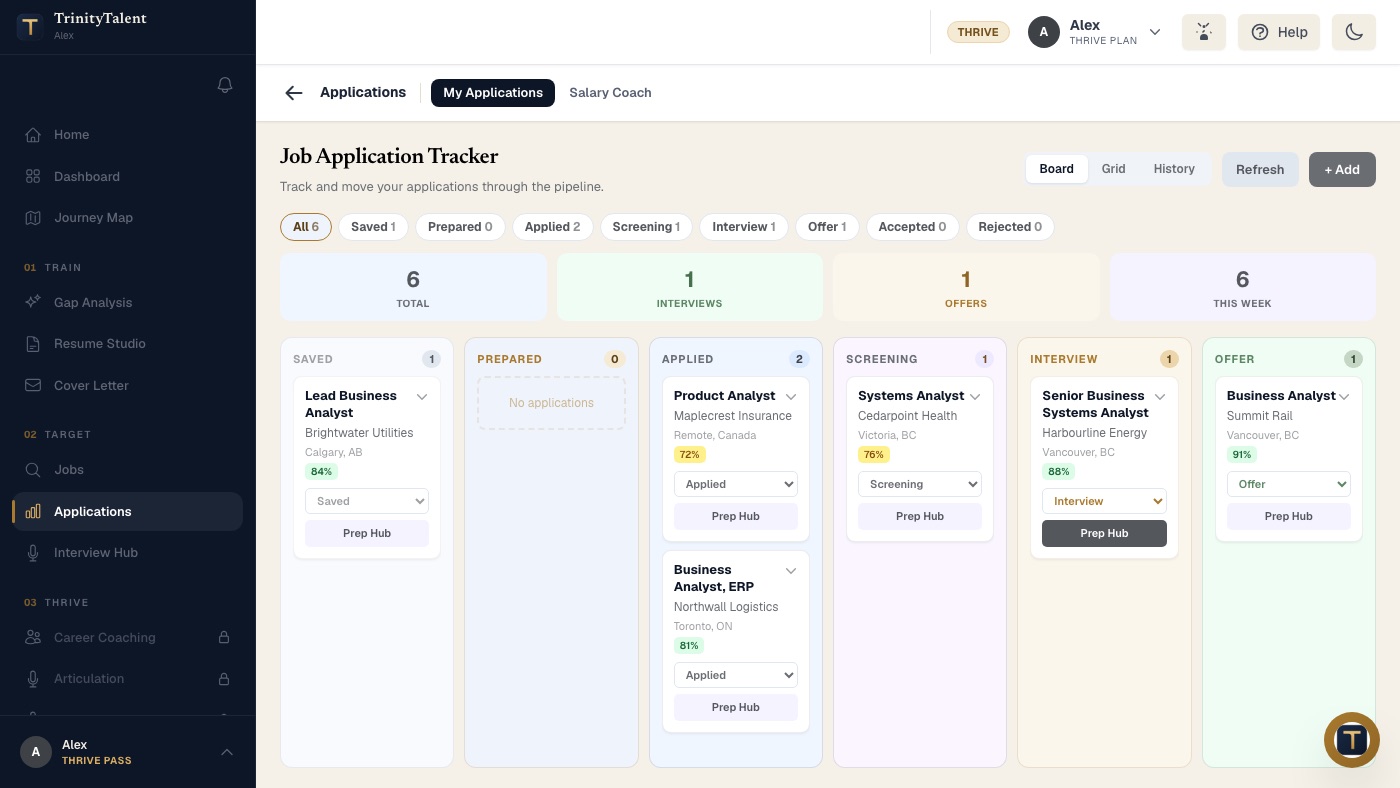
When the offer arrives, move that application's card to the Offer column in your tracker and note the response date you promised. The offer stage is where details get lost, because the conversation moves from one recruiter to several people.
The three emails
After review, your response is one of three. Each is short on purpose; a long email invites reinterpretation.
Email one: accept
Subject: Re: Offer for Payroll Coordinator - Acceptance
Dear Ms. Okafor,
I am delighted to accept the offer for the Payroll Coordinator position at Harbourview Credit Union, with a start date of Monday, December 1, at the salary and terms set out in the offer letter dated November 3.
I have signed and attached the agreement. Please let me know what you need from me before the start date, including any onboarding paperwork.
Thank you again. I am looking forward to joining the team.
Kind regards, Priya Raman
Restating the start date and the letter date protects both sides if there is a later mix-up.
Email two: ask for more time
Subject: Re: Offer for Payroll Coordinator
Dear Ms. Okafor,
Thank you again for the offer and for sending the full agreement. I am giving it the careful attention it deserves. Could I have until Monday, November 10, to confirm? I want to be certain of my decision so that I can commit fully once I start.
Kind regards, Priya Raman
Ask for an extension once, and only once. A second request makes an employer doubt your interest.
Email three: negotiate
Negotiate in writing first, then offer to talk. Pick one or two points, not five, and anchor each in evidence: postings for similar roles, your current package, or a skill the posting asked for.
Subject: Re: Offer for Payroll Coordinator
Dear Ms. Okafor,
Thank you for the offer. I am enthusiastic about the role and about joining Harbourview.
Before I accept, I would like to discuss two points. First, the base salary: postings for payroll coordinator roles with multi-province experience in this region sit around 8 percent above the offer, and I bring four years of exactly that experience. Second, vacation: would three weeks be possible in the first year, given that I currently have three?
I am flexible on how we get there and happy to talk by phone if easier. If we can agree these, I am ready to accept.
Kind regards, Priya Raman
The final line matters. It tells the employer this is the last step, not the start of a long process.
Timing and tone rules that apply to all three
- Reply to the person who sent the offer, and copy anyone they copied.
- Use the subject line they used. It keeps the thread together.
- Stay warm even when negotiating. Every sentence should still read as a person who wants the job.
- Never accept verbally and then negotiate. Once you say yes, the terms are set.
- Never resign from your current job until you hold the signed agreement. A verbal offer can be withdrawn.
- Keep copies of everything, including the posting, so the role promised matches the role hired for.
Common mistakes
The most expensive mistake is silence. Candidates who wait a week to reply, hoping another offer arrives, sometimes find the first one withdrawn. The second is negotiating by phone with no notes, then finding the written agreement does not match what was said. The third is over-explaining: a paragraph about your other interviews gives the employer information that cannot help you.
If, after review, the answer is no, respond just as promptly and just as warmly. Our guide on how to decline a job offer has the emails for that case.
How TrinityTalent helps
TrinityTalent's application tracker follows each role from Saved through Applied, Screening, Interview and Offer to Accepted, and every card keeps the posting text and the resume version you sent. When an offer arrives, moving the card to Offer puts the posting, your notes and the offer conversation in one place, so you can check that the title, pay and duties in the letter match what was advertised.
The Salary Coach inside the Applications area helps you prepare the negotiation conversation, and the cover letter tool, which drafts from your resume and the posting in several tones, is a useful model for short, warm emails like these. Nothing is sent without you pressing send. Free to build, edit and export your resume. AI tailoring, interview practice and coaching run on prepaid passes, and nothing renews by itself.
Frequently asked questions
How quickly should I respond to a job offer?
Acknowledge the offer within one business day, even if you have not decided. Thank the employer and give a specific date for your full answer. Two to five business days is a normal review period, and most employers grant it without hesitation when you name the date.
Is it acceptable to ask for more time to consider a job offer?
Yes, once. Ask politely, give a specific date, and explain that you want to be certain so you can commit fully. A single request is normal. A second extension suggests you are waiting for something better, and some employers will withdraw the offer rather than wait.
Should I accept a job offer by phone or email?
Accept in writing, by email, and attach the signed agreement. A phone acceptance is fine as a courtesy, but follow it with an email the same day that restates the position, start date, salary and the date of the offer letter. The written record protects both you and the employer.
Can I negotiate after receiving a written job offer?
Yes. The written offer is the right moment to negotiate, because you now know every term. Raise one or two specific points with evidence, stay warm, and say that you are ready to accept if they can be agreed. Do not accept first and then try to change the terms.
Put this into practice
Move the card to Offer in your free application tracker, keep the posting and offer details together, and draft your reply before you send it.
Write your cover letter