
How to Resign Professionally: Notice, Letter and Last Weeks
Knowing how to resign well is a career skill, because the way you leave a job is the last thing your colleagues remember and the first thing your next reference describes. The method for how to resign is the same in almost every case: tell your manager first and in person, give two weeks of notice as the Canadian norm unless your contract says more, follow with a short letter, write a handover document, and work the final weeks as if you were staying. This guide gives the order, the scripts, the letter, the counter-offer and the exit interview.
TL;DR: Resign only after the new offer is signed. Tell your manager first, in a private conversation, in three sentences: you are resigning, your last day, and thanks. Follow the same day with a three-line letter. Two weeks of notice is the Canadian norm; check your contract for more. Prepare a handover document, decline counter-offers you did not ask for, and keep the exit interview factual.
Before you say anything
Three things must be true before you resign. First, your new offer is signed, not verbal; a verbal offer can be withdrawn. Second, you have read your employment agreement for the notice period, any repayment clauses for training or signing bonuses, and any non-compete terms. Third, you have saved personal files, and only personal files, from your work devices. Taking client lists or company documents is a breach, whatever your intent.
Then choose the day. Early in the week and early in the day is best, so your manager has time to react and plan. Avoid the day before a major deadline if you can.
Tell your manager first, in person
Your manager must hear it from you, not from a colleague or a calendar invitation titled "Resignation". Ask for fifteen minutes in private, in person or on a video call if you are remote. Say it plainly in the first sentence; hesitating makes the conversation longer and harder.
Script
"Thank you for making time. I wanted to tell you directly that I have accepted a position with another company, and I am resigning. My last day will be Friday, November 21, which gives two weeks of notice. I am grateful for what I have learned here, and I want to make the handover as smooth as possible."
Then stop talking. Your manager may be surprised, disappointed or briefly annoyed. Let them respond. Answer questions honestly but briefly. You do not have to say where you are going or give a reason. "It is a role that fits where I want to go next" is enough.
What to avoid saying
- Anything critical of the team, the manager or the company. Save feedback for the exit interview.
- "I have been unhappy for a long time." It invites a debate you have already decided.
- Any hint that a better offer would change your mind, unless it truly would.
The three-line resignation letter
The letter is a record, not an essay. Email it to your manager within an hour of the conversation, copying HR if that is your workplace's practice.
Subject: Resignation - Sofia Marquez
Dear Ravi,
Please accept this letter as formal notice of my resignation from my position as Client Services Coordinator at Harbourview Credit Union. My last working day will be Friday, November 21, 2026.
Thank you for the opportunities and support over the past three years. I will do everything I can to ensure a smooth transition before I leave.
Sincerely, Sofia Marquez
Nothing else belongs in it: no reasons, no feedback, no praise for the new employer. It should be a letter you would be comfortable seeing in your HR file in ten years.
Two weeks, or what your contract says
Two weeks is the norm in Canada for most roles, and it is what most employers expect. Some contracts require more, often four weeks for senior or specialised roles, and that is binding. Read the notice clause before you set your last day.
Your employer may ask you to leave sooner than your notice date, sometimes the same day, especially in roles with access to sensitive information. Whether the remaining notice must be paid depends on your province; ask your provincial employment standards office rather than guessing, and do not agree to leave early without confirming how the remaining days will be paid.
The handover document
A handover document is the most professional thing you can leave behind, and it protects you from calls after you have gone. One or two pages, covering:
- Your recurring tasks, with frequency, steps, and where the files live.
- Open items, each with status, next step, and who else knows about it.
- Key contacts, inside and outside the company, and what they need from your role.
- Access and passwords handled through your IT process, never in the document itself.
- Things that only you know: the quirks, the workarounds, the person to call when the system freezes.
Share it with your manager in the first week of notice, and offer to walk a colleague through it.
The counter-offer
Many people receive a counter-offer within a day or two of resigning: more money, a new title, a promise of change. Decide your stance before you resign, so the moment does not decide for you.
Most career advisers recommend declining. The reasons that made you look are usually still there, the relationship has changed because your employer knows you were leaving, and the raise often comes from next year's budget. If you accept, accept only a written offer that fixes the specific problem that made you leave.
"I appreciate the offer, and it means a lot that you would make it. I have made my decision, and I think it is the right one for me. I would rather spend the next two weeks making sure the team is set up well."
Working the last two weeks
Show up fully. Finish what you can, document what you cannot, and be generous with your time to whoever picks up your work. Thank people individually. Return equipment through the official process and get written confirmation.
Keep your exit interview factual. Describe processes, not people. "The approval chain for client changes took four steps and often delayed work by a week" is useful and safe. "My manager never listened" is not. Once you start the new role, our guide to your first 90 days in a new job covers the next transition. If you are still deciding on the offer itself, read how to respond to a job offer first.
How TrinityTalent helps
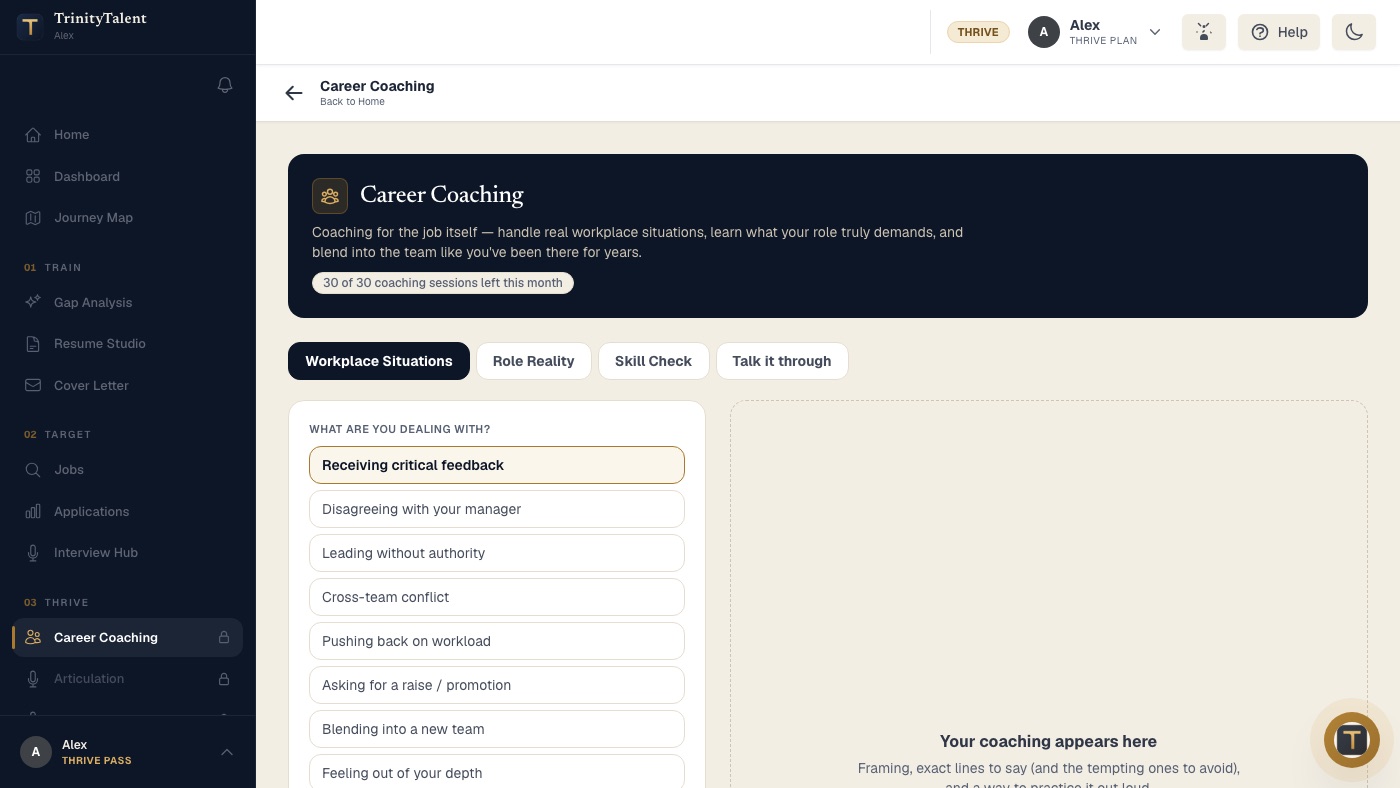
Resigning is a workplace conversation, and TrinityTalent's Career Coaching is built for exactly that kind of moment. Describe your own situation, including a manager who may react badly, a counter-offer you expect, or an exit interview you are nervous about, and the coach returns framing, exact lines to say and the tempting lines to avoid, along with a way to practise the conversation out loud before it happens.
Voice Studio lets you rehearse the three-sentence script and hear your pace and pauses from a recording that stays on your device, which helps if it may get emotional. Free to build, edit and export your resume. AI tailoring, interview practice and coaching run on prepaid passes, and nothing renews by itself.
Frequently asked questions
How much notice should I give when resigning in Canada?
Two weeks is the norm for most roles and what most employers expect. Some employment agreements require more, often four weeks for senior or specialised positions, and that clause is binding. Read your contract before setting your last day, and put the exact date in your resignation letter.
Should I tell my manager I am resigning before sending a letter?
Yes. Tell your manager first, in a private in-person or video conversation, and send the letter the same day as the written record. A manager who learns of a resignation from an email, a colleague or a calendar entry will remember it, and that memory follows you into future reference checks.
Do I have to say why I am resigning or where I am going?
No. You may share the new employer if you wish, but you are not required to, and you do not owe a reason. A single neutral sentence such as "it is a role that fits where I want to go next" is enough. Save specific feedback for the exit interview, and keep it about processes rather than people.
Should I accept a counter-offer after resigning?
Usually not. The reasons you looked elsewhere are typically still there, the relationship has changed because your employer knows you intended to leave, and the raise is often borrowed from a future review. If you do consider it, accept only a written offer that fixes the specific problem that made you leave.
Put this into practice
Describe your resignation conversation in Career Coaching and get say-this and avoid-this scripts to rehearse before you speak to your manager.
Practise a mock interview