
Job References: Who to Choose and How to Prepare Them
Job references are the last step most candidates prepare for and the step that most often decides a close race between two finalists. Good job references are chosen before you need them, asked every time, briefed on the specific role, and kept off the resume. This guide covers who to choose, how to ask, what to send them, what employers actually ask, and the few situations, such as a difficult last manager, that need a different approach.
TL;DR: Prepare three references: your most recent manager first, then another manager or senior colleague, then someone who saw your work closely. Ask permission before every application, not once. Send each reference the posting, your resume and two stories you would like them to mention. Give the list only when asked, on a separate page, never on the resume itself.
Who to choose
Employers want people who supervised your work recently and can describe it in detail. Rank your candidates in this order:
- Your most recent manager. The first person a reference checker wants. If you cannot use them, be ready to say why in one calm sentence.
- A previous manager or a senior colleague who assigned or reviewed your work.
- Someone who saw your work from a different angle: a client, a project lead from another team, or a professor or placement supervisor for new graduates.
Three is the standard number. Prepare four so that one can be unavailable. Avoid friends, family and peers at the same level unless you have nothing else, and avoid anyone who has not worked with you in the last five years.
Example
Hana is applying for a senior accounts payable role. Her list: her current finance manager at Northgate Logistics, the controller from her previous employer who signed off her month-end work, and the external auditor who worked with her through two year-end cycles. Each can speak to a different part of the posting: process ownership, accuracy under deadline, and how she handles outside scrutiny.
Ask permission every time
Asking once, years ago, is not enough. Ask before each application that is likely to reach the reference stage, or at least each time you enter a new search. This does three things: it confirms the person is still willing, it lets them expect the call, and it gives you the chance to brief them on this role.
Subject: Reference for a role I am pursuing
Hi Daniel,
I am in the final stage for a Senior Accounts Payable Specialist role at Cedar Ridge Health, and they may check references next week. Would you be comfortable speaking about our work together at Northgate? If so, I will send the posting and a short note on what they are likely to ask. Thank you either way.
Hana
If the answer is slow or lukewarm, choose someone else. A hesitant reference does more damage than a missing one.
Brief each reference properly
A reference who has to improvise will give a generic answer. A reference who knows the role will give a specific one. Send three things:
- The job posting, with the two or three skills it repeats highlighted.
- Your current resume, so their account of your dates and titles matches yours.
- Two stories you would like them to mention, in three or four lines each, with the result. They may not use them, but they will remember the shape.
Add the name and title of the person likely to call, and when. After the call, ask your reference how it went and thank them. A small gift is not expected; a specific thank-you note is.
What employers actually ask
Reference checks in Canada are usually a 10 to 15 minute phone call or an online form. Common questions:
- Can you confirm the dates of employment and the title?
- What were their main responsibilities?
- How did they handle pressure or conflict?
- What would you say is an area for development?
- Would you rehire them?
The last two matter most. Brief your reference on the development question in particular. "She sometimes took on too much herself and has learned to delegate earlier" is honest and harmless. A reference caught by surprise may say something worse.
Never put references on the resume
A resume that lists names and phone numbers wastes space, exposes other people's contact details to every database the file lands in, and signals an older style. "References available on request" is also unnecessary; every employer knows that. Keep a separate one-page document with the same header as your resume, three names, titles, employers, the relationship to you, and contact details, and provide it only when asked.
Difficult cases
You cannot use your current manager. Common and understood. Say "My current employer does not know I am looking, so I have provided a previous manager and a senior colleague instead," and offer the current manager once an offer is conditional.
Your last manager would not be positive. Use a different manager from the same employer or a senior colleague who saw your work. If asked directly, give one sentence without blame: "We had different working styles, and I have provided two other people from that role."
You are new to Canada. References abroad are acceptable. Give email addresses and time zones, tell your references to expect a call or a form in English, and add one Canadian reference as soon as you have one, such as a volunteer coordinator or a placement supervisor.
You are a new graduate. Professors, co-op supervisors and part-time job managers all count. Choose the ones who saw you finish work under a deadline.
Keep the list with each application
Keep your reference list with the application it belongs to, not in a separate folder. When the call comes, you should be able to see the posting, the resume version you sent and the three names you chose for that role in one place. This also lets you rotate references, so that nobody receives four calls in a fortnight.
Once you have accepted, the guide to your first 90 days in a new job covers thanking the people who helped you get there.
How TrinityTalent helps
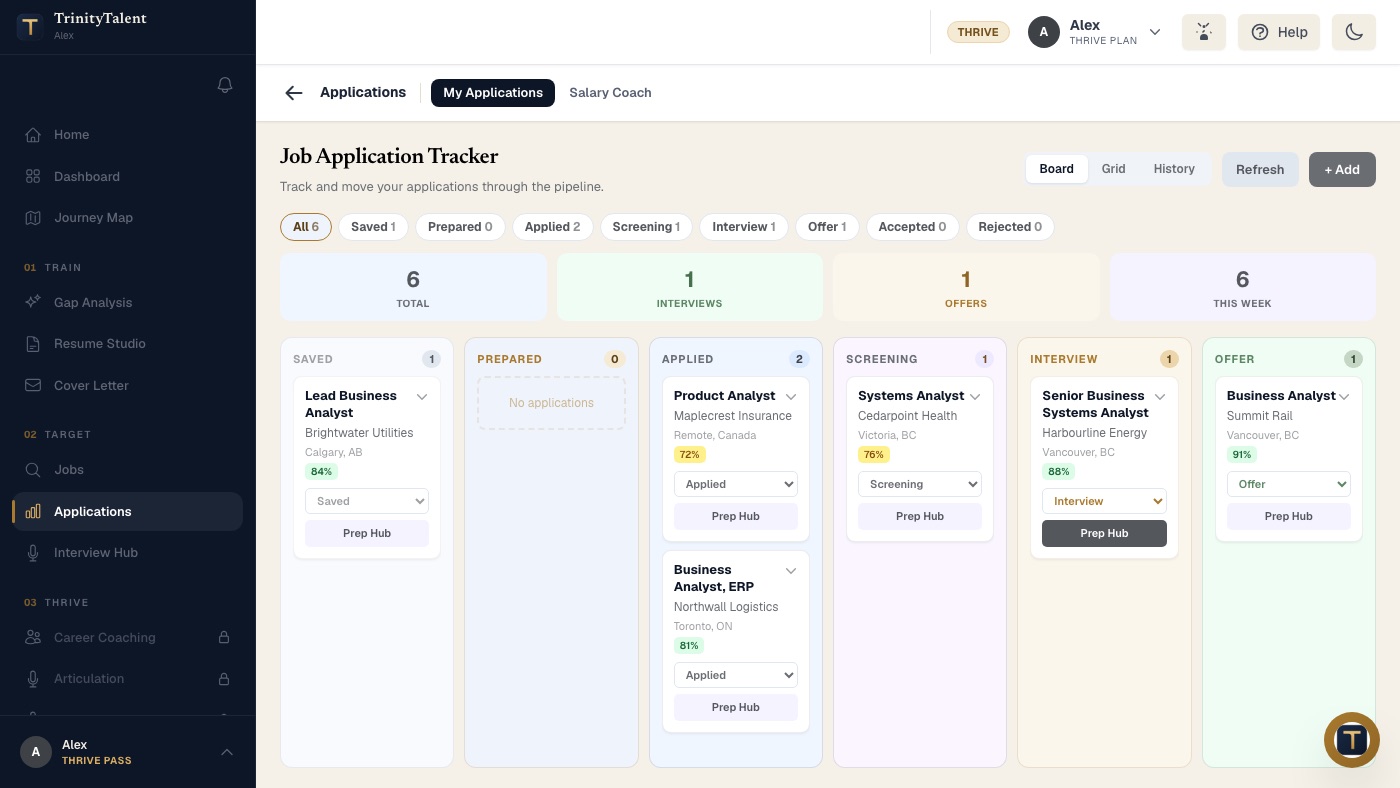
TrinityTalent's application tracker keeps each posting and the resume version you sent on the card as it moves from Saved through Applied, Screening, Interview and Offer, so your reference list for that role can live beside the exact document your references will be asked about, and you can see which references you have already used this month.
The free resume builder includes a rules-based Check that runs on your device and audits the page against cited career-centre rules, which keeps the document focused on the evidence that gets you to the final stage, with Word and PDF export in single-column, ATS-safe templates. When you tailor the resume to a posting, the same facts are rewritten around that role, which is also the version to send your references so their account matches yours. Free to build, edit and export your resume. AI tailoring, interview practice and coaching run on prepaid passes, and nothing renews by itself.
Frequently asked questions
How many job references should I have?
Three is the standard number that most employers request. Prepare four so that one can be unavailable when the call comes. Rank them by how recently and how closely they supervised your work, with your most recent manager first, and rotate them so that nobody receives several calls in a short period.
Who should I not use as a job reference?
Avoid family members, friends who never worked with you, and peers at your own level when a manager is available. Avoid anyone who has not seen your work in about five years, and avoid anyone whose answer to "would you be comfortable being a reference" is slow or hesitant. A lukewarm reference hurts more than a missing one.
Should I put references on my resume?
No. Names and phone numbers on a resume waste space, expose other people's contact details, and signal an outdated format. "References available on request" is also unnecessary. Keep a separate one-page reference document with the same header as your resume, and provide it only when an employer asks for it.
What if I cannot use my current manager as a reference?
This is common and employers understand it. Explain in one sentence that your current employer does not know you are looking, provide a previous manager and a senior colleague instead, and offer to make your current manager available once an offer is made conditional on references.
Put this into practice
Keep your reference list beside the posting and the resume version you sent on each card in the free application tracker.
Build your resume free