
Greatest Weakness Interview Answer: Honest Answers That Work
A good greatest weakness interview answer has three parts: a real weakness that would not disqualify you from the job, what you already do to manage it, and evidence that it is improving. Most candidates get the greatest weakness interview answer wrong in one of two directions: they name a fake weakness ("I work too hard") or a fatal one ("I miss deadlines"). Neither is believed, and the interviewer learns nothing except that you did not prepare. This guide gives the structure, five examples, the answers to avoid, and a way to practise.
TL;DR: Pick a real weakness that is not central to the job. Say it plainly in one sentence. Describe the specific habit or system you use to manage it. Give one piece of evidence that it is getting better. Stop. Keep the whole answer under 45 seconds and never use "perfectionist" or "I work too hard".
What the interviewer wants to hear
The question is not a trap. It checks self-awareness: do you know what you are not good at, and do you do anything about it? People who cannot name a weakness are hard to manage, because they cannot take feedback. People who name a fatal one are not ready for the role. The interviewer wants the middle: an honest, specific weakness with a working plan attached.
It is also a test of composure: a calm answer to an uncomfortable question shows how you will handle a difficult conversation on the job.
The three-part structure
- The weakness, plainly (one sentence). Name it without softening. "I find it hard to delegate work I know I can do faster myself."
- What you do about it (one or two sentences). A specific habit, tool or rule. "For the last year I have listed every task at the start of a project and marked which ones I am the only person who can do; everything else gets assigned."
- Evidence it is improving (one sentence). Something measurable or observable. "On my last project I handed off 60 percent of the tasks and it still finished a week early."
Then stop. Under 45 seconds is right.
Choosing a weakness that is real but not fatal
The weakness must be true, or the follow-up question will expose it. It must also not be the core of the job. A bookkeeper cannot say "attention to detail".
A quick way to choose: list three things a manager has genuinely given you feedback on. Cross out any that a person in this role must be excellent at. Of the remaining, choose the one where you have the strongest improvement story.
Weaknesses that work for many roles because they are real and manageable: delegating, public speaking, saying no to extra work, asking for help early, writing concisely, giving critical feedback, and moving on from a decision once it is made.
Five worked examples
Each is fictional and runs 30 to 45 seconds aloud. Notice the plain first sentence and the hard stop after the evidence.
Team lead: delegating
"I find it hard to delegate tasks I know I can do faster myself. What helped was a rule I set two years ago: at the start of every project I list the tasks and mark the ones only I can do, and everything else is assigned in the first week. On the warehouse layout project last spring I kept four tasks out of twenty and it finished ahead of schedule."
Analyst: public speaking
"Presenting to a large group makes me nervous, and early in my career it showed. I joined a monthly speaking group eighteen months ago and I now volunteer to present our team's results at the quarterly review. The last two reviews I ran the whole 20-minute section without notes, and my manager's feedback was that the pacing was the clearest in the room."
Nurse: asking for help early
"I used to take on too much before asking for help, because I did not want to seem unable to cope. After a difficult shift two years ago I set a personal rule: if I am behind on two patients at once, I say so at that moment, not at the end. Our charge nurse has since asked me to explain that rule to new graduates during orientation."
Developer: writing concisely
"My written explanations run long. A senior colleague pointed out that my pull request descriptions were being skipped because of it. I now write the summary line first, cap the description at five lines, and move detail into comments. Reviews on my changes have been coming back about a day faster since I started doing that six months ago."
Coordinator: saying no
"I say yes to extra work too quickly and then have to renegotiate later. I now answer any new request with a trade-off instead: 'I can do this by Friday if the report moves to Monday.' Since I started doing that in January I have not missed a deadline, and two managers have told me it makes planning easier for them."
Answers to avoid
- "I am a perfectionist" or "I work too hard." Every interviewer has heard these and none believes them. They read as a refusal to answer.
- A strength in disguise. "I care too much about quality" is the same trick with different words.
- A fatal weakness. Anything that is the core of the role: missed deadlines, poor attention to detail for a bookkeeper, dislike of customers in a customer role.
- A personality trait with no plan. "I am shy" with nothing after it. The plan is the answer; the weakness is only the setup.
Prepare the follow-up
Interviewers often follow with "can you give me an example of when that weakness caused a problem?" Have one ready. Choose a real incident where the weakness cost something small and you changed something afterwards. Told plainly, it strengthens the original answer. The STAR method gives that story a shape, and it is the same shape the behavioural questions later in the interview will need.
Practise it fast and often
This answer improves with repetition, because the difficulty is composure, not content. Practise it in rapid-fire conditions: someone asks, you answer in 45 seconds, no pause to think. Do it ten times across a week, recorded, and listen for hedges such as "kind of" and "I guess". Cut them. A weakness said plainly sounds like confidence; said with hedges it sounds like a worse weakness.
How TrinityTalent helps
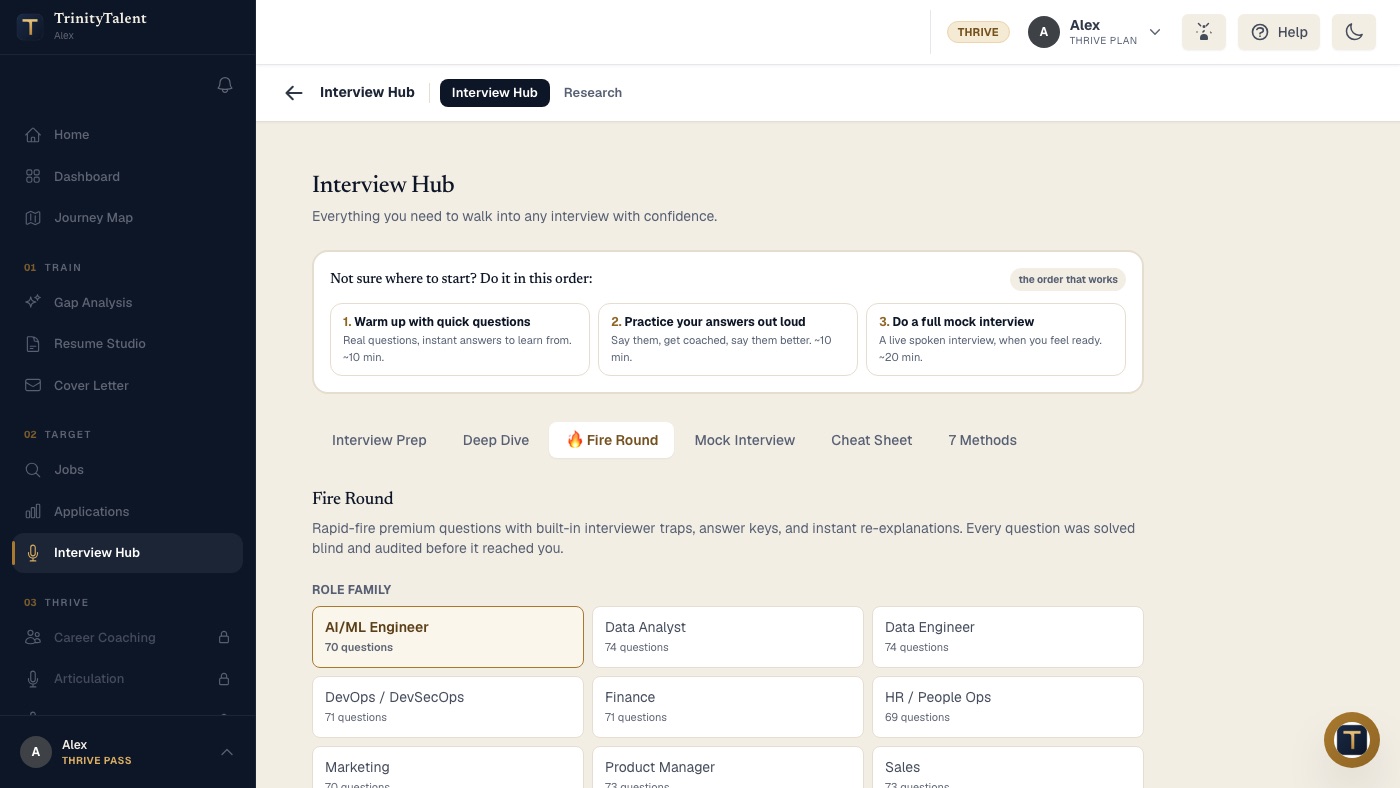
TrinityTalent's Fire Round is built for the kind of rapid-fire practice this question needs: 700+ real interview questions, asked quickly, with an instant model answer to learn from after each one. Run a set until the plain first sentence comes out without hedging, then move to the live mock interview, where a spoken interviewer asks it in context and follows up with "give me an example".
The Voice Studio shows pace, pauses and each filler word in a transcript of your recording. Recordings stay on your device. Building, editing and exporting your resume on TrinityTalent is free.
Frequently asked questions
What is a good weakness to say in an interview?
A real one that is not central to the job and that you have a working plan for: difficulty delegating, nerves when presenting, saying yes too quickly, asking for help too late, or writing too long. Pick from feedback a manager has actually given you, and choose the one with the strongest evidence of improvement.
What weaknesses should you never say in an interview?
Never say "perfectionist" or "I work too hard"; they are not believed. Never name a weakness that is the core of the role, such as attention to detail for a bookkeeper. Avoid jokes, lists of several weaknesses, and anything that blames colleagues. One honest weakness with a plan is the whole answer.
How long should the greatest weakness answer be?
Under 45 seconds: one plain sentence naming the weakness, one or two on the habit or system you use to manage it, and one giving evidence it is improving. Then stop. The extra words after that are usually hedges or apologies.
Is it acceptable to say I do not have any weaknesses?
No. It signals either low self-awareness or unwillingness to be honest, and both make you harder to manage. Every interviewer knows everyone has weaknesses. The question is whether you know yours and do something about it, so name one real weakness and spend most of the answer on the plan and the evidence.
Put this into practice
Practise the weakness question in the Fire Round, where 700+ rapid-fire questions give you an instant answer to learn from.
Practise a mock interview