
Self-Assessment Examples for Your Performance Review
The best self-assessment examples share one shape: a result with a number, a skill that grew, a challenge with what you did about it, and a goal for the next period. If you are looking for self assessment examples because your review form is due on Friday, that shape is the answer. Managers do not read a self-assessment to learn how you feel about the year. They read it to find facts they can repeat in the calibration meeting. This guide shows the four parts, six examples by role, and a way to make next year's assessment take twenty minutes.
TL;DR: A self-assessment has four parts: results with numbers, growth in a named skill, a challenge and your response to it, and one or two goals for the next period. Write in the third person of facts, not the first person of feelings. Keep each part to three or four sentences. Record results monthly so the review is a summary, not an excavation.
What managers actually read
A manager with eight direct reports reads eight self-assessments in the same week, with one question in mind: what can I quote about this person when I defend their rating? Sentences that survive that reading are specific, dated and measurable. "Improved the onboarding process" does not survive. "Cut new-hire setup time from five days to two by writing a twelve-step checklist, used by all four teams since March" does.
Three things make a line quotable:
- A number the manager did not know, or had forgotten.
- A method, so the result reads as repeatable rather than lucky.
- A link to a team or company goal the manager is measured on.
The four parts, in order
- Results with numbers. Two to four bullets: what changed, by how much, over what period, by what method. Lead with the result closest to your team's stated objective.
- Growth. One named skill you did not have twelve months ago. Say how you built it and where it showed up in the work.
- Challenges, with what you did. One or two. The value is in the second half. A challenge you name without a response reads as a complaint. A challenge you name with a response reads as judgement.
- Goals. One or two for the next period, each with a measure. Pick goals your manager can help with, so the assessment doubles as a request.
Aim for 300 to 500 words in total.
Six examples by role
Each example is fictional. Replace the numbers with your own, and only use figures you could show a source for.
Customer support representative
"Handled an average of 62 tickets a day against a team target of 55, with a satisfaction score of 93 percent. Wrote eleven help-centre articles for the most repeated questions; repeat contacts on those topics fell by about a fifth. Growth: learned the billing system well enough to resolve refund cases without escalation. Challenge: the queue doubled during the June launch. I proposed a triage tag for launch tickets, which the team kept. Goal: complete the escalation-handling certification by March."
Software developer
"Shipped the export feature on schedule and cut report generation from 40 seconds to under 6 by moving the heavy query to a nightly job. Reviewed 140 pull requests with turnaround under one working day. Growth: took over the deployment pipeline after the lead left; deployments went from weekly to daily with no rise in rollbacks. Challenge: the August migration caused a two-hour outage. I wrote the post-incident review and added a pre-flight check that would have caught it. Goal: mentor the two new hires until each can deploy independently."
Registered nurse
"Maintained full compliance on medication documentation across 210 shifts. Led the unit's rollout of the new fall-risk assessment, training 26 staff over six sessions; recorded falls fell from nine to four in the following two quarters. Growth: completed the preceptor course and precepted three new graduates, all of whom passed probation. Challenge: repeated short-staffing on nights. I proposed a swap board, which reduced last-minute agency calls. Goal: begin charge nurse orientation in the new year."
Warehouse supervisor
"Ran a 22-person day shift with on-time dispatch above 97 percent in ten of twelve months. Reduced mis-picks by 30 percent with a two-scan confirmation at packing. Growth: learned to build the weekly labour forecast myself, which cut overtime by about 15 percent. Challenge: two safety incidents in the spring. I re-ran the forklift refresher for the whole shift and moved the pedestrian walkway; no incidents since. Goal: cross-train four pickers on receiving."
Marketing coordinator
"Managed the monthly newsletter to 18,000 subscribers; open rate rose from 21 to 29 percent through weekly subject-line tests. Coordinated three webinars averaging 240 registrants, all on budget. Growth: learned the analytics platform and now produce the monthly report without the agency. Challenge: the spring campaign launched a week late because approvals were unclear. I drafted a one-page approval flow now used on every campaign. Goal: own the paid social budget for one product line."
Accountant
"Closed the month within five working days in every period, down from eight, by moving three reconciliations to automated matching. Cleared a 14-month backlog of supplier statements by July. Growth: led the audit file preparation for the first time; the auditors raised two findings compared with seven the year before. Challenge: the new expense tool created duplicate entries for two months. I documented the fault, worked with the vendor and wrote the correction procedure. Goal: complete the two remaining modules toward my designation."
Keep a running record all year
Most self-assessments are painful because they are written from memory, and memory keeps the last two months and the worst week. A running record fixes that. Once a month, spend ten minutes writing down a result with a number, a skill you used at a higher level, and a problem you handled. Date each entry. By review time you have 36 entries and the assessment becomes a selection exercise.
The same record has a second use. Every dated result is a resume bullet in waiting, and if you plan to ask for a promotion, the record is the case.
Mistakes that lower the rating
- Adjectives instead of evidence. "Strong communicator" is unverifiable. "Ran the weekly client call for nine months with no escalations" is not.
- Listing duties. The assessment says what happened because you did the job, not what the job was.
- Hiding the challenge. Managers know the year had problems. Naming one and showing your response is the most senior thing in the document.
- Goals without a measure. "Improve my leadership" cannot be checked. "Run the team stand-up for the second quarter" can.
How TrinityTalent helps
TrinityTalent is built around a running record of your working life. The free resume builder stores every role and bullet you add, so when you log a dated result each month it is already in the form a review, a promotion case or a job application needs. Editing is free, runs on your device and never sends anything without you.
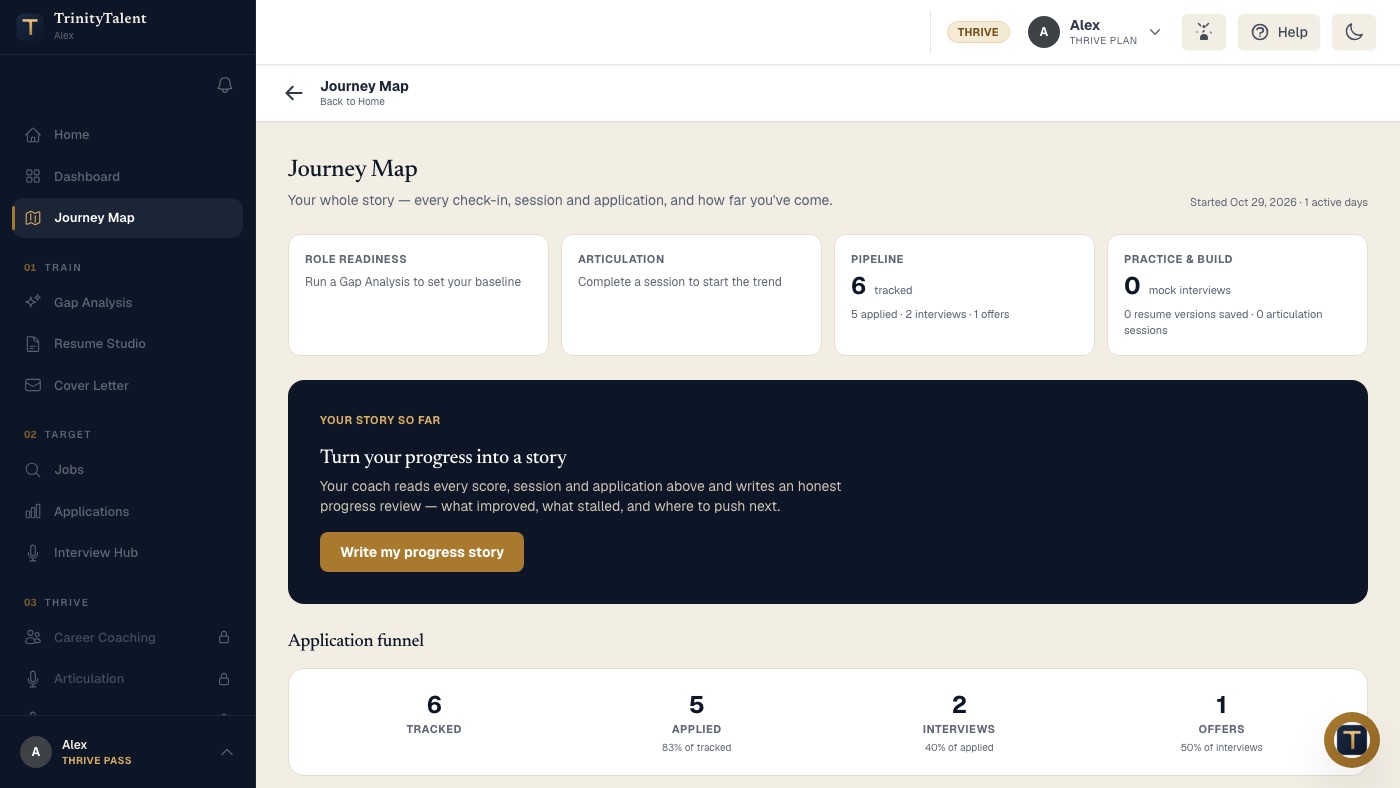
The Journey Map keeps the longer story: readiness scores over time, practice sessions and application milestones in one dated timeline, so you can see what improved and when. When review season comes, the evidence is already collected rather than reconstructed from memory. Career Coaching covers the conversation itself, with say-this and avoid-this scripts for asking for a raise or a promotion and for receiving critical feedback. Building, editing and exporting your resume on TrinityTalent is free.
Frequently asked questions
How long should a self-assessment be?
Between 300 and 500 words is enough for most review forms. Use two to four result bullets, one growth paragraph, one or two challenges with your response, and one or two measurable goals. A longer document is skimmed harder, not read more carefully.
Should I mention weaknesses in a self-assessment?
Yes, but frame each as a challenge with a response. Name the problem in one sentence, then spend two sentences on what you did and what changed. Managers already know the year had difficulties. Showing that you noticed and acted is more senior than pretending the year was perfect.
What if I do not have numbers for my work?
Count something. Tickets, shifts, documents, meetings run, people trained, days saved, errors avoided. Compare a before and an after, even roughly, and say how you measured it. A defensible estimate with a stated method beats an adjective, and it gives your manager something to repeat in the calibration meeting.
How is a self-assessment different from a resume bullet?
They share the same raw material: a result, a number, a method and a timeframe. A self-assessment adds context, names the challenge behind the result and sets goals. A resume bullet strips all of that to one line. Keep a dated record and you can write both from it.
Put this into practice
Log each result in your resume as it happens, and the Journey Map keeps the dated record your next self-assessment and your next resume both need.
Build your resume free