
Why You Should Record Yourself: Interview Practice That Works
The single biggest upgrade to interview preparation is a record-yourself interview practice habit. Most people rehearse by thinking through answers or saying them once into the air, and both methods share a flaw: you cannot hear yourself while you are speaking. A record-yourself interview practice routine gives you the interviewer's seat for a few minutes, and what you hear there is usually different from what you felt. This guide covers what recordings reveal, a three-take method that takes fifteen minutes, what to score, and how to keep the recordings private.
TL;DR: You cannot hear fillers, pace, trailing endings or rambling while you speak, but a recording shows all four in minutes. Use three takes: record, listen once for one habit, record again with that fix, then a third take for a second habit. Score structure, pace, fillers and endings. Keep recordings on your own device and delete what you do not need.
What you cannot hear live
Producing sentences under pressure leaves little attention for evaluating them. That is why people who are told "you say um a lot" are often surprised. They were not lying when they said they did not notice; they genuinely could not hear it.
A recording reveals four things almost every time:
- Fillers. "Um", "like", "so", "you know", "basically". Most people count two or three times more than they expected.
- Pace. Fast speech feels normal from the inside. On playback, it sounds rushed, and you can hear the listener's problem.
- Trailing endings. Sentences that fade out, end with "so, yeah", or rise into a question. These undercut the facts you just stated.
- Rambling. The answer that reached the point at 90 seconds when it could have opened with it. On playback, you can hear exactly where the story should have started.
There is a fifth, quieter finding: many people sound better than they feared. The recording is reassuring about the voice and specific about the habits.
The three-take method
Fifteen minutes, one question, three recordings. The method isolates one habit at a time, and the third take gives you proof of change on the same day.
- Take one: baseline. Pick a common question. Record your answer on your phone without preparing beyond deciding the first sentence. Do not stop and restart. This take has to be honest.
- Listen once, for one thing. Choose the habit you will listen for before you press play: fillers, or pace, or endings, or structure. Count or note only that. Ignore everything else, including how your voice sounds. Write one line: what you heard and what you will change.
- Take two: the fix. Record the same answer again, changing only that one thing. If it was fillers, close your mouth where the fillers were. If it was pace, finish every word. If it was the ending, drop your tone on the last word and stop.
- Listen to both. The difference is usually obvious. That is the evidence that the habit is fixable, which matters more than the fix itself.
- Take three: a second habit. Keep the first fix and add one more. Stop there. Two changes in one session is the limit for most people; a third starts to break the first.
Repeat on another day with another question. Over two weeks, five sessions covers the ten most common questions and every major delivery habit. For structuring a full practice alone, see /blog/mock-interview-practice/.
A worked example
Tomasz Nowak, preparing for a facilities coordinator interview, recorded "Tell me about yourself". Take one ran two minutes and ten seconds. Listening for fillers only, he counted eleven "so"s. Take two, with silent pauses in their place, ran one minute forty and had two. On take three he added a headline sentence, "I have run maintenance scheduling for two mid-size office buildings for five years," and the answer came in at 75 seconds. Same content. Three recordings. Fifteen minutes.
What to score
Listening without criteria turns into vague dissatisfaction. Use four, and score each from one to five.
- Structure. Was the first sentence the answer? Could a listener say what the proof was? Did it end on purpose? /blog/how-to-structure-interview-answers/ explains the answer-first shape.
- Pace. Did you finish every word? Count the words in a 60-second stretch; a common coaching target is 140 to 160 per minute.
- Fillers. Count them. Two in a 90-second answer is normal speech. Ten is a habit.
- Endings. Did each sentence end with a falling tone and a full stop, or did it trail off, rise, or run into the next one? For the filler habit specifically, /blog/stop-saying-um/ has a dedicated drill.
Keep a simple log: date, question, four scores, one note. After three sessions the log shows a pattern, and the pattern tells you what to practise next, which is more useful than any single recording.
Audio or video?
Start with audio. Video adds information about posture and eye contact, but it also adds self-consciousness, and most people spend their first video review looking at their face instead of listening. Once the four audio habits are stable, record one video and watch it with the sound off for posture and hands. For a video interview, one take in the actual setup is worth doing the day before.
Keep the recordings private
Recordings of you rehearsing are personal. They contain your voice, your employer names, your salary expectations and your unpolished answers. Keep them on your own device, not in a shared drive or a chat thread. Name the files by date and question so you can find the comparison, and delete the ones you have already learned from. The value is in the comparison and the log, not in an archive. If you use any tool to analyse a recording, check where the audio goes and whether it stays with you.
When to stop recording
You have done enough when two things are true: your baseline take on a new question already scores four or five on all four criteria, and you no longer feel surprised by what you hear. At that point, move the practice to full mock interviews, where the question is unknown and the pressure is closer to the real room. Recording remains useful before each real interview as a warm-up and a check, but it should take ten minutes, not an evening.
How TrinityTalent helps
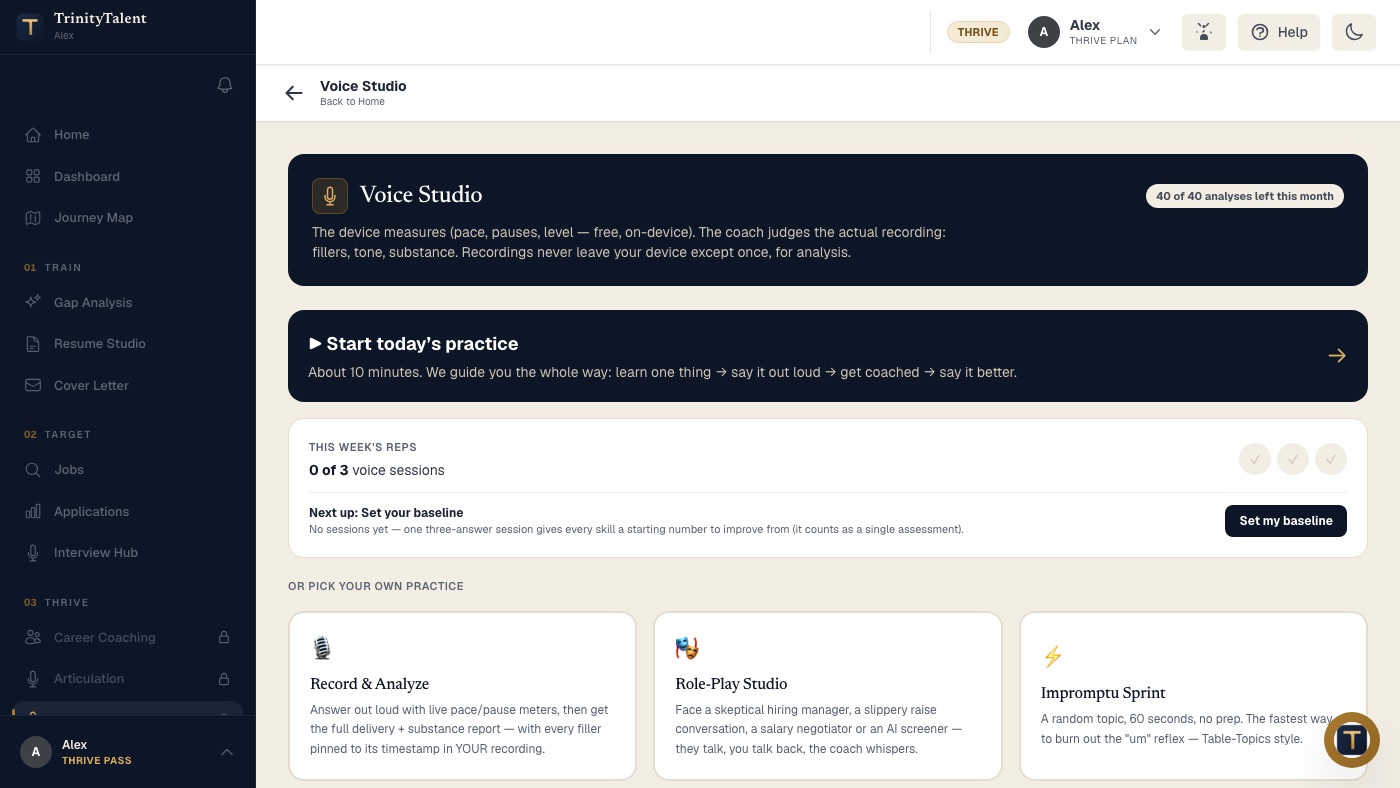
Voice Studio in TrinityTalent does the listening step for you. You record an answer, and it hears the actual recording: your pace in words per minute, your pauses, your filler words with a verbatim transcript that shows each filler where it happened, and a measure of vocal confidence. That replaces counting by hand and makes the take-one, take-two comparison exact. The recording stays on your device. ESL Clarity Mode coaches clarity and pace and never comments on accent. When your baseline takes are steady, the Interview Hub offers a full mock interview with a live spoken interviewer, and Articulation Training scores a spoken answer for structure, clarity and conciseness with the evidence quoted back. Building, editing and exporting your resume on TrinityTalent is free.
Frequently asked questions
Why should I record myself practising interview answers?
Because you cannot hear yourself accurately while speaking. Fillers, fast pace, trailing endings and rambling are invisible to the speaker and obvious to the listener. A recording puts you in the listener's seat for a few minutes. Most people find two or three habits they did not know about, and a second take shows they can be fixed the same day.
How many times should I record the same interview answer?
Three takes in one session is enough: a baseline, a second take fixing one habit, and a third adding a second habit. More than that in one sitting tends to make the answer sound memorised. Return to the same question on another day if the scores are still low, and rotate through the ten most common questions over two weeks.
Should I record audio or video when practising for an interview?
Start with audio, because the four habits that matter most are all in the voice and video adds self-consciousness that gets in the way of listening. Once fillers, pace, endings and structure are stable, record one video to check posture and eye contact, and do one take in your real video-interview setup the day before.
Is it safe to record myself for interview practice?
Yes, if you keep the recordings on your own device and delete what you no longer need. They contain your voice, employer names and unpolished answers, so do not store them in shared drives or chat threads. If you use a tool to analyse a recording, check where the audio goes and whether it stays with you.
Put this into practice
Record one answer in Voice Studio, read the pace, pause and filler report, then record it again and compare the two.
Practise a mock interview