
How to Write a Resume Summary (With Examples)
If you want to know how to write a resume summary, start with what it is for. A resume summary is the first thing a recruiter reads after your name. It sits at the top of the page, it is three or four sentences long, and it answers one question: why should this person keep reading? Most summaries fail because they try to describe a whole person. A good one describes a fit. This guide shows the structure, the mistakes, and five examples you can adapt.
TL;DR: A resume summary is 3 to 4 sentences and under 70 words. Sentence one names your target role and years of experience. Sentence two states your scope. Sentence three proves one result with a number. Sentence four names what you bring to this employer. Write it last, after the rest of the resume is done.
What a resume summary is, and what it is not
A resume summary is a short paragraph under your contact details. It replaces the old objective statement, which told the employer what you wanted. A summary tells the employer what they get. That change matters. Recruiters scan the top third of the page first, so the summary is the part most likely to be read in full.
It is not a biography. It is not a list of adjectives. "Motivated, detail-oriented team player with excellent communication skills" says nothing a recruiter can verify.
Three things separate a strong summary from a weak one:
- It names the role you are applying for, in the words the posting uses.
- It contains at least one number the reader can picture.
- Every sentence could be checked against the rest of the resume.
The four-sentence structure
The structure below works for almost every career stage. Keep each sentence short. Aim for 50 to 70 words in total, which is four lines on a standard page.
- Role and experience. "Payroll specialist with six years of experience in unionized manufacturing environments." Name the job title from the posting, not your old title, as long as it is honest.
- Scope. "Runs bi-weekly payroll for 400 hourly staff across two provinces." Scope tells the reader the size of the work you can handle.
- One proven result. "Cut payroll errors by 35 percent in one year by introducing a pre-run audit." A number, a method, and a timeframe.
- What you bring next. "Looking to bring the same process discipline to a growing team at a mid-size employer." This sentence links you to them.
Write the summary last
The summary is a condensation of the rest of the page, so it cannot be written until the page exists. Write your experience section first. Then read your bullets and pick the one result you are proudest of that also matches the posting. Pull the role title from the posting. Count your years. Now the summary almost writes itself.
This is also why the summary must change for every application. Your experience does not change, but which parts of it matter does.
Match the posting, not your past
Open the job posting and mark three things: the exact job title, the two or three skills it repeats, and the level it describes. Your first sentence should use that title. Your second sentence should mention at least one of the repeated skills. If the posting says "senior" and you led the work, say senior. If it says "coordinator" and you were a director, that gap is a conversation for the interview, not a word to hide.
Applicant tracking systems rank resumes partly on how closely the language matches, so a summary that uses the posting's own terms helps. This is translation, not exaggeration. You did the work. Describe it in the reader's vocabulary.
Five examples by career stage
Each example follows the four-sentence structure. Replace the details with your own facts. Do not copy a number you cannot defend in an interview.
New graduate
"Recent business graduate seeking a junior marketing coordinator role. Completed a two-term co-op running social campaigns for a regional credit union. Grew newsletter open rates from 18 to 27 percent over eight months by testing subject lines weekly. Brings a working knowledge of email tools and a habit of measuring every campaign."
Early career, first job change
"Customer support representative with three years of experience in software subscriptions, moving into a client success role. Handles 60 to 80 tickets a day with a 94 percent satisfaction score. Reduced repeat contacts by 20 percent by writing help-centre articles for the ten most common issues. Ready to own a book of accounts and keep the same standard of response."
Mid-career professional
"Operations manager with nine years in food distribution, including four years leading a 45-person warehouse team. Owns receiving, picking and outbound scheduling for a site shipping 1,200 orders a day. Lowered mis-picks by 40 percent in 2025 through barcode scanning and a daily five-minute stand-up. Looking to lead a multi-site operation for a company that is scaling."
Career changer
"Registered nurse with eight years of acute care experience, transitioning into clinical software implementation. Led the ward rollout of a new charting system for 120 staff, writing the training guide and running 14 sessions. Cut charting time per patient by 15 minutes within two months. Brings a clinician's understanding of the workflows software has to fit."
Senior leader
"Director of finance with 15 years in professional services, including seven years at partner level. Leads a team of 12 across accounting, FP&A and billing for a 300-person firm. Improved cash collection by 22 days of DSO in 18 months by rebuilding the billing process. Seeking a CFO role at an owner-led company preparing for growth or sale."
Mistakes that get a summary skipped
- Adjective stacks. "Dynamic, passionate, results-driven" is invisible to a recruiter and to a ranking system. Replace each adjective with a fact.
- No target role. A summary that does not say what job you want makes the recruiter guess. They will not.
- Too long. Six sentences becomes a paragraph nobody reads. Cut to four.
- First person. "I am a" wastes words and reads as a cover letter. Start each sentence with the role, the scope or the result.
- Claims without evidence. If the summary says "strong leader" and the bullets show no team, the reader notices.
- The same summary everywhere. A generic summary signals a generic application.
Before you send it, read the summary aloud and ask three questions. Could a stranger tell which job you want? Is there a number in it? Could every sentence be defended in an interview with a specific story? Fix the first sentence that fails.
How TrinityTalent helps
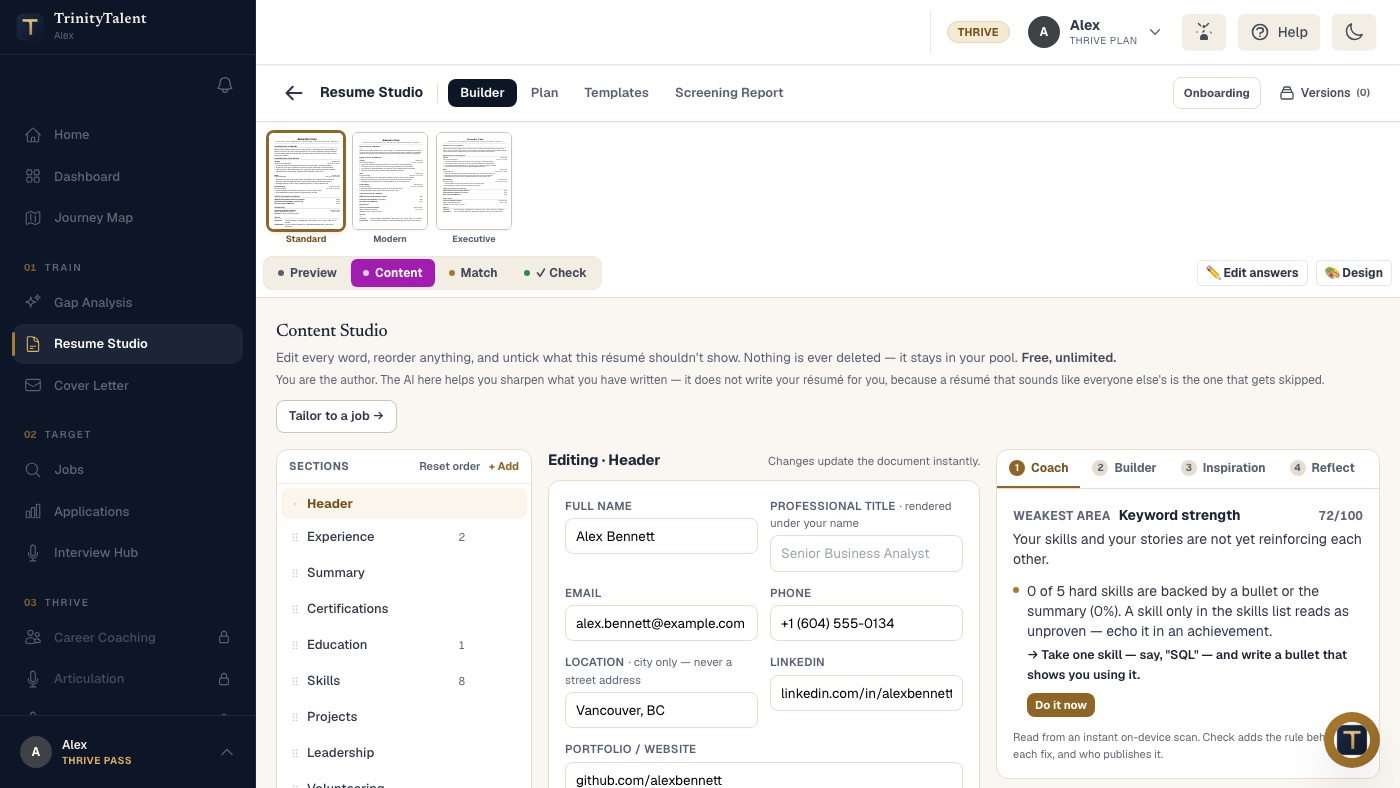
TrinityTalent's free resume builder handles the order for you. You build the experience section first, with a rules-based check that flags weak verbs, missing numbers and merged bullets as you go. Then the summary tool drafts three or four sentences from the facts already on the page. It names the target role you set during onboarding, keeps the draft under 70 words, and only uses figures that exist in your resume. You review the draft, edit it, and press "Use this" before anything is saved.
When you tailor the resume to a posting, the same summary is rewritten around that posting's language, so the first sentence always matches the job you are applying for. The builder is free while the product is in beta.
Frequently asked questions
How long should a resume summary be?
Three to four sentences and no more than 70 words. On a standard page that is about four lines. Recruiters scan the top of the page in seconds, so a longer summary is read less, not more.
Should a resume summary be in first person?
No. Drop the pronoun and start each sentence with the role, the scope or the result. "Project coordinator with five years of experience" reads faster than "I am a project coordinator". First person belongs in the cover letter, where you are writing to a named reader.
Do I need a resume summary if I am a student with no experience?
Yes. It tells the reader what you want and what you have already done. Use co-op terms, projects, part-time work and coursework as evidence, name the role in the first sentence, and include one measurable result, even a small one.
What is the difference between a resume summary and a resume objective?
An objective describes what you want from the employer. A summary describes what the employer gets from you. Objectives were common in the past, but most recruiters now prefer a summary because it answers their question, not yours.
Put this into practice
Paste your resume into the free builder. The summary tool drafts four sentences from the facts on the page, and you edit before anything is saved.
Build your resume free