
How to Structure Interview Answers: Answer First, Then Prove
The simplest way to structure interview answers is to give the answer first and the proof second. Most candidates do the opposite: they tell the story, build up to the point, and hope the interviewer is still listening when they reach it. Learning to structure interview answers around a headline sentence fixes rambling, removes the rush, and makes every answer easier to score. This guide covers two structures, answer-first for direct questions and STAR for behavioural ones, plus timing, signposting and a way to grade your own answers.
TL;DR: For a direct question, use three parts: a one-sentence headline that answers it, two or three sentences of proof, and one sentence that closes. For a "tell me about a time" question, use STAR: situation, task, action, result, with most of the time on action and result. Keep answers between 60 and 90 seconds. Signpost the parts so the listener can follow.
Why structure matters more than content
Interviewers hear many answers in a day and score each soon after. An answer with a clear shape is easy to score; the interviewer can write down the point and the evidence. An answer with no shape, however good the content, leaves them with a feeling and no notes. When they compare candidates later, the notes win.
Structure also helps you. When the first sentence is the answer, you stop searching for the point while speaking. The pace steadies, fillers drop, and you finish on time.
Structure one: answer first
Use this for any question that asks for an opinion, a method or a preference: "How do you prioritise?" "Why this role?" "What would you do in your first month?"
- Headline. One sentence that answers the question directly. If the interviewer heard only this sentence, they would have your answer.
- Proof. Two or three sentences of evidence: an example, a number, a method you have used.
- Close. One sentence that connects the answer to the role in front of you.
A worked example
Question: "How do you handle a stakeholder who keeps changing requirements?"
Without structure: "That happens a lot, actually. On my last project the marketing team kept adding things, and at first I just tried to fit them in, but it got out of hand, so eventually we had a meeting and..."
Answer first: "I make the cost of each change visible before agreeing to it. On my last project, the marketing lead added requests weekly, so I started sending a one-line note with each one: what it would delay and by how much. Within a month, about half the requests were withdrawn by the person who made them. I would bring that habit to this role, where the posting mentions several internal clients."
The second answer is 70 words. The interviewer can write "makes change cost visible" and move on.
Structure two: STAR for behavioural questions
Any question that starts "Tell me about a time" or "Give me an example of" is asking for a story, and stories need a different shape. STAR gives it: Situation, Task, Action, Result. The most common mistake is spending half the answer on the situation. Keep it to one sentence and put the time where the scoring is: what you did and what changed.
- Situation. One sentence: where you were and what was going on.
- Task. One sentence: what you had to achieve, or what was at stake.
- Action. Three or four sentences: what you specifically did, in order. Use "I", not "we".
- Result. One or two sentences: what changed, with a number if you have one.
/blog/star-method-examples/ has full worked examples; /blog/behavioral-interview-questions/ lists the questions worth preparing.
Combine the two
Experienced candidates often open a STAR answer with a headline: "The clearest example is when I recovered a client relationship that was about to end." Then situation, task, action, result. The headline tells the interviewer where the story is going, so they listen for evidence instead of waiting for the point.
Timing: 60 to 90 seconds
At a normal speaking pace, 60 seconds is about 150 words and 90 seconds about 220. That is enough for a headline, evidence and a close, or a complete STAR story. Below 40 seconds, most answers lack proof. Above two minutes, most interviewers have stopped taking notes.
Practise with a timer. If an answer runs long, the cut is almost always in the situation or the proof, not the headline or the result. If it runs short, add the number, the method or the timeframe. Do not fear a short answer to a simple question: "Yes, I have used that system daily for three years" is complete. The interviewer will ask for more if they want it.
Signposting: tell them where you are
Signposts are short phrases that name the part of the answer you are in. They cost two or three words and make an answer feel organised even when it is being built live.
- Opening a headline: "In short," or "My approach is..."
- Moving to proof: "For example," "The clearest case was..."
- Listing: "There are two reasons. First... Second..."
- Closing: "So what I would bring here is..." or "The result was..."
Use one or two per answer; signposting every sentence sounds like a presentation. But "There are two reasons", followed by two, is one of the simplest ways to sound structured, because the listener knows when you will finish.
A rubric for scoring your own answers
Record an answer and grade it against four criteria. The point is to find the one to fix first.
- Structure. Could a listener name the headline, the proof and the close? For STAR, was the action the longest part?
- Clarity. Was every sentence complete? Could a stranger to your industry follow it?
- Conciseness. Was it between 60 and 90 seconds? Could a sentence be cut without losing anything?
- Confidence. Did it start immediately, hold a steady pace, and end on a falling tone rather than trailing off?
Score each from one to five. Most first recordings score low on structure or conciseness. Fix structure first; the others often improve with it.
Mistakes that break a good answer
- Starting with the story. Context first means the point arrives last, if at all.
- "We" instead of "I". The interviewer is hiring you, not your team.
- No result. A story without a result is a description of activity. End with what changed.
- Answering a different question. If they asked about conflict, do not tell your leadership story. Interviewers notice.
- Trailing off. "...so, yeah." Finish with a sentence that ends.
How TrinityTalent helps
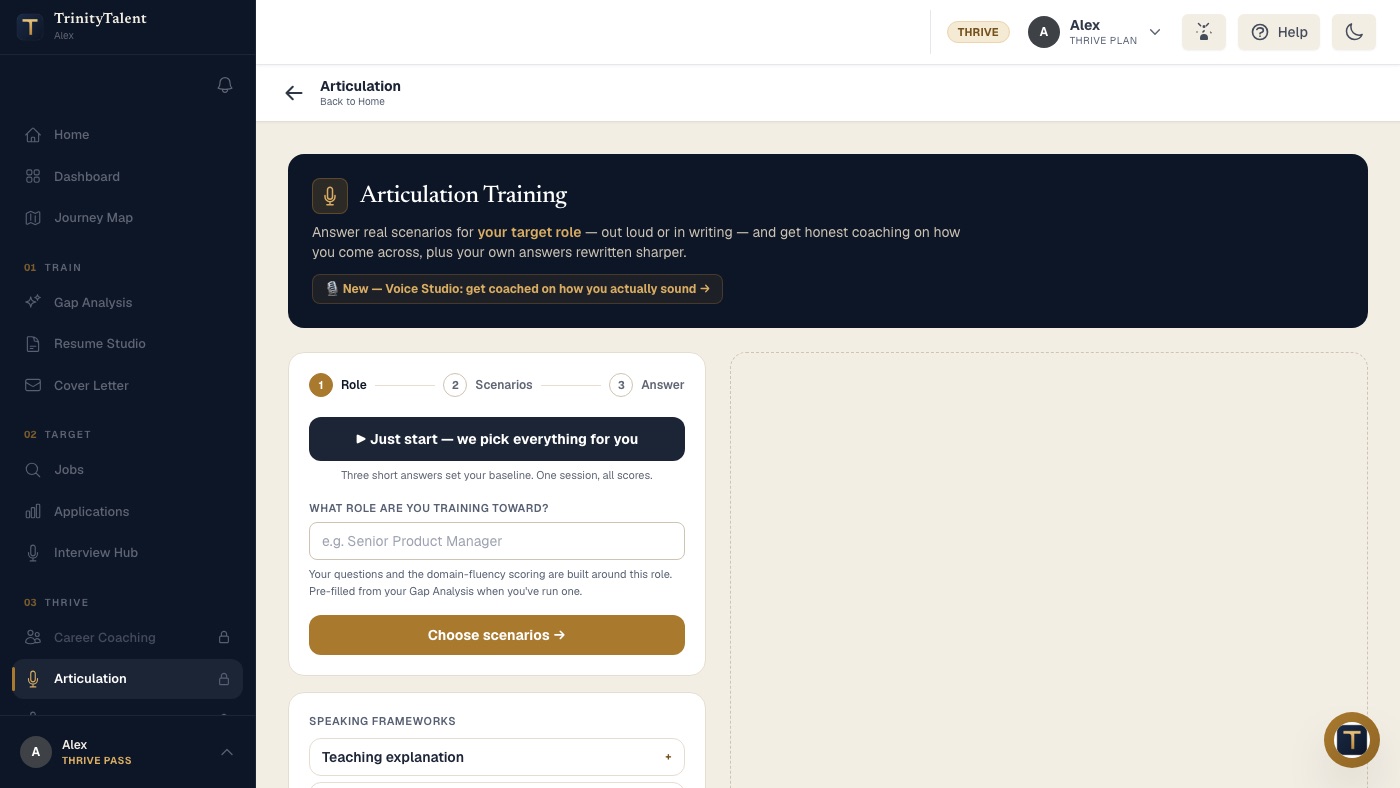
Articulation Training in TrinityTalent is built around the rubric above. You answer a real scenario for your target role, out loud or in writing, and it scores structure, clarity, conciseness, confidence and domain fluency. It quotes the evidence behind each score, shows the framing that works for that scenario, rewrites your own answer sharper so you can hear the difference, and gives you drills and a two-week practice plan you can start the same day. The Interview Hub adds a mock interview with a live spoken interviewer for full-length rehearsal, and the Fire Round's bank of more than 700 questions for quick practice. Everything is free while the product is in beta, with no credit card required, and nothing is sent to an employer unless you send it.
Frequently asked questions
How long should an interview answer be?
Between 60 and 90 seconds for most questions, which is roughly 150 to 220 words at a normal pace. That is enough for a headline, evidence and a close, or for a complete STAR story. Simple factual questions can take ten seconds. Above two minutes, most interviewers have stopped taking notes and are waiting for you to finish.
What is the answer-first method for interviews?
Answer-first means giving the direct answer in your first sentence, then supporting it with two or three sentences of evidence, then closing with one sentence that connects it to the role. It suits questions about your approach, opinions or methods. It stops rambling because the point is delivered before the story starts.
When should I use STAR instead of answer-first?
Use STAR for behavioural questions, the ones that begin "Tell me about a time" or "Give me an example". These ask for a story with a beginning, an action and an outcome. Use answer-first for questions about your approach, opinion or method. Many strong candidates open a STAR story with a headline sentence, combining both.
How do I stop rambling in interview answers?
Decide the first sentence before you speak; that sentence is the answer. Once it is said, everything else is support and there is nothing to race toward. Keep a timer in practice and cut answers at 90 seconds. A signpost like "There are two reasons" tells the listener, and you, when the answer ends.
Put this into practice
Answer one real scenario aloud in Articulation Training and see your structure, clarity and conciseness scored with the evidence quoted back to you.
Practise a mock interview