
How to Speak Up in Meetings When You Are the Quiet One
To speak up in meetings when you are the quiet one, prepare one point before the meeting, say it in the first ten minutes, and lead with the headline. If you have wanted to speak up in meetings for months and keep leaving without a word, the problem is rarely confidence. It is that the moment to speak is decided in the meeting, under pressure, with nothing prepared. Moving the decision to before the meeting changes everything. This guide covers the preparation, the timing, the sentence structure, and how to practise the spoken form so it holds up in the room.
TL;DR: Prepare one point before every meeting and write it as one sentence. Say it in the first ten minutes, before the conversation gets crowded. Put the conclusion first and the reasons after. When you have no point, build on someone else's or ask a question. Practise out loud, because a sentence you have said before is easier to say again.
Why quiet people stay quiet in meetings
Most quiet people are not short of opinions. They are short of a moment. The typical pattern looks like this: you have a thought, you check it for flaws, you wait for a gap, someone else fills the gap, the topic moves on, and the thought is now out of date. Meanwhile the people who talk most are not checking their thoughts for flaws. They are speaking to find out what they think.
Two things follow. First, waiting for the perfect moment guarantees you will miss it, because meetings do not have perfect moments. Second, the first ten minutes are the easiest time to speak, because the room is still settling and nobody has claimed the floor. Everything below is built on those two facts.
Prepare one point before the meeting
Read the agenda the day before. For the item that matters most to your work, write one sentence you could say about it. Not a paragraph. One sentence, such as "I think we should test the new form with five customers before the launch, because the last change broke sign-ups for a week."
One point is enough. People who prepare five points say none of them, because they are still choosing when the moment passes. People who prepare one point say it, because the choice was made at their desk.
If there is no agenda, prepare a question instead. "What decision are we trying to make today?" is always relevant and always welcome.
Speak in the first ten minutes
The longer you wait, the harder the first contribution becomes. Silence accumulates, and after twenty minutes a first comment feels like an event. A comment in minute four feels like participation.
So make the first ten minutes a rule. Your prepared sentence goes in early, even if the point is small. Once you have spoken, the second contribution costs a fraction of the first, and the rest of the meeting is open to you.
If the agenda item you prepared for is later in the meeting, use a lighter opening early: a question about the goal, a one-line update, or agreement with a specific reason. "I agree with Lena, mainly because the vendor said the same thing on Tuesday" is a real contribution that takes eight seconds.
Headline first, then the reasons
Quiet people often build up to the point: context, history, caveats, and then the conclusion. By the time the conclusion arrives, the room has stopped listening or someone has interrupted. Reverse the order. State the conclusion, then give one reason, then stop.
Compare two versions of the same point from Marcus, a support lead.
Avoid this: "So, I was looking at the tickets from last month, and there were quite a few about the login page, and I know we changed the button in September, and some customers mentioned it in the survey too, so I was wondering whether maybe it might be worth looking at whether that change had an effect."
Say this: "I think the September login change is causing tickets. Login complaints doubled in October, and the survey mentions the button. I would like to check it this week."
The second version is shorter, easier to respond to, and impossible to interrupt before the point lands. A useful frame is "answer first": conclusion, then evidence, then what you want to happen.
Build on others when you do not have a point
You will not have a prepared point for every item. The lowest-cost way in is to build on what someone else said. Three moves work:
- Add a reason. "Building on Sofia's point, the other cost is the training time for the new team."
- Add an example. "That matches what I saw with the Halifax account last month."
- Connect two comments. "I think Omar and Jae are describing the same problem from two sides."
Building on others is not lesser participation. It moves the discussion forward and it is remembered as contribution, especially by the person you built on.
Ask a question when you have nothing to add
When you have no view, ask a question. A good question is short, specific and about the decision: "What would make us choose option B?" or "Who owns this after Friday?" Questions carry no risk of being wrong and often surface the thing the room has been avoiding.
Avoid questions that are really statements with a question mark on the end, and avoid asking for information that was in the pre-read. One clear question per meeting is plenty.
Practise the spoken form
A sentence that exists only in your head comes out differently in a room, usually longer, with more hedges. So say your prepared point out loud before the meeting, twice, and time it. If it takes more than twenty seconds, cut it.
Recording yourself is the fastest way to hear the difference between the sentence you planned and the sentence you said. Listen for three things: did the conclusion come first, how many hedges did you add ("maybe", "just", "sort of"), and did you stop when the point was made. Fix one at a time. This is the same skill that helps in interviews, and the guide on networking for introverts applies the same prepared-sentence idea to conversations.
How TrinityTalent helps
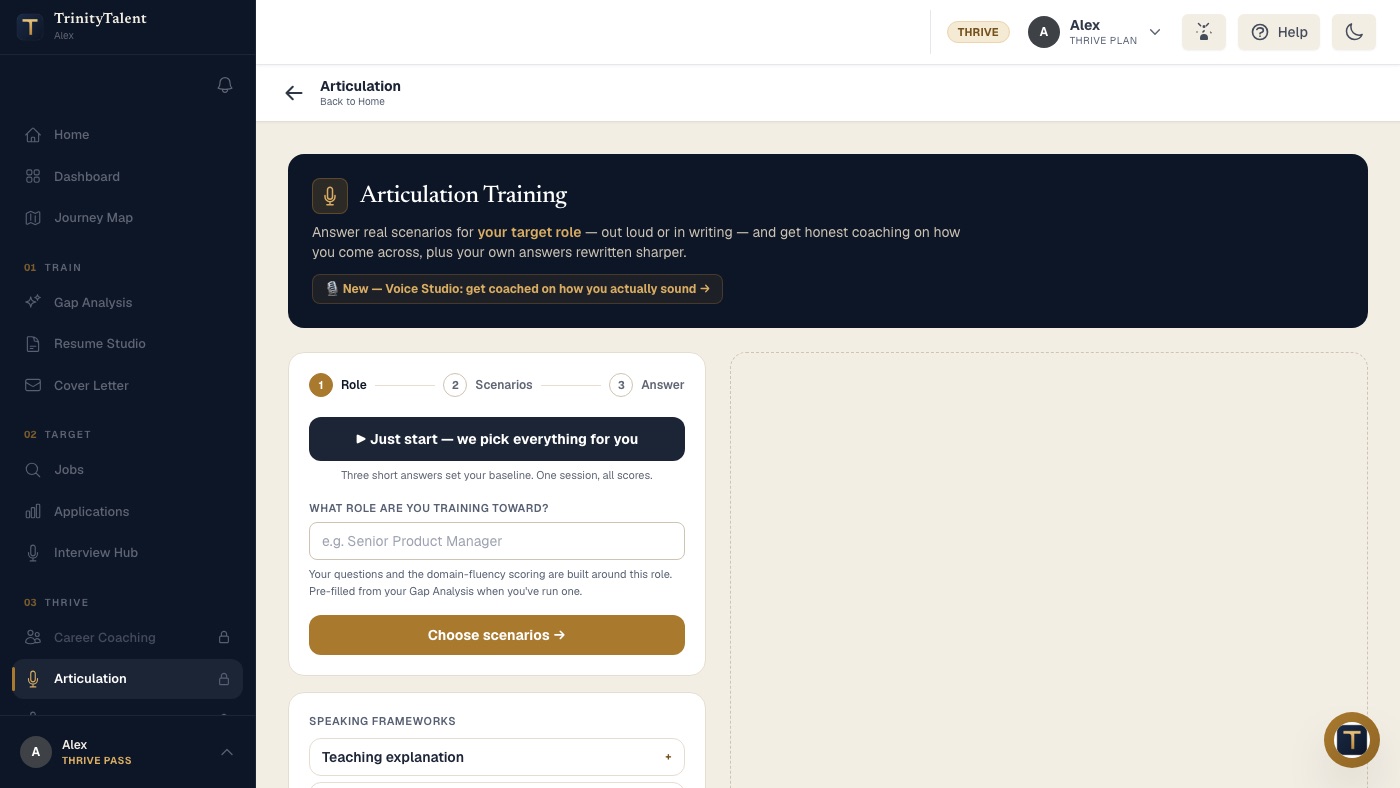
TrinityTalent's Articulation Training gives you a place to rehearse before the room does. You answer a real scenario for your target role, spoken or typed, and get an honest rubric assessment on structure, clarity, conciseness, confidence and domain fluency, with quoted evidence for each gap, your own answer rewritten sharper, and drills built into a two-week practice plan. The speaking frameworks include "answer first" and "principled pushback", which are the two you need most in meetings.
Voice Studio measures how you actually sound, including pace, pauses and filler words shown in a verbatim transcript, from a recording that stays on your device. An ESL Clarity Mode coaches clarity and pace, never accent. Career Coaching adds say-this and avoid-this scripts for situations such as leading without authority and disagreeing with your manager. Building, editing and exporting your resume on TrinityTalent is free.
Frequently asked questions
How do I speak up in a meeting when I am nervous?
Decide what you will say before the meeting and write it as one sentence. Say it in the first ten minutes, before silence has built up. Put the conclusion first so the point lands even if you are interrupted. Nervousness fades after the first contribution, so the goal is to make that first contribution early and small.
What if someone else already made my point?
Say so, and add one thing. "I agree with Ana, and the other reason is the support cost." Agreeing with a specific reason is a real contribution, and it puts your voice in the room. If you truly have nothing to add, ask a question about the decision instead.
How do I stop rambling when I finally speak?
Reverse the order. State the conclusion, give one reason, then stop. Most rambling comes from building context before the point. Practise your sentence out loud before the meeting and time it; anything over twenty seconds gets cut. Recording yourself shows how many hedges you add without noticing.
Is it bad to be quiet in meetings?
Being quiet is not a problem in itself, but being invisible is. Decisions about work and promotions are made partly on what people have heard you say. You do not need to talk often. One clear, prepared contribution per meeting, made early, is enough to be seen as engaged.
Put this into practice
Answer a real meeting scenario for your role out loud in Articulation Training and get your own answer rewritten sharper, with structure and clarity scored.
Practise a mock interview