
Employment Gaps on a Resume: How to Show Them Honestly
Employment gaps on a resume are normal, and most recruiters have seen hundreds of them. The question is not whether to show employment gaps on a resume but how to show them so the reader trusts the rest of the page. A hidden gap that surfaces in a background check costs more than an honest one ever will. This guide covers when years-only dates are fair, how to write a one-line gap entry, how to frame caregiving, study and health, and the few things you should never do.
TL;DR: Show the gap; do not hide it. Use years-only dates if every entry uses them and the gap is under a year. For longer gaps, add a one-line entry with dates and a neutral label such as "Career break, family care". Put any work done during the gap, paid or not, in the experience section. Never stretch dates or invent a role.
Why hiding a gap backfires
Recruiters check dates against your online profile, your references and, at offer stage, a background check. A resume that says 2021 to 2023 when the employer says March 2021 to January 2022 raises a question you now have to answer defensively. An honest one-line gap raises no question at all.
There is a second reason. A gap that is explained is finished. A gap that is discovered becomes the topic of the interview. You want the interview to be about the job, and that means settling the gap on the page.
Rule one: years-only dates are honest only when consistent
Many people list years instead of months to soften a short gap. That is acceptable under two conditions:
- Every entry on the resume uses years only. Mixing "2019 to 2022" with "Mar 2023 to present" signals that the years-only entries are hiding something.
- The gap is under twelve months. Years-only dates can make a nine-month gap invisible. They cannot make a two-year gap invisible, and trying to looks evasive.
A fictional example. Lena Moreau left a bookkeeping role in November 2022 and started a new one in July 2023. Her resume shows "2020 to 2022" and "2023 to present" for the two roles. The eight-month gap does not show, and if asked in an interview she answers plainly. This is honest because nothing on the page is false and nothing is stretched.
Rule two: for longer gaps, add a one-line entry
When the gap is a year or more, or when the posting asks for month-level dates, write the gap into the experience section as its own entry. Keep it to one or two lines. A neutral label, the dates, and, if useful, one line about what you did.
Formats that work:
- Career break, family care | Jan 2022 to Aug 2023. Full-time care for a parent; completed a bookkeeping certificate part-time.
- Career break, health | 2021 to 2022. Fully recovered and cleared to work.
- Full-time study | Sep 2022 to Apr 2024. Diploma in Network Administration, Fraser Valley Institute.
- Planned sabbatical | 2023. Travel and language study; returned to the labour market in early 2024.
The entry sits in the experience section, in date order, so the timeline reads continuously. It has a heading like every other entry, so a parser reads it correctly.
Rule three: work done during the gap is experience
Most gaps are not empty. People freelance, volunteer, study, run a household budget, or care for someone with a medical schedule. Anything with a date range and a result can be an entry.
- Freelance or contract work goes in as a role: "Freelance Graphic Designer, self-employed, 2022 to 2023", with two bullets and a client count.
- Volunteering goes in as a role if it was regular: "Treasurer, Community Food Bank (volunteer), 2022 to 2023", with the budget size.
- Study goes in Education and, if full-time, as the gap entry itself.
- Caregiving can carry one bullet if it developed a skill the posting names, such as coordinating medical appointments or managing a care budget. Keep it factual and short.
The test for any bullet is the same as for a paid role: could you defend it with a specific story in an interview?
Framing the reason without oversharing
You do not owe the reader a medical history or a family situation. You owe them a truthful, neutral label. "Career break, health" is complete. "Career break, family care" is complete. Do not write "Fired" or "Laid off" as the label; the reason a role ended belongs in the interview, not on the page. Do not write an apology, and do not write a paragraph.
If you were laid off and the search has taken time, no label is needed. The last role ends on a month, the search is visible, and that is normal. Our guide to a 30-day comeback plan after a layoff covers what to do with that time. The interview side of the conversation, including scripts, is in our guide to explaining a career gap in an interview.
What never to do
- Stretch dates. Extending a role by a few months to close a gap is the one mistake that ends a candidacy when discovered.
- Invent a role. A consulting business that had no clients is a lie a reference check exposes.
- Switch to a functional resume to hide the timeline. Recruiters know why people do it, and many applicant tracking systems parse functional resumes poorly.
- Leave a gap unexplained for two years or more. The reader fills the silence with the worst guess.
- Explain in the summary. The summary sells your fit. The gap entry carries the dates.
A worked example, before and after
Rajan Pillai is a warehouse supervisor who left work in 2022 to care for his father and returned in 2024. His old resume listed "Warehouse Supervisor, 2018 to 2022" then "Warehouse Lead, 2024 to present" with months on both and nothing between. Every recruiter asked about the missing two years.
His new resume adds one entry between them: "Career break, family care | Jun 2022 to Feb 2024. Full-time care; completed a forklift recertification and a WHMIS refresher." The timeline is continuous, the reader sees he kept his credentials current, and the interview moves on to the job.
How TrinityTalent helps
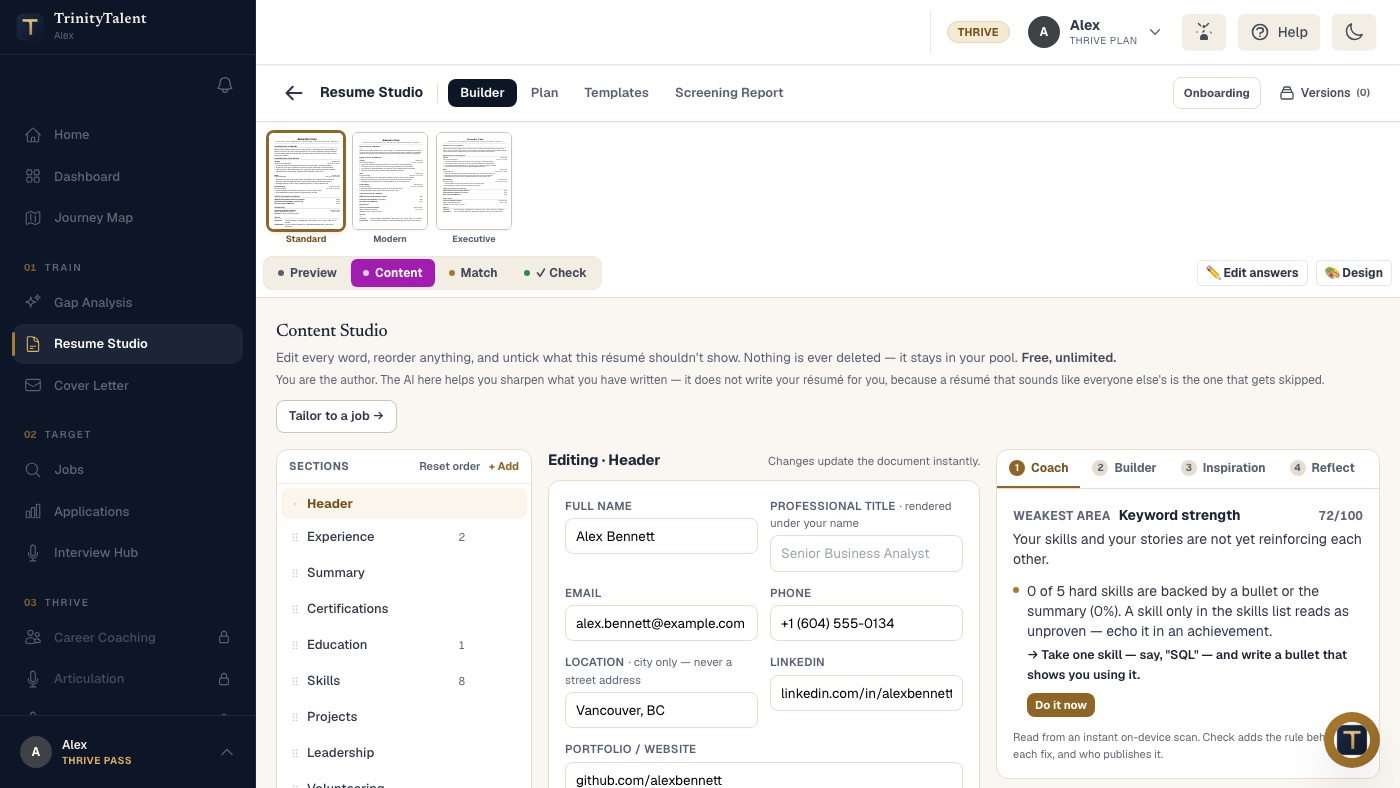
TrinityTalent's free resume builder lets you add a career break as an ordinary entry in the experience section, with a title, a date range and a short description, so the timeline stays continuous and the parser reads it as a normal block. Because every template is single-column and renders the same sections, the gap entry sits in date order with the roles around it.
The rules-based Check runs on your device and flags date formats that are inconsistent across entries, which is the detail that makes years-only dates look evasive. Editing and checking are free while the product is in beta. If you did contract or volunteer work during the gap, you add it as a role and the same bullet rules apply: an action verb, a task and a result.
Frequently asked questions
Should I explain employment gaps on a resume or wait for the interview?
Show the dates on the resume and keep the explanation to a neutral one-line label such as "Career break, family care". The fuller explanation belongs in the interview. A gap that is visible and labelled settles the question; a gap that is discovered becomes the topic of the interview.
Is it dishonest to use years only on a resume?
No, provided every entry uses years only and the gap is under a year. Mixing months on some entries with years on others signals that the years-only entries hide something. For gaps of a year or more, years-only dates do not hide the gap anyway, so add a one-line entry instead.
How do I list a career break for caregiving on a resume?
Add an entry in the experience section: "Career break, family care", the date range, and one line about anything you did that is relevant, such as a certificate completed or a budget managed. Keep it factual and short. You do not owe the reader medical or family detail.
Does a functional resume hide employment gaps?
Not from an experienced recruiter, who knows why people choose that format and will look for the dates anyway. It also parses poorly in many applicant tracking systems. A chronological resume with a one-line gap entry is more honest and more effective.
Put this into practice
Open the free builder, add a one-line career break entry to your experience section, and let the Check confirm your dates read consistently.
Build your resume free